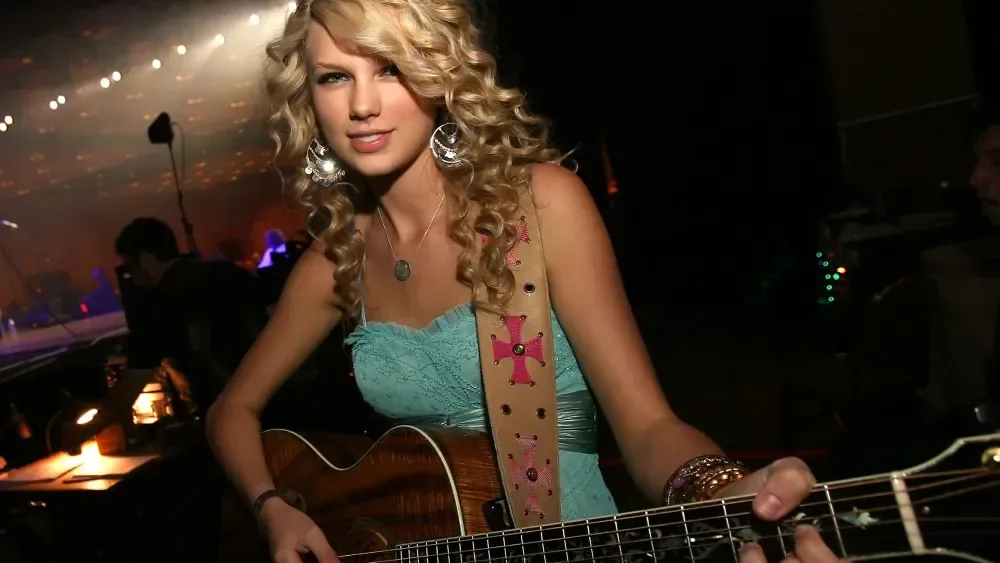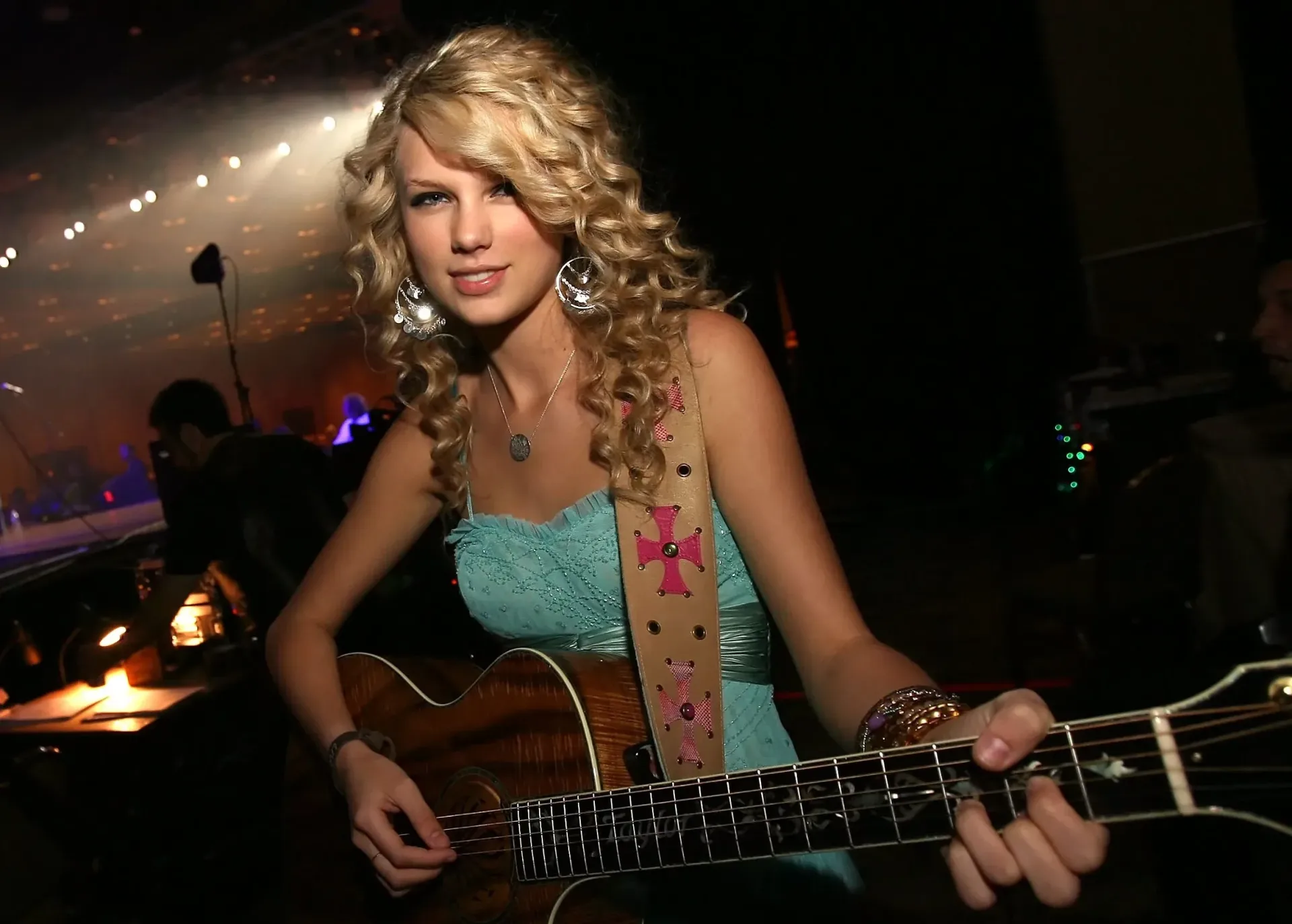
Taylor Swift’s self-titled debut album reached its 20th anniversary on October 24, 2026. That milestone invites the obvious look backward at a record whose commercial and cultural implications became much clearer with time. Yet a revealing early-2008 conversation, conducted while the album was still actively producing country hits and beginning to touch pop radio, shows that several defining parts of Swift’s approach were already firmly in place: write personally, protect the work, meet fans where they are, and treat every apparent barrier as a problem to work through rather than a reason to stop.
The album arrived in 2006 when Swift was 16, entering a country ecosystem where her age, gender, songwriting control and association with a newly created label could all be viewed as risks. In the conversation, Swift did not frame those circumstances as a heroic myth in the making. She spoke instead with a mixture of surprise, ambition and practical focus. That is part of what makes the material valuable two decades later. It does not retroactively pretend the outcome was obvious.
At that moment, Our Song had logged six weeks at No. 1 on the country chart, while Teardrops on My Guitar was starting to receive Top 40 exposure. The self-titled album was also performing strongly more than a year after release: it reached No. 1 on the country albums chart for five consecutive weeks, although its overall Billboard 200 high was No. 5. That distinction matters. Swift was plainly successful, but she was not yet the universally recognized pop figure she would become. Her music was still expanding outward from country radio.
A first No. 1 built from a school talent-show song
Swift’s response to Our Song becoming her first country No. 1 went to the core of her artistic identity. She had written it alone in ninth grade for a school talent show, and described completing it in roughly 20 minutes. The achievement was especially meaningful to her because she wanted recognition from Nashville’s songwriting community; she also noted receiving the NSAI songwriter-artist of the year award, voted on by songwriters.
For more context, explore Clayface Review: A Viscous Villain Origin Story With More Gore Than Depth.
That emphasis on authorship was not a minor footnote to the debut’s story. It was a central part of her case for being taken seriously. Young artists are often treated as performers first, with the industry’s veteran writers and decision-makers expected to supply the material. Swift’s own account makes clear that writing was the differentiator she intentionally developed after an early trip to Nashville at age 11 produced no record deal.
She had brought a demo of karaoke songs and knocked on doors along Music Row. Rejection, rather than discouraging her, made the objective more specific: she would learn guitar and write original songs. The plan was not merely to demonstrate talent but to create a reason for people to remember her. Her later description of practicing until her fingers bled is understandably dramatic, but it reflects a straightforward strategy: acquire skills that make an artist less interchangeable.
The early songs also demonstrate why the debut’s songwriting connected beyond a narrow teenage audience. The Outside, written when she was 12, came from the anxiety of being isolated at school and unsure whom to speak to. Swift identified that experience as a form of rejection harsher than a professional no. The feeling is rooted in adolescence, but it is not exclusive to adolescence. That is the useful trick of the song’s perspective: an exact personal circumstance points toward a wider emotional truth.
She applied the same principle to Our Song. Its details are unmistakably youthful, but its speed, directness and ordinary language make it easy for listeners to insert themselves into the story. In the interview, Swift agreed with the description of her vocal and writing style as “conversational.” It is an important technical word here. Conversational songwriting does not mean unpolished songwriting. It means lyrics are shaped to feel like speech: clear scenes, simple phrasing, memorable turns of phrase and the sense that a narrator is speaking directly to one person. That approach became one of Swift’s most enduring tools.
Specificity was the engine, not the obstacle
Swift’s early explanation of her work was unusually blunt. She said she did not remove names, details or personal elements simply to make songs less revealing. She also did not claim an overwhelming vocal range as her defining advantage. What she could offer, she said, was the act of writing what she felt.
That philosophy is easy to recognize in hindsight, but it was already visible in the debut-era singles. Teardrops on My Guitar had a real-life “Drew” at its center. Swift recalled him appearing at her driveway after they had not spoken for roughly three years, and said his MySpace profile jokingly referred to the song as his claim to fame. Should’ve Said No, meanwhile, was described as tracking a cheating experience line by line. She also said Tim McGraw and Our Song came from the same youthful relationship.
There is a practical songwriting lesson in that openness. Specificity is sometimes mistaken for a limitation: surely a song about a particular person, place or encounter cannot belong to everyone else. But specificity often does the opposite. General lines can leave listeners with nowhere to stand. A driveway visit, a remembered song, a sharp detail from a relationship or an awkward school hallway gives the listener a physical entry point. The audience supplies its own emotional context.
Swift also understood that literal autobiography was not the only route to emotional credibility. Looking ahead to Fearless, she discussed Breathe, written with Colbie Caillat, as a song about losing a friend that could sound like a devastating romantic breakup. The observation is more insightful than it first appears. Songs use shared emotional structures. Loss, resentment, uncertainty and longing can move between romantic, platonic and professional relationships without losing force. A songwriter can be precise about a feeling without announcing every factual detail behind it.
For a broader companion read on that early creative foundation, Taylor Swift’s Debut at 20: The Songwriting Blueprint Was There From the Start explores the record’s lasting authorial throughline.
Country, pop and the idea of “spillover”
The interview also captures Swift before the language around her genre position hardened into a familiar narrative. She called herself a country songwriter and did not present pop reach as a rejection of that identity. When asked about Teardrops on My Guitar crossing into Top 40 radio, she preferred “spillover” to “crossover.”
That distinction is revealing. “Crossover” can suggest an artist has left one category in pursuit of another. “Spillover,” in the way Swift used it, suggests the original work remains intact while finding additional listeners. For the debut era, that was a fair description: the songs began in the country market, and the pop-radio interest was an extension of their reach rather than a full reinvention of their sound.
CHR, or contemporary hit radio, is the industry term generally used for Top 40 pop stations. Country airplay and CHR were more separated at the time than they would later become in Swift’s career. The early experiment with a pop remix of Teardrops on My Guitar therefore carried real significance. It was evidence that the record’s hook-driven, intimate songwriting could travel between radio formats.
The important point is not that one artist single-handedly erased genre lines. The interview itself resists such simplified history. Swift spoke about wanting country music to attract people from everywhere and said she hoped other artists who wrote their own material and built audiences online would emerge too. Her stated goal was expansion, not escape.
That ambition came with an early understanding of digital community. She referred to building a fan base on MySpace, a platform that now sounds period-specific but represented a meaningful artist-to-listener channel at the time. Before social media became a near-universal promotional expectation, it offered a way for musicians to cultivate direct awareness beyond traditional radio and press gatekeepers.
Why the business choices matter to the debut’s legacy
The debut album is sometimes remembered mainly as the beginning of an extraordinary discography. The 2008 discussion makes it equally clear that it was the result of choices about creative control and timing.
Swift said she signed a development deal with RCA after repeated Nashville visits. A development deal is essentially a trial-stage industry arrangement: a label helps develop an artist and later decides whether to commit to a conventional recording contract. As she described it, RCA wanted to continue development for another year when the initial period ended. She chose to look elsewhere.
She had also become, at 14, the youngest person signed to Sony/ATV Publishing for songwriting. Publishing is distinct from a recording contract. A recording deal concerns recorded performances; a publishing deal concerns the underlying composition—the lyrics and music—and the rights and income tied to its use. That early publishing relationship put songwriting at the center of Swift’s professional path even before the debut album established her as a recording artist.
Her subsequent label agreement was a leap of faith with a startup that had only 10 employees and, as she remembered it, no furniture yet. Swift and her mother helped put CD singles into envelopes for radio promotion. It is a small operational detail, but it sharpens the scale of the gamble. The debut was not launched from a fully settled machine. It came from a new operation trying to persuade country radio to support a teenage female artist performing material she had written herself.
Swift did not turn this history into a grievance against those who passed. She argued that success depended on a precise sequence of circumstances: a label that allowed her to write and select her material, singles that connected, and timing that allowed those elements to build on one another. That is a notably mature understanding of A&R—the label process of finding and developing artists. A&R staff make judgments under uncertainty, and no amount of confidence from an aspiring performer can guarantee that a particular career will take shape.
The lesson is not that every rejection secretly points toward an inevitable triumph. It is that rejection can clarify an artist’s priorities. For Swift, those priorities included retaining a voice in her material and finding partners who would support it.
Fan connection before scale changed the equation
Another striking element is how seriously Swift took the early fan relationship. She described post-show autograph sessions lasting four and a half hours and said that, if people were willing to wait, she believed she should stay as long as possible. She recognized that security and practical constraints could eventually make that impossible, but the principle was clear.
In retrospect, those encounters matter because they show a career model built around reciprocity. Fans were not treated only as metrics—sales, requests, streams or ticket demand—but as people spending time to make a direct connection. That attitude fits the debut’s songwriting as well. The songs invite a listener inward; the lengthy signing lines extended that invitation into the real world.
There is an unavoidable tension in this approach. The bigger an artist becomes, the less feasible a one-to-one model is. Swift’s manager had already told her that a point would come when the crowds, rather than the artist, had become too big. But early habits can set expectations for a career’s emotional contract with its audience. The debut-era emphasis on detail, access and acknowledgement helped establish one.
Twenty years on, Taylor Swift is not important merely because it launched an immense career. Its importance lies in how much of the later framework can already be heard and seen within it: personal stories engineered into memorable songs, a young writer defending authorship, genre reach treated as an opening rather than a betrayal, and a determination to turn vulnerability into work with a public life. The scale that followed was extraordinary. The blueprint, however, was there from the beginning.