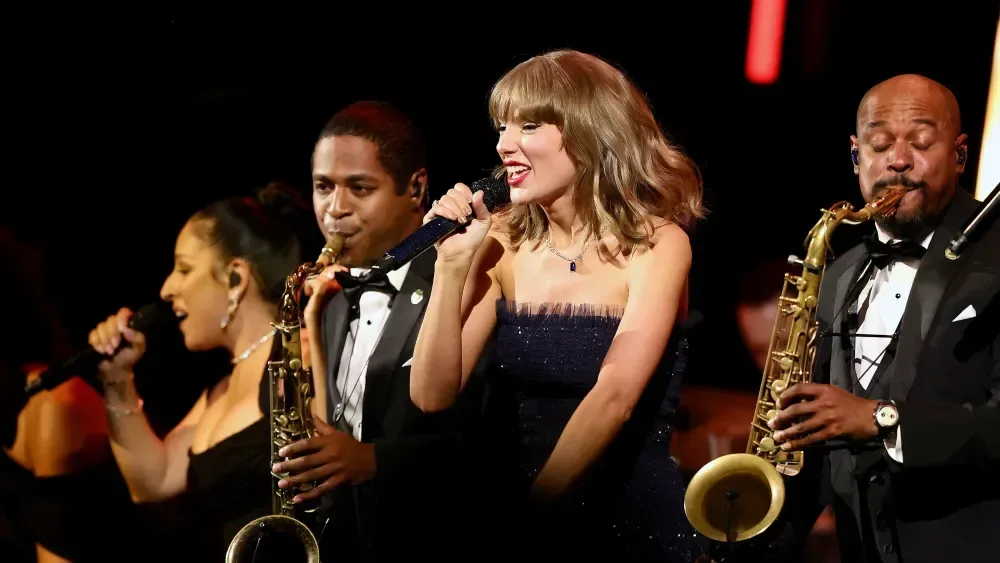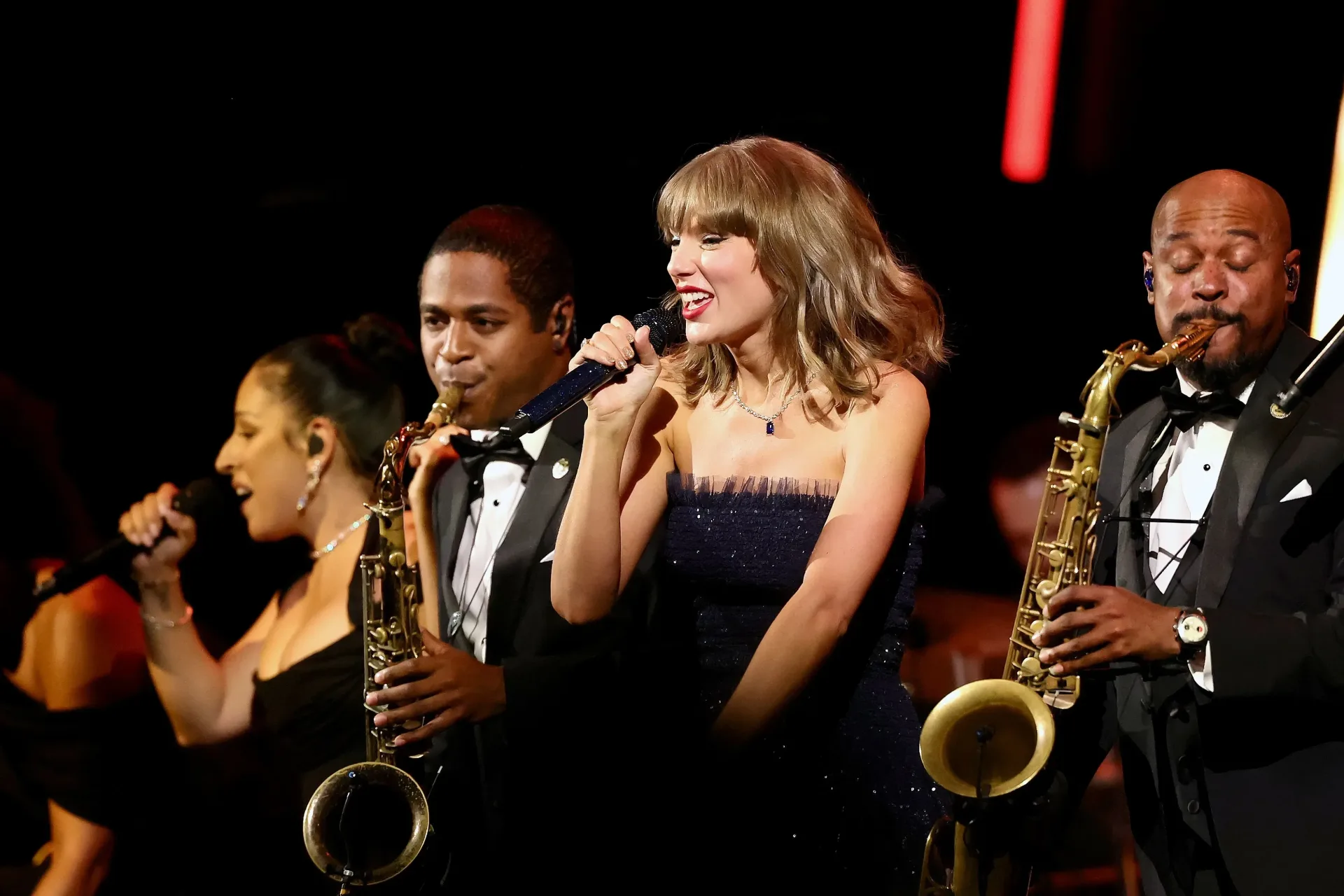
Taylor Swift returned to a full-band stage at the Academy Museum’s sixth annual gala on October 17, delivering a compact four-song performance that blended two established hits with newer material tied to the next awards season. It was her first performance with a complete backing band since the Eras Tour, making a black-tie museum event an unusually high-profile setting for a reset of the live ensemble.
The set opened with “Blank Space” and closed with “Love Story,” two songs that supplied familiar bookends for the room. Between them, Swift performed “The Fate of Ophelia” live for the first time and gave “I Knew It, I Knew You,” her song from Pixar’s Toy Story 5, its first live outing with a full band.
Conan O’Brien introduced Swift with a playful Toy Story 5-themed line, calling her a cherished part of the film’s family and comparing her to “John, Paul, George and Ringo all in one.” O’Brien and Joan Cusack, both associated with the animated feature, were among the attendees photographed with Swift during the evening.
A short set with two distinct purposes
Four songs is not the kind of set that can summarize a catalogue as wide as Swift’s. This one did something more strategic: it paired durable crowd-recognition songs with two tracks whose live histories are still comparatively limited.
- “Blank Space” opened the performance.
- “The Fate of Ophelia” received its first live performance.
- “I Knew It, I Knew You” was performed live with a full band for the first time.
- “Love Story” ended the performance.
“The Fate of Ophelia” was released on October 3, 2025, a little more than a year before the gala. Its arrival in a live set matters simply because it had not previously been performed onstage. The song is expected to be a significant contender at the 2027 Grammy Awards, where voters had recently received their initial ballots.
“I Knew It, I Knew You” had appeared live before, at the Grammy Museum and at a private Ross House For Your Consideration showcase. The gala performance was different in arrangement and context: it was not part of a mash-up, and it added a full backing band. The song is being considered for the 2027 Oscars through its connection to Toy Story 5, while its Grammy entries include song of the year, film soundtrack and country categories.
What “For Your Consideration” means: FYC is shorthand for the awards-campaign phase in which a project is presented to voters and industry members for consideration. A performance at an FYC event is not the same thing as a public concert date, but it can still be an important early live showcase for a song connected to an awards campaign.
The band returned, with a few new colors
Swift’s gala group combined familiar personnel with a setup distinct from the touring configuration audiences may associate with the Eras era. The ensemble included a guitarist, bassist, keyboard player, drummer and four singers, along with two saxophonists. The horn presence stood out because saxophones were not a regular part of her standard touring band setup.
Related coverage includes Taylor Swift Returns to Full-Band Stage at Academy Museum Gala.
Paul Sidoti, a longtime Swift guitarist, confirmed the personal significance of the occasion in an Instagram post. He described it as his first time playing alongside his “onstage partner of 19 years” since the Eras Tour. That detail places the night less as a replacement for a stadium-scale production than as a reunion of a core working relationship in a more contained gala format.
Why a horn section changes the feel of a performance: horns do more than make a mix louder. Saxophones can reinforce rhythmic accents, fill transitions between vocal phrases and give a pop arrangement a more celebratory, physical pulse. Without a released arrangement or further musical detail, it would be a reach to specify precisely how they were used in each song. But their inclusion signals that this was not simply a minimal replay of the usual live setup.
Swift wore a Ralph Lauren gown and encouraged the formally dressed attendees to loosen up: “Dancing is absolutely allowed. It’s not mandatory, but it’s more fun.” The remark fit a room that was seated and gala-oriented rather than constructed as a conventional arena audience, while still acknowledging that the set was meant to function as a performance, not merely background entertainment.
A soundtrack song at a film-world event
The Academy Museum Gala was a particularly fitting venue for “I Knew It, I Knew You.” A film song can travel through overlapping award paths: one related to its role in a movie, another related to songwriting and recording categories. The gala placed Swift’s performance in front of a film-industry audience while also giving the song a proper band presentation.
That crossover is a familiar part of modern entertainment culture: an artist’s work can be experienced as a recording, a concert number and a film component, each with a different audience and different criteria for recognition. It is also why event performances attached to movies can attract attention beyond a song’s ordinary promotional cycle. The broader relationship between performers and screen work remains a regular pop-culture subject, as seen in LL Cool J’s discussion of how Bruce Lee’s example informs his stunt work.
For Swift, the practical distinction is clear. “The Fate of Ophelia” is a newer single moving into a major Grammy conversation. “I Knew It, I Knew You” has both music-award and film-award routes. Putting both in a single four-song performance allowed the show to acknowledge those current projects without abandoning the songs likely to immediately connect with a mixed industry crowd.
What the gala performance does—and does not—signal
The event is meaningful as a first full-band appearance since the Eras Tour, but it should not automatically be read as confirmation of a new tour, an extended concert run or a larger slate of public shows. The available details establish a single gala booking and the specific milestones attached to the two newer songs. They do not establish future live plans.
That distinction is worth keeping intact. One special-event performance can be a useful showcase, an awards-season moment, a band reunion and a celebration of a film collaboration all at once. It does not need to function as a teaser for something else to be notable on its own terms.
The choice of older material also suggests a carefully balanced gala format rather than a deep-cut exercise. “Blank Space” and “Love Story” frame the newer songs with instantly recognizable pop narratives: one sharp and self-aware, the other romantic and celebratory. The contrast gave the set a clear arc without requiring the extended theatrical apparatus associated with a major tour.
Who was in the room
In addition to O’Brien and Cusack, the gala’s attendees included Cara Delevingne, Sabrina Carpenter, Eli Roth, Charlize Theron, Colman Domingo, John Carpenter, Hannah Waddingham, Dakota Fanning and Elle Fanning. Swift was photographed with several guests, including Carpenter.
The guest list underscores what made the evening different from a fan-centered concert stop. This was a museum gala involving performers, filmmakers and other entertainment figures, with Swift appearing as a featured musical performer. Yet the music itself carried its own small set of milestones: the first live rendition of “The Fate of Ophelia,” the first full-band version of “I Knew It, I Knew You,” and the reassembly of key members of her live band following the Eras Tour.
For fans tracking performances rather than speculation, those are the durable takeaways. Four songs were played. Two were newer works with awards relevance. A full band was back in place. And, at least for one evening in Hollywood, the dress code did not override the invitation to dance.