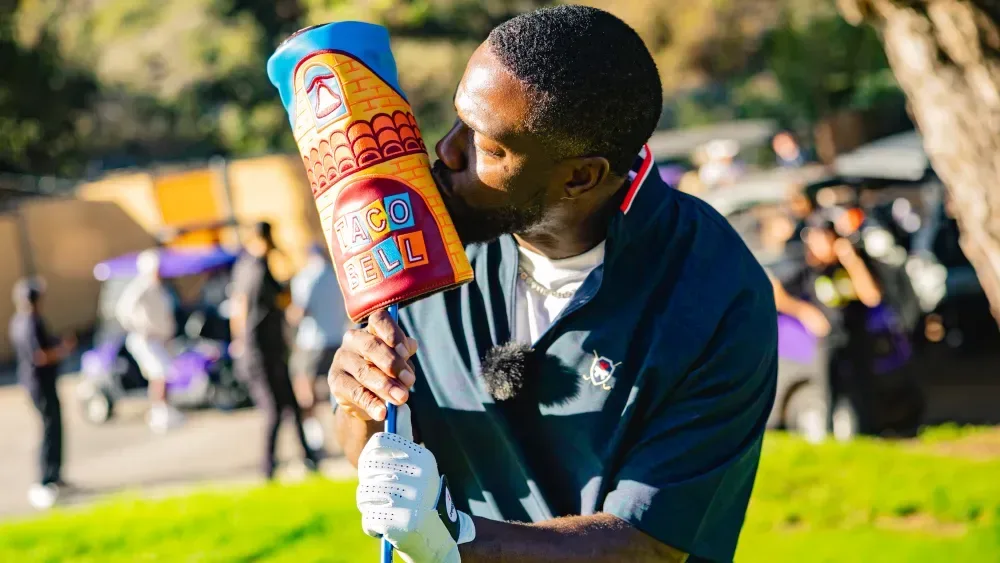
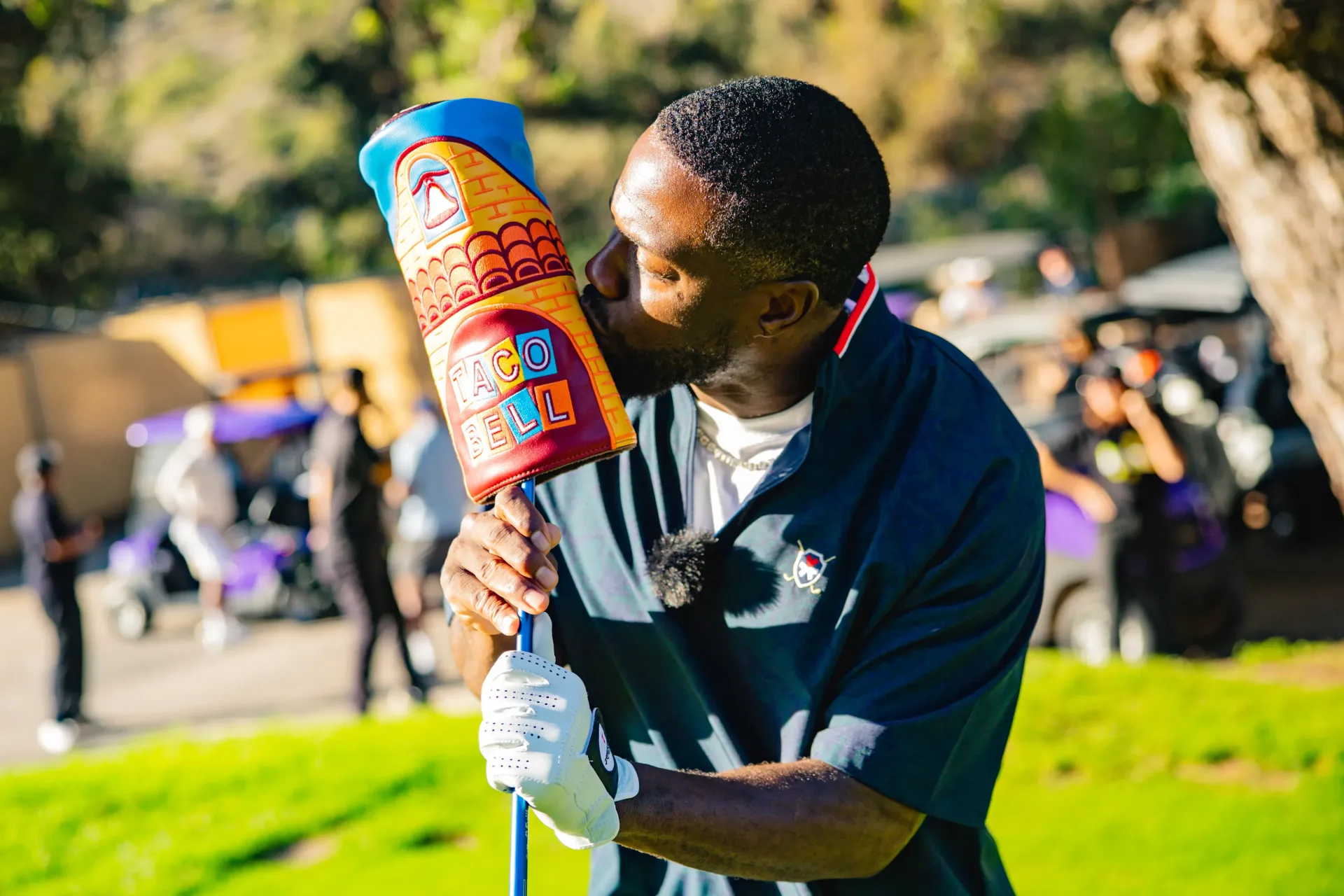
Taco Bell is taking a swing at a different kind of sports marketing. Instead of simply buying time around a tournament, the restaurant chain has backed the Live Más Open, a nine-hole golf event designed as its own entertainment program.
The competition was held in Laguna Beach on November 2 and is scheduled to stream on Peacock on November 20, with a Golf Channel airing also planned. Its field combines celebrities, professional athletes, creators and qualifying fans. Kevin Hart and his Hartbeat production company lead the project creatively, and the finished program is intended to include more than golf: contestants encounter Taco Bell products, including items that have not previously appeared in its restaurants.
That distinction is the point. The Live Más Open is not merely a conventional sponsorship package with a logo planted beside a tee box. Taco Bell is using golf as the framework for a program it can shape from the competition through the surrounding entertainment. The brand is still attached to the event in an obvious way, but its role is closer to a producer than an advertiser dropping in between someone else’s scenes.
A golf tournament built as branded entertainment
Branded entertainment is content made or substantially controlled by a company, rather than a standard ad purchased inside programming controlled by a broadcaster or streaming service. The practical difference is control over the format, participants, tone and how the product is present. A 30-second commercial has a fixed slot. A brand-backed show can put its identity into the premise itself.
That does not automatically make the material less commercial. In many ways, it makes the commercial connection more central. The question is whether viewers experience that connection as a welcome part of the show rather than an interruption. Taco Bell’s answer appears to be a social, personality-driven golf contest where food discoveries and the tournament share the screen.
Luis Restrepo, Taco Bell’s chief marketing officer, has framed the move around a changing golf audience. His view is that younger participants are making the sport more social and expressive, creating room for the chain to bring its own perspective to golf while connecting with fans. Hart has similarly emphasized content that feels live, candid and transparent rather than interchangeable promotional material.
Those are ambitions, not guarantees. A branded event still has to give people a reason to watch after they understand who paid for it. The nine-hole format may help on that front. It suggests a shorter, more contained event than a traditional full round, potentially leaving more room for personalities, competition beats and unscripted moments without asking an audience to commit to an all-day broadcast.
Why this is different from buying a sports ad
Traditional sports advertising can place a company alongside a vast established audience. That reach can be valuable, but the advertiser is competing with every other commercial and has limited influence over the game itself. The Live Más Open flips the arrangement: Taco Bell assumes more creative responsibility while making its association with the event much deeper.
Related coverage includes Taco Bell Takes Its Golf Ambitions to Peacock With the Live Más Open.
That can make financial sense if the event produces something people choose to seek out, discuss or share. It also lets the company spread one production across several forms of attention: the full Peacock stream, the Golf Channel airing, social conversation around participants, and the novelty of new products appearing within the program. None of those elements alone proves success, but together they demonstrate why a brand may prefer building a spectacle over occupying a few isolated ad breaks.
Restrepo has said the event will not include traditional advertising, though other marketing partners could appear during the program. That wording matters. A show without conventional ad breaks is not ad-free in the broader sense; it is built around an identifiable sponsor. Instead, it changes the placement of promotion from interruption to integration.
For viewers, integration is a balancing act. It can make a program feel cohesive when the sponsor’s role matches the concept. It can also feel overly managed if every joke, challenge or encounter points too visibly at a menu item. The Live Más Open’s creative challenge is to preserve the unpredictable appeal of celebrities, athletes, creators and fans playing golf while allowing Taco Bell’s identity to remain unmistakable.
Golf is the setting, not the entire pitch
The company is not presenting the Open as a replacement for professional golf’s established competitive ecosystem. The available details point instead to a culture-forward event that borrows golf’s setting and rules while using an eclectic participant mix. That is why the inclusion of creators and qualifying fans is as notable as the presence of professional athletes and celebrities. The project is trying to make a spectator feel closer to the action than a conventional tournament broadcast might.
It is also an example of how sports can work as entertainment infrastructure. Golf supplies recognizable stakes: shots, holes, scores and the occasional disaster that every player knows is possible. Participants supply personalities. The restaurant brand supplies the premise and product reveals. Peacock and Golf Channel provide established screens on which the event can reach viewers.
This is a broader entertainment contest for attention, where live events, comedy, creator culture and streaming formats are often placed side by side. Scripted series continue to chase that same fragmented audience; for example, the newly previewed return of 3 Body Problem illustrates the constant flow of high-profile programming competing for a place in viewers’ schedules. Taco Bell’s approach is not trying to win through drama or prestige television. It is attempting to turn a restaurant’s cultural identity into the reason an event exists at all.
It follows Taco Bell’s earlier experiments with programming
The Live Más Open is not Taco Bell’s first move beyond ordinary commercials. Earlier in the year, its annual Live Más Live food celebration was transformed into a Peacock streaming variety show hosted by Vince Staples. The Open expands that approach into sports, using a tournament as the organizing device rather than a straightforward product presentation.
There is precedent in Taco Bell’s own marketing history for fictional or entertainment-led promotion. In 2018, the company released a movie-trailer-style campaign for an invented project called Web of Fries, starring Josh Duhamel. The campaign supported the then-new Nacho Fries and helped generate 53 million orders in its first five weeks.
That result does not mean every entertainment project can be measured by immediate orders, nor is the Live Más Open structured like a launch trailer. But it explains the logic behind giving promotional work a narrative, a cast and a reason to be watched. Taco Bell has repeatedly treated its food as a pop-cultural prop rather than only a menu listing.
The chain’s longer history also includes campaigns that became widely recognizable through characters and phrases, from the Taco Bell Chihuahua in the 1990s to slogans such as “Yo quiero Taco Bell,” “Make a run for the border” and “Think outside the bun.” The current strategy is less about a single catchphrase and more about owning an occasion: build an event, invite people into it and make the brand part of the experience from the start.
What Taco Bell is testing—and what it needs to prove
The immediate test is straightforward: can a fast-food-backed golf show feel entertaining enough to stand on its own? The longer test is more complicated. Taco Bell wants to create what Restrepo calls cultural moments that help it remain present throughout the year, rather than treating marketing as only a direct path to a purchase.
That philosophy is often described as brand building. It means investing in familiarity, associations and consumer interest that may not be visible in a single sales transaction. A campaign can prompt a quick order through an offer or new item; brand building aims to ensure that a company is remembered and considered well after an individual promotion disappears.
There are practical advantages to the strategy. An owned event gives Taco Bell a recurring format if it succeeds, a recognizable place to introduce food concepts, and a route to collaborate with talent without fitting every idea inside a standard commercial. It may also create a more useful relationship with a fan than a brief pre-roll ad: people can follow the participants, react to the competition and see the food as part of the program’s world.
There are risks as well. Producing an event requires a stronger creative proposition than attaching a name to an existing property. It needs an audience beyond the brand’s most devoted followers, and its tone has to work for golf viewers, casual streaming browsers and people who arrive because they recognize someone in the field. If it feels too polished or too product-heavy, the authenticity Taco Bell and Hart are seeking could be hard to sustain.
Taco Bell is already considering a second year for the Open, while also looking at other areas of culture that could become its own events. That does not confirm what comes next, but it makes the intended direction clear. The company is not just looking for a sponsorship logo. It is looking for formats it can turn into Taco Bell occasions.
On November 20, the Live Más Open will offer a clearer look at whether that idea holds up on screen. For Taco Bell, the goal is bigger than a clean drive or a tricky putt. It is to make viewers feel that the restaurant chain did not merely sponsor the golf day—it created the reason this particular golf day was worth tuning in for.