Major spoilers follow for all six episodes of The Good Daughter.
The Good Daughter ends by solving two interlocked crimes, but its most important resolution is less about identifying a culprit than changing what the Quinn sisters are able to say to one another. The Peacock limited series, adapted by Karin Slaughter from her own novel, begins with Sam Quinn returning to Pikeville, Georgia, after years away. By its finale, she and her younger sister Charlie have confronted the hidden facts that shaped nearly every part of their estrangement.
The show’s mystery machinery is deliberately dense: a school shooting, a coerced teenage suspect, an abusive school principal, a teacher with a deadly plan, an old home invasion, and long-buried misunderstandings within the Quinn family. Yet the final episodes bring those threads back to a shared idea. Secrets can look like protection in the moment, particularly within a family fractured by violence, but they keep inflicting damage when nobody is given enough information to understand another person’s choices.
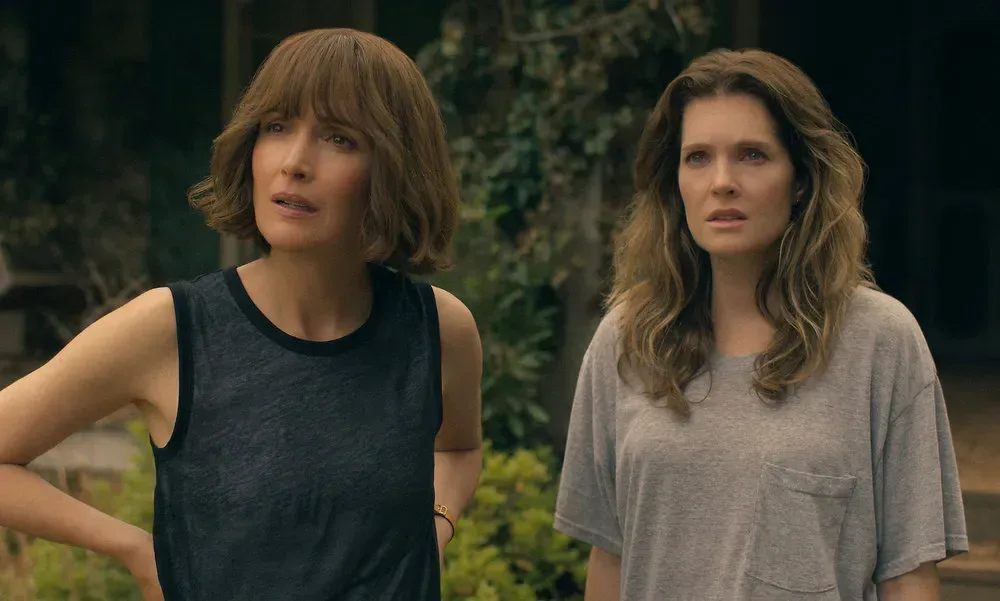
Rose Byrne’s Sam and Meghann Fahy’s Charlie approach that damage from opposite directions. Sam escaped Pikeville, became a patent lawyer in New York, and sees leaving as the only viable response to the corruption and constriction she associates with home. Charlie stayed, became a criminal-defense lawyer like their father Rusty Quinn, and appears tethered to the place where everything went wrong. Neither approach has healed the sisters. The finale makes clear that both were attempts to survive the same catastrophe.
What happened in the school shooting case?
The present-day legal case begins when a shooting at a school kills principal Douglas Pinkman and a young student. Kelly Wilson, a pregnant teenager, appears to have confessed. Rusty is injured while taking the case, forcing Sam into an unfamiliar role as Kelly’s defense attorney despite Sam’s career being in patent law rather than criminal defense.
Patent law is a specialized legal field dealing with intellectual-property rights over inventions. Sam’s professional life is therefore structured around technical details, documentation and defined disputes, a telling contrast with Pikeville’s emotionally explosive criminal case. Her initial lack of defense experience is not treated as a superpower; it makes her reluctant to step in. But her distance from the town’s old loyalties and assumptions lets her keep looking at the case differently.
Sam, Charlie and Charlie’s estranged husband Ben eventually establish that Kelly was manipulated. Judith, a teacher who had once cared for Charlie after the earlier family tragedy, learned that Douglas had sexually abused and impregnated Kelly. Douglas expected Judith and Kelly to accept an arrangement in which they would all raise the child. Judith’s response was not simply to expose him: she engineered a scenario intended to have Kelly bring a gun to school, kill Douglas, and take the blame.
Kelly hesitated. Judith then took the weapon, killed Douglas herself and accidentally shot another child during the struggle. That distinction matters to the finale’s moral architecture. Kelly is not exonerated because the situation is uncomplicated; she brought a gun into a school amid a plan shaped by trauma and manipulation. But the series reveals that the apparent confession did not tell the whole story, and that Judith was the person who turned Kelly into the intended fall person.
For Charlie, Judith’s guilt is especially devastating. Judith had offered care at a time when Charlie’s ability to trust anyone had been severely compromised. She took Charlie in after an assault, looked after her at school, and defended her from bullying. The discovery turns one of Charlie’s few remembered sources of safety into another betrayal. It also prevents the finale from offering an easy division between familiar comfort and danger; the person Charlie trusted most outside her family has committed something horrific.
The old home invasion: who was really responsible?
The shooting investigation revives the unanswered questions around the Quinn family’s defining trauma. More than two decades earlier, masked intruders invaded the family’s rural Georgia home, murdered Sam and Charlie’s mother Gamma, and left both daughters seriously injured. The event did not unite Sam and Charlie. Instead, incomplete memories, guilt and withheld information drove them apart, leading to their later falling-out.
Charlie had believed the attackers were Zach Culpepper and Zach’s brother Daniel. The truth is that Zach and Mason “Huck” Huckabee carried out the invasion. Huck had recruited Zach to target Rusty as retaliation for Rusty’s legal defense of the man accused of raping Huck’s sister. Huck’s connection to the family becomes even more painful because Charlie had a one-night stand with him shortly before the school shooting that launches the series.
The final answer also clarifies a terrible earlier mistake. Charlie had identified Daniel as the man who assaulted her, but Zach was the assailant. Daniel was killed after being wrongly accused. The show does not frame Charlie as culpable for an error made while she was a traumatized child with limited information. Instead, it examines the burden she carries once the truth emerges: she must live with the knowledge that a false identification had deadly consequences, while recognizing that she did not possess the clarity or safety required to process what happened at the time.
That is a crucial distinction. The series gives Charlie guilt without treating her trauma as a plot device that makes her responsible for everyone else’s actions. She was assaulted by Zach Culpepper, and on the day Gamma was killed she told Rusty about the assault. Rusty kept Charlie’s secret for decades at her request. His silence may have honored what Charlie asked for, but it also became part of a family culture where vital truths remained locked away.
Why Sam and Charlie chose such different lives
Sam’s departure for New York and Charlie’s decision to stay in Pikeville can initially look like a straightforward contrast: one sister gets out, the other cannot. The finale complicates that reading. Sam is deeply influenced by Gamma’s belief that the daughters should leave a town she viewed as rigged and oppressive, particularly for young women. Sam’s ambition, sharpness and instinct to seek a larger world resemble qualities she associates with her mother.
Charlie’s choice to remain is not presented simply as resignation. She did not want to abandon Rusty, and she followed him into criminal defense despite the immense damage his work and clients brought to the family. Her path can be understood as an attempt to gain agency over a place and story in which she had once had none. Charlie also finds genuine meaning in advocating for young people who lack someone willing to fight for them.
The sisters’ careers capture their differences. Sam finds refuge in patent law’s impersonal specificity, while Charlie works amid the direct human consequences of criminal cases. But both are drawn to law because they grew up in an intensely intellectual household and, despite their anger at Rusty, retain some respect for the help he tried to provide through his work. Their choices are not a contradiction the show needs to solve. They demonstrate how children can inherit both a parent’s gifts and the fallout of that parent’s decisions.
Sam’s central flaw is her inability to understand why Charlie did not make the same choice she did. From Sam’s perspective, Charlie’s behavior has long looked like a rejection of their mother’s example and a betrayal of sacrifices Sam believes she made. Without knowing about Charlie’s assault, Sam reads distance as indifference or weakness. Once she learns the truth, her fury does not vanish, but it is directed more clearly at the systems and people who hurt Charlie rather than at Charlie herself.
Ben and Charlie’s relationship is a quieter kind of resolution
The finale also reframes Charlie’s marriage to Ben, played by Michael Dorman. Early on, they are estranged, and the audience can see the distance without initially knowing its source. Charlie has never told Ben about the assault. Her inability to disclose it has prevented the intimacy she wants, while Ben has stepped back rather than demanding closeness she is unable to offer.
When Charlie finally shares the truth, the series does not pretend disclosure itself makes years of trauma disappear. The more modest, hopeful point is that a relationship can make space for honesty without making the person who has been hurt pay for speaking. Ben has boundaries, but he is not depicted as punishing Charlie for needing time. That gives their reconciliation a different emotional texture from the murder revelations. It is not a twist; it is a choice to begin relating to one another with more knowledge and care.
Charlie says she and Ben are moving to Atlanta, while Sam is expected to return to New York. Geography remains important in the story, but separation is no longer synonymous with estrangement. Charlie can leave Pikeville without abandoning herself, and Sam can go back to New York without treating escape as the only form of strength. The sisters’ better future is not based on living in the same place. It is based on no longer forcing one another to carry impossible assumptions alone.
How the finale uses music and memory
Episode 5 uses a stripped-down, haunting cover of Guns N’ Roses’ “Sweet Child O’ Mine,” performed by Fahy, as the sisters mourn Rusty and search one of his old properties for a photograph. The search yields evidence of Huck’s involvement in Gamma’s death. The song then functions as more than a recognizable needle drop: its placement connects Charlie and Sam’s adult grief to their childhood bond.
The episode ends with Charlie calling for Sam from a doorway, echoing how she called for her sister at the beginning of the series. The repetition returns viewers to the threshold before the worst night of their lives, but the context has changed. Memory in The Good Daughter is not fixed or perfectly reliable. It arrives in fragments, distorted by fear, missing context and years of avoidance. By replaying a familiar image after key truths have surfaced, the show makes the past feel newly legible rather than erased.
The musical moment also highlights how a vocal performance can carry narrative meaning beyond lyrics alone. Fahy’s version is intentionally sparse and unsettling, an approach that suits an episode about bereavement and a sisterhood being recovered under awful circumstances. Readers following other performance news can also see how shifts in a singer’s presence can shape a story’s emotional temperature in this update on Journey’s November lineup change.
Is a second season planned?
The adaptation plays as a complete, contained six-episode story. Fahy described the novel and the show as feeling complete rather than built to continue, while also saying she would be interested in where Charlie might go after the events of the finale. Byrne similarly characterized the onscreen story as the one the team set out to tell, while leaving open the broad possibility that circumstances in television can change.
There is source material adjacent to the series: Slaughter wrote a digital-short prequel, Last Breath, about a younger Charlie handling a high-stakes case involving a motherless teenager. But that existence should not be confused with confirmation of another season. No continuation is established here.
For now, the ending works because it resists a fantasy of total repair. Gamma is still dead. Rusty is dead. Kelly and the surviving families have endured irreversible harm. Charlie cannot undo Daniel’s death or the years she spent unable to articulate what happened to her. Sam cannot recover the relationship with her mother or reclaim the time she lost with Charlie. What they can do is stop confusing silence with safety.
That makes the finale’s small imagined reward especially fitting: not another mystery, not a grand speech, but quiet. After a season of gunfire, grief and family history that keeps rewriting itself, Sam and Charlie have earned the chance to speak about ordinary things—and to do so as sisters who finally know what the other has survived.