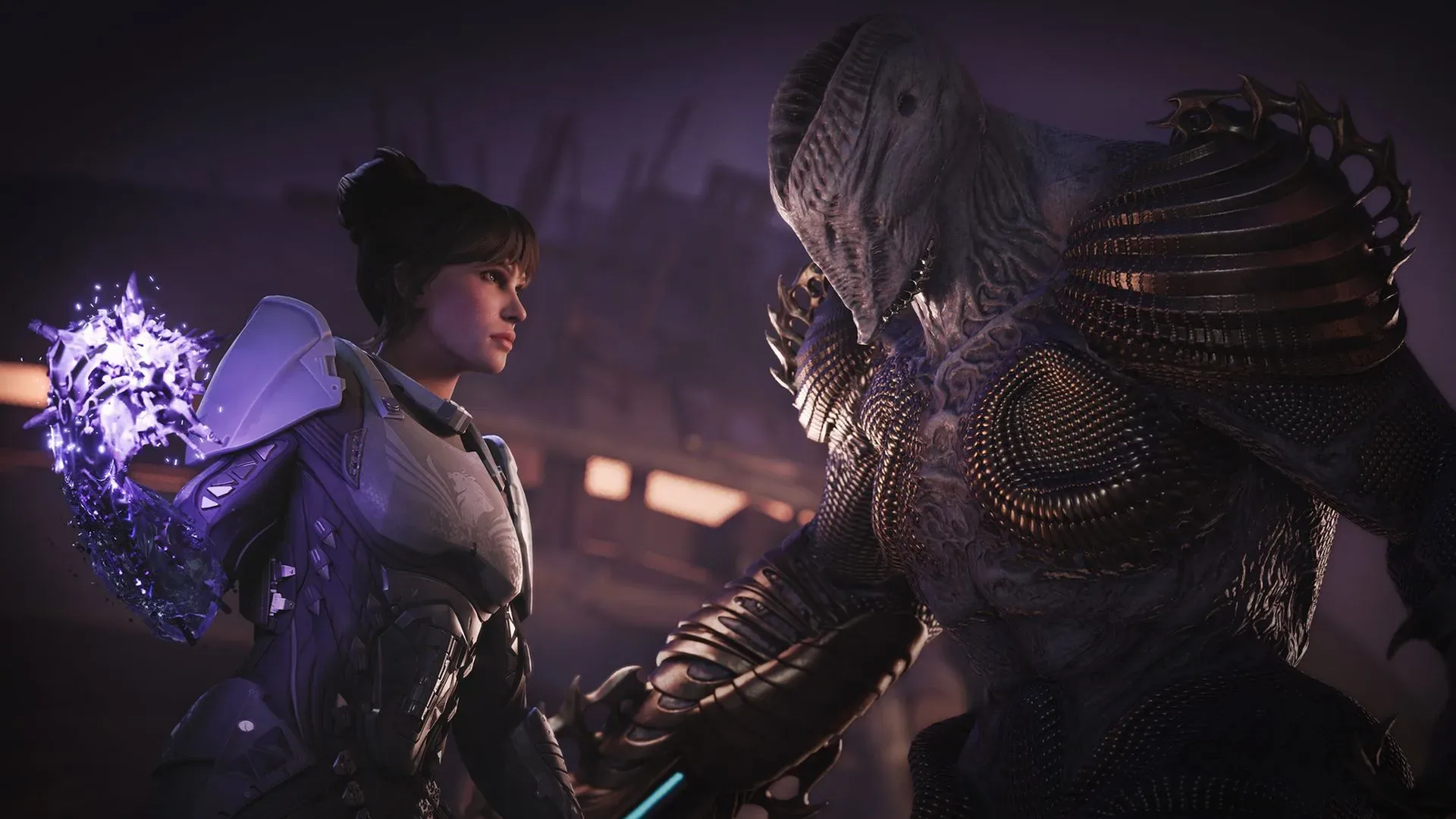

3 Body Problem will return for its second season on January 14, 2027, and its first trailer makes one point unmistakable: humanity’s encounter with the San-Ti is moving beyond a desperate attempt to understand an impossible threat. The new season is poised to turn that looming crisis into a more direct contest shaped by war, political maneuvering and the disturbing arrival of an emissary from far beyond Earth.
The new episodes arrive three years after the first season, picking up after Detective Da Shi brought together the surviving members of the Oxford Five at a moment when their prospects appeared bleak. The fundamental imbalance remains: the San-Ti are still 400 years away. But distance has never made their influence irrelevant, and the trailer stresses that the struggle over humanity’s future is already happening in the present.
An emissary brings a warning, not reassurance
The trailer frames its central development as an apparent diplomatic intervention. The San-Ti tell Earth that they have dispatched an emissary to help stop a war. Thomas Wade, however, voices the suspicion that defines the preview’s mood:
“Wake up, they haven't flown 24 trillion miles to negotiate. They are coming to exterminate us.”
That statement establishes the tension at the center of season 2. An emissary is ordinarily a representative sent to communicate or negotiate on behalf of a larger power. In this case, the word carries little automatic comfort. Wade’s response treats the visitor as an extension of a hostile force rather than a neutral messenger, making the claimed effort to stop war feel like a potentially strategic move in a wider conflict.
It is a useful escalation for a story where the immediate danger cannot be measured only in conventional military terms. The San-Ti’s arrival remains centuries away, yet the first season made clear that their plans and interventions could affect Earth long before that journey ends. Season 2 appears ready to explore what happens when a distant invasion is no longer merely a future date on a calendar, but an active pressure reshaping decisions in the present.
The conflict grows from survival crisis to political struggle
The trailer promises war on the horizon, but the season’s stakes are not presented as simple battlefield stakes. Its emphasis on political machinations suggests another major question: who gets to decide humanity’s response when the consequences are existential?
That is where Wade’s blunt certainty becomes significant. His line does not only warn of an enemy; it proposes an interpretation of the enemy’s intentions. In a high-stakes situation where information is incomplete, competing interpretations can become a source of conflict in their own right. One side may see a path to negotiation or de-escalation. Another may conclude that any seeming offer of peace is a trap. The trailer’s premise leaves room for those competing calculations to collide.
“Political machinations” can sound abstract, but it describes the practical business of power: alliances, leverage, competing agendas and efforts to control the terms of a decision. Against an alien threat, those pressures would not disappear. They could become sharper, because every institution and individual would be forced to act with limited certainty and enormous consequences.
For viewers, that points to a season with conflicts operating at more than one scale. There is the immense, long-term question of a civilization trying to avoid conquest. Then there are the nearer-term disagreements over strategy, trust and authority. The trailer’s language suggests that season 2 intends to connect those two levels rather than treat the cosmic premise as background decoration.
Why the 400-year timeline still matters
The 400-year gap is one of the story’s defining ideas. It makes the San-Ti threat unusual: the endpoint is remote, while the contest surrounding it is immediate. Humanity is not simply waiting for an enemy fleet to arrive. It is attempting to make consequential choices in the shadow of an event that future generations may experience most directly.
That tension naturally changes the meaning of victory and defeat. A conventional war can be judged by territory held, a battle won or an opponent forced to surrender. A conflict whose decisive moment is centuries away demands a different mindset. Preparation, deterrence, information and long-range planning become as important as immediate survival. At the same time, people living in the present still have their own crises to manage, making it difficult to ask everyone to sacrifice for an outcome they will never personally see.
The trailer’s focus on an emissary makes that timeline feel more urgent rather than less. If the San-Ti can intervene now, their physical distance does not translate into safety. The result is a science-fiction setup that can deliver cosmic scale without losing its human pressure: people must respond to an adversary whose journey is unimaginably long, but whose influence is already close at hand.
Returning characters and new faces
The principal returning cast includes Jovan Adepo as Saul Durand, Liam Cunningham as Thomas Wade, Eiza González as Auggie Salazar, Jess Hong as Jin Cheng, Marlo Kelly as Tatiana Haas, Sea Shimooka as Sophon and Benedict Wong as Da Shi.
Da Shi’s position is especially important to the handoff from the first season. The previous run ended with the detective rallying the remaining Oxford Five after hope seemed to be slipping away. That makes the group’s next moves a natural place for season 2 to begin: they are not approaching the San-Ti crisis as detached observers, but as people already pulled into a fight that has become more visible and more dangerous.
The new season will also add Claudia Doumit as Captain Van Rijn and Ellie de Lange as Ayla. Alfie Allen joins in a recurring role. The trailer does not spell out the full place each new character will occupy in the coming conflict, but a larger cast fits the stated expansion in scale. If the story is opening into war and political maneuvering, it follows that the number of people, institutions and interests involved may expand as well.
A larger, more cosmic second season
David Benioff and D.B. Weiss created the series with Alexander Woo, and the creative team has described season 2 as a substantial tonal shift. Their description is direct: the season becomes bigger, wilder and more cosmic.
Cosmic, in this context, does not merely mean that the plot takes place around space-travel concepts. It signals a widening of perspective. The San-Ti conflict is no longer just a mystery that needs solving or an isolated threat that a small group can contain. It is a confrontation with implications that reach across worlds, generations and the basic survival of humanity.
That does not mean the more grounded elements must vanish. In fact, the trailer’s strongest material comes from placing huge ideas beside a recognizably human response: fear, suspicion, urgency and arguments about what must be done. Wade’s warning works because it cuts through the enormous number attached to the journey—24 trillion miles—and turns it into a simple, alarming conclusion about intent.
The season’s challenge will be balancing those perspectives. The show needs the scale of a species-level threat to feel genuinely overwhelming, while retaining characters whose choices make the crisis legible. The returning ensemble, the new arrivals and the emphasis on political strategy all suggest that season 2 will approach that balance through a wider network of competing responses rather than a single straightforward mission.
What the trailer establishes—and what it keeps unclear
The preview provides a clear direction without offering every answer. It establishes that the San-Ti conflict is intensifying, an emissary is on the way, and Wade sees extermination rather than negotiation as the likely endgame. It also makes the season’s larger scope plain, with war and internal political maneuvering positioned alongside the extraterrestrial danger.
What remains uncertain is equally important. The teaser does not explain how the emissary will operate, whether its stated purpose can be trusted, or how the various human characters and factions will respond. It does not define what form the war will take, nor does it settle the disagreements implied by Wade’s warning. Those unanswered questions are not gaps in the premise so much as the engine for a season built around uncertainty.
For sci-fi viewers who like narratives where enormous ideas drive character conflict, the setup is promising. It shares a thematic neighborhood with stories that use long timeframes and difficult choices to pressure their protagonists; Exodus’ exploration of time dilation and branching decisions is another recent example of how science-fiction concepts can make personal choices more complicated rather than less.
3 Body Problem season 2 arrives January 14, 2027. Its first trailer points toward a season where the future invasion is no longer an abstract eventuality, diplomacy is treated with deep suspicion, and Earth’s response may be as consequential—and contested—as the threat bearing down on it.