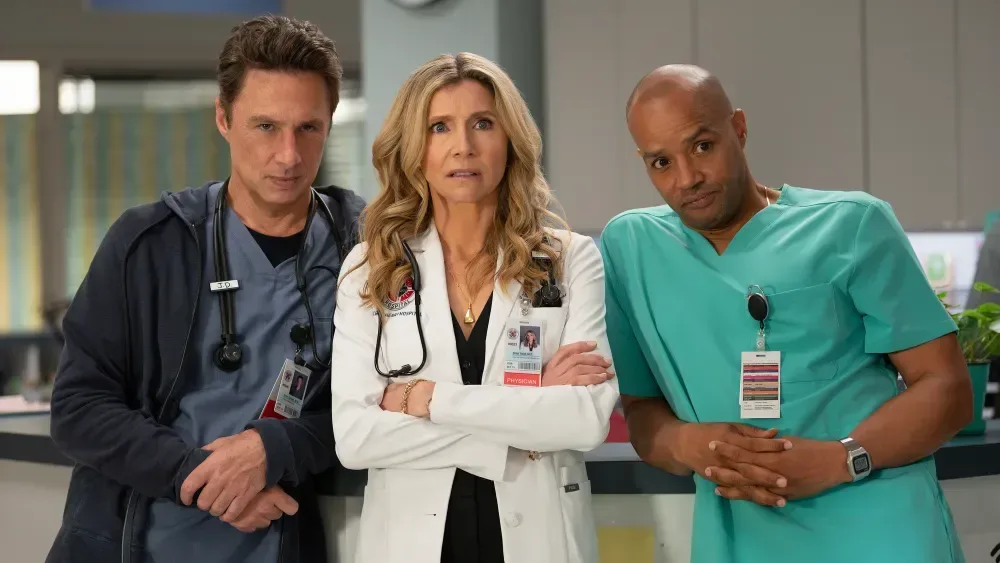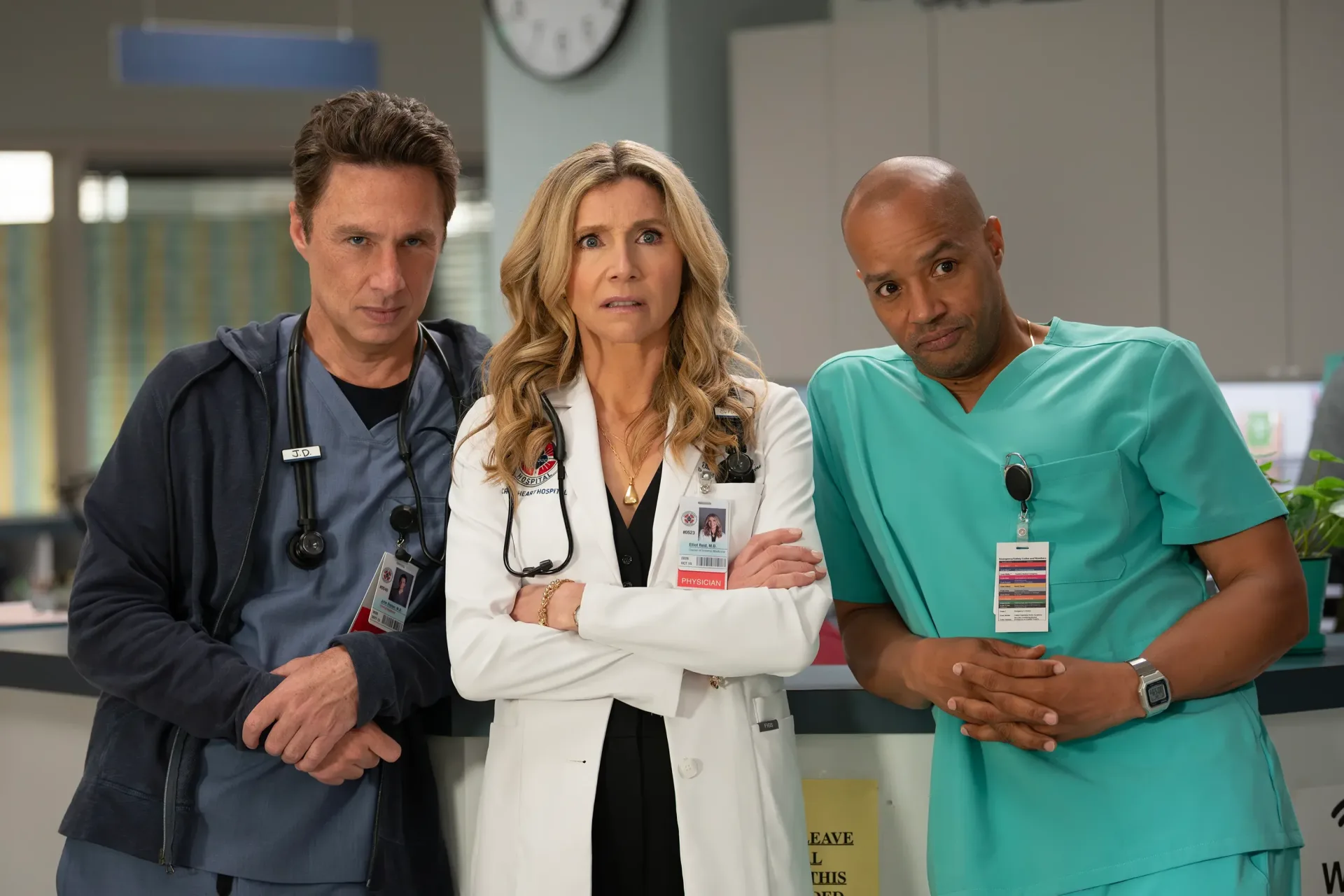
Major spoilers for the first two episodes of the second season of the Scrubs revival follow.
The second season of the Scrubs revival is steering directly into the complication that defined its first: J.D. and Elliot are no longer married, yet they remain colleagues at Sacred Heart and parents to their child, Ollie. The opening pair of episodes, “My First Time in a While” and “My Mentee,” begins testing what that arrangement actually means rather than treating the divorce as a one-season reset button.
J.D., played by Zach Braff, has returned to the hospital as chief of medicine. That role keeps him in daily proximity to Sarah Chalke’s Elliot, his ex-wife. Season 2 makes the premise more difficult—and dramatically more useful—by allowing both characters to move forward romantically. J.D. is drawn to Charlie, played by Rachel Bilson, while Elliot’s past connection Sean, played by Scott Foley, is due to resurface later in the season.
At the same time, the show is addressing the concern surrounding Dr. Perry Cox’s autoimmune disease. The season’s early episodes concentrate on efforts to stabilize the condition and find an appropriate treatment, rather than framing Cox’s health as an immediate death storyline. John C. McGinley is expected to appear in roughly four episodes this season, an availability-driven limitation that gives those appearances added weight without implying that the character is being written out.
Dr. Cox’s illness is about treatment, not a farewell
An autoimmune disease is a broad term for a condition in which the immune system mistakenly attacks healthy parts of the body. The series has not specified a real-world diagnosis in the information available, so it would be inaccurate to attach one to Cox. What has been made clear is the storytelling priority: the doctors are attempting to manage his condition with treatment and medication, and the show wants viewers to understand that Cox remains part of Sacred Heart’s extended family.
That distinction matters because Scrubs has always made room for medical stakes alongside broad comedy. A serious diagnosis can naturally invite fears for a character, particularly one as central as Cox. But the early Season 2 material positions the narrative around care, stabilization and the strain illness places on loved ones—rather than using the condition solely as a mechanism for looming tragedy.
Jordan’s return gives that premise an additional emotional angle. Christa Miller reprises Cox’s wife as the story moves beyond the moment she learned about his illness and toward her response to someone close to her being sick. Carla, played by Judy Reyes, also appears in the season opener, while Robert Maschio returns as The Todd. Their appearances are necessarily shaped by outside schedules and the production’s Vancouver filming, but the season is finding room for familiar faces within those practical constraints.
The result is a sensible revival strategy. Legacy characters can still matter to the present-day show even if they cannot be present every week. Cox’s limited episode count does not erase his importance; it sharpens the question of how J.D. behaves when the mentor whose approval he spent years pursuing is no longer constantly nearby.
J.D. is now the mentor—and that does not make him less needy
Season 2 shifts J.D.’s old dynamic with Cox into a new form. J.D. is supposed to be the established authority now, but his relationship with new arrival Grant, played by John Higgins, turns that promotion into comedy. J.D. wants the kind of mentor-mentee bond he associates with Cox. Grant, however, does not seem inclined to provide it on J.D.’s preferred terms.
That is an effective inversion. A mentor-mentee relationship is not merely a workplace hierarchy: it is a relationship in which an experienced person provides guidance, support and professional development. J.D.’s trouble is that he appears to want emotional validation from the relationship as much as he wants to offer guidance. Grant’s resistance means J.D. cannot simply reproduce the version of mentorship he thinks he received.
Their disagreement over bending rules to help Cox also creates a generational and ethical tension. Grant is presented as unwilling to make that concession, while J.D. sees the situation through the lessons and attachments built over his years with Cox. Neither position needs to be reduced to simple villainy. The interesting point is that both can see themselves as ethical while disagreeing about what ethics require in a difficult case.
For a hospital comedy, that is a strong engine for episodic stories. It allows medical situations to become tests of personality and professional judgment, rather than functioning as background scenery. It also preserves a key part of J.D.’s character: age and authority have not cured his insecurity.
Elliot has her own mentorship story with Tosh, played by Ava Bunn. Their scenes are set to explore a different form of intergenerational friction. Tosh does not accept age as a reason to abandon ambitions, presenting Elliot with the possibility that some of the limits she has internalized are not inevitable. Where J.D.’s mentoring strain comes from craving a particular response from Grant, Elliot’s appears to come from being challenged to reconsider her own assumptions.
J.D. and Elliot’s divorce is the season’s core story
The show’s decision to split J.D. and Elliot was divisive, but Season 2 is designed to examine the consequences rather than rush them back into a familiar romantic pattern. Their present relationship is defined as friendship after marriage, complicated by co-parenting and by the fact that both work in the same place.
That workplace context intensifies ordinary post-breakup problems. An ex dating again can be uncomfortable under any circumstances. An ex dating again when the two people share a hospital, professional responsibilities and likely pieces of the same social orbit offers far fewer opportunities to quietly step away. The show can draw comedy from J.D. and Elliot knowing too much about one another’s personal lives, while also recognizing that their changed relationship is genuinely difficult.
J.D.’s involvement with Charlie is framed as a possible rebound. A rebound relationship is a relationship that begins relatively soon after a significant breakup, often while someone is still adjusting to loss, loneliness or a changed sense of self. It does not automatically mean the connection is unserious or doomed. The comedy lies in J.D. approaching it with too much anxiety and effort, including a gesture involving Joey Fatone that escalates beyond a simple off-screen gag.
The season is expected to let J.D. settle somewhat in the relationship rather than merely use Charlie as a one-episode punchline. That choice is important: a rebound can be both messy and meaningful, and it gives J.D. an opportunity to figure out who he is away from his marriage.
Elliot’s side of the equation becomes more complicated with Sean’s return. The premise is not simply that an old flame walks back in, but that Elliot must decide what renewed chemistry means when she is in a substantially different stage of life. The situation mirrors J.D.’s in one key respect: neither character has a clean, uncomplicated route to “moving on.”
Ollie will appear during the season, though the available episode time means the child will not necessarily be a constant on-screen presence. That is still a significant confirmation. The revival is not ignoring the fact that J.D. and Elliot are parents. Even brief appearances or references can ground the story’s divorce and dating arcs in the responsibilities the pair continue to share.
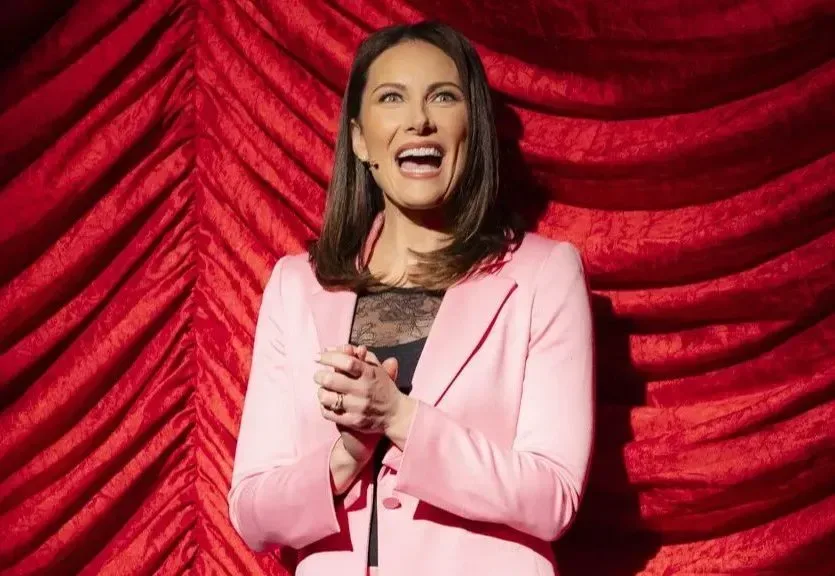
For more comedy coverage centered on personal reinvention and performance, see Laura Benanti’s “Nobody Cares” and its turn toward personal comedy.
Turk’s mental health story will not be dropped
Donald Faison’s Turk is also facing visible strain. The show had previously hinted at his mental health concerns, and Season 2 will return to them rather than treating the issue as resolved because time has passed. That approach is meaningful in a sitcom structure, where a problem introduced in one episode can easily disappear by the next.
The stated intention is not to turn every installment into a heavy drama. Instead, the series is trying to keep friendship, humor and ongoing personal difficulty in the same frame. J.D.’s perspective on what Turk is experiencing will be part of that material, making the storyline not only about Turk’s internal state but also about how longtime friends respond when a problem does not vanish on schedule.
That fits the broader Season 2 emphasis. Whether it is Cox seeking the right treatment, J.D. adjusting to divorce, Elliot reevaluating her future, or Turk continuing to deal with mental health pressures, the common thread is that adulthood does not always supply tidy endings. A comedy can acknowledge that without surrendering its comic voice.
The Janitor, Sean and the challenge of returning faces
Neil Flynn’s Janitor is also set to return, with an episode that revisits the strange question of whether a character at the hospital is really the Janitor’s son. The uncertainty itself is part of the joke, and the storyline provides an organic reason for the Janitor to enter the Sacred Heart orbit again.
Season 2 is working with a mix of returning cast members and new faces rather than attempting to recreate the original ensemble’s exact day-to-day balance. Grant, Mimi—played by Keyla Monterroso Mejia—and Tosh give the hospital a new generation of people to mentor, frustrate and challenge the established doctors. Familiar characters, meanwhile, arrive when their stories and schedules permit.
Ken Jenkins’ Dr. Kelso has not been confirmed for the season. The door remains open should he be able to participate, but there is no indication that an appearance is scheduled. That uncertainty is worth preserving: wishful thinking is not the same as a casting confirmation.
Viewed together, the first two episodes establish a season less interested in resetting old relationships than in testing how they survive change. J.D. and Elliot are not being asked to pretend their history never happened. Cox’s illness is not being used only for shock value. And the younger doctors are not present merely to repeat the past. The revival’s central question is whether Sacred Heart can still feel like a family when its members are older, busier, divorced, ill, mentoring others and unable to fall back on the roles that once defined them.
New episodes air on ABC and are available to stream on Hulu the following day.