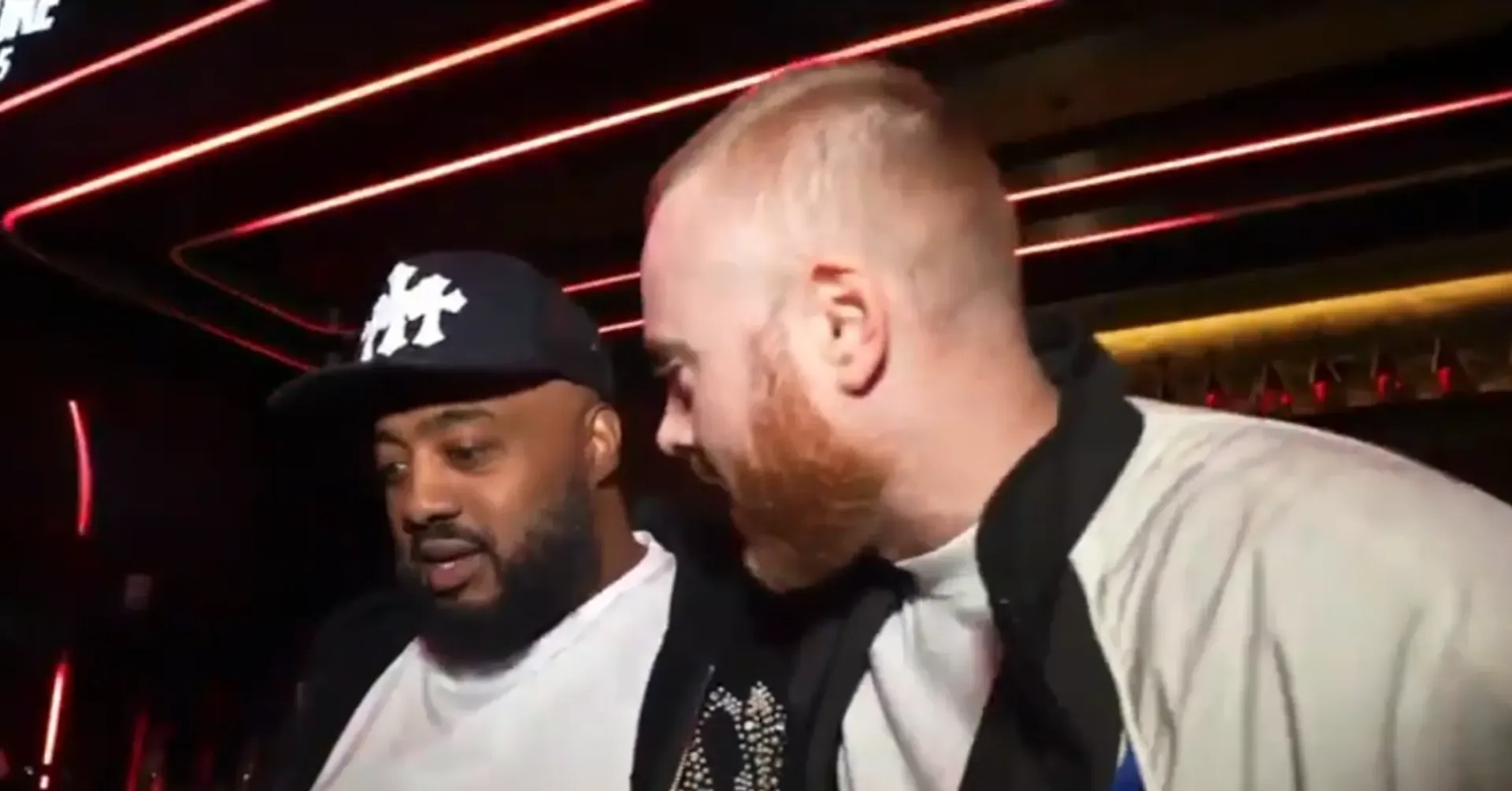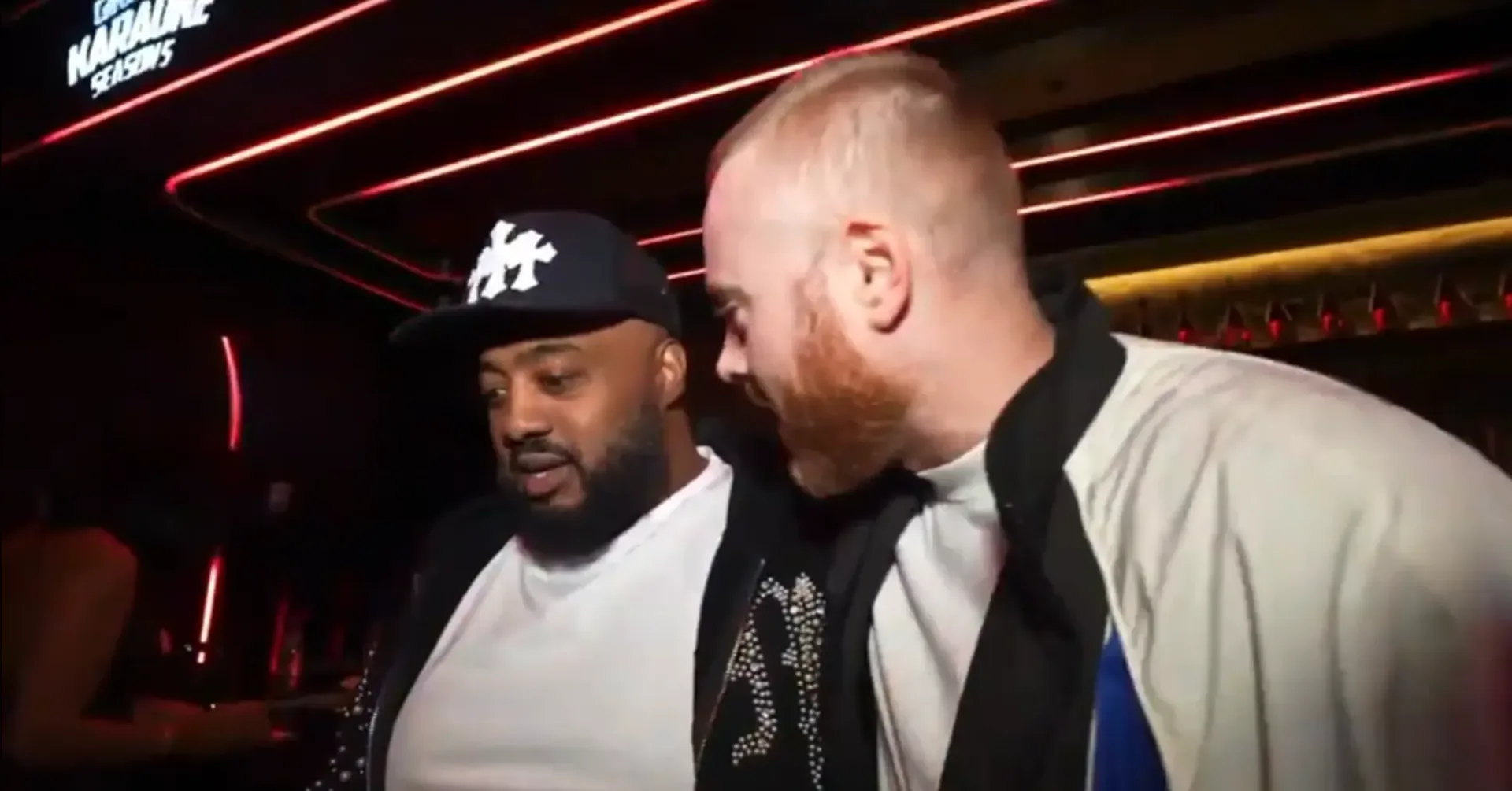
Podcast-world tension briefly moved from old clips and recurring talking points into a face-to-face encounter when Rory Farrell appeared during a QueenzFlip livestream filmed inside a club. The available footage shows Farrell repeatedly asking QueenzFlip, “we were suckers right?”—an apparent reference to comments QueenzFlip had previously made about Farrell and his co-host, Mal.
The exchange is notable less for a confirmed escalation than for what it represents: a long-running network of podcast relationships, professional splits and public criticism narrowing to one pointed question in a live setting. The clip appears to show QueenzFlip initially caught off guard. Farrell walks away, but QueenzFlip then moves back toward him and the confrontation continues off the clearest view of the camera.
There is no verified account in the material available of how the discussion ended. The video turns away and cuts off before viewers can see whether the pair settled the matter, agreed to disagree, or carried the dispute further. That distinction matters. A clipped livestream can establish that a confrontation happened; it cannot establish an ending that the footage does not show.
What Farrell was addressing
Farrell and Mal were previously prominent voices on the Joe Budden Podcast before their split from Joe Budden. They subsequently continued together with the New Rory & Mal podcast. That history has left an obvious layer of context around any public friction involving people connected to the respective shows.
QueenzFlip later joined Budden’s podcast orbit and had referred to Farrell and Mal as “suckers.” In the club clip, Farrell’s repeated wording directly invokes that label rather than opening a broad debate about the older split. It is a compact form of confrontation: identify the statement, put it back to the person who made it, and request an answer in person.
“Suckers,” in this context, is not a technical term. It is an insult that questions someone’s judgment, standing or willingness to be taken advantage of. Because it can carry several implications at once, a direct response can matter more than a later general explanation. Farrell’s phrasing appears designed to make the original characterization the central issue.
A livestream changes the dynamics
The encounter reportedly occurred on what appeared to be QueenzFlip’s own livestream from inside a club. A livestream is video broadcast as events unfold, often with an audience watching in real time. Unlike a recorded podcast segment, it generally offers less opportunity to reset, edit around an uncomfortable pause, or add full context before a moment becomes shareable.
That does not mean every livestream moment is fully self-explanatory. In fact, the opposite is often true. Club environments are noisy, crowded and visually inconsistent; a camera can move at the exact moment when the decisive part of a conversation occurs. The material here illustrates that limitation. Viewers can see Farrell raise the past remark and can see QueenzFlip’s initial uncertainty, but the camera’s shift and the cutoff prevent a definitive reading of the outcome.
It is therefore more accurate to say that the clip captures an unresolved public exchange than to characterize it as a completed reconciliation, a major altercation or a settled feud. None of those larger claims is supported by the available footage description.
Why the older podcast split remains relevant
The dispute lands against a backdrop that listeners already understand as complicated. Farrell and Mal’s departure from Budden’s show was a major professional break, and the parties have continued along separate podcast paths. Budden has still publicly floated the possibility of Farrell returning, while his relationship with Mal has appeared more contentious.
Budden also showed support for Farrell after Farrell suffered a stroke while attending a Jay-Z pop-up in Brooklyn. That detail is a reminder that public podcast rivalries are not always cleanly divided into permanent alliances and permanent hostilities. Professional disagreement, personal concern and content-driven commentary can coexist, often in ways that are difficult to reduce to a single storyline.
That is also why a confrontation with QueenzFlip should not automatically be read as an answer to the much wider history between Farrell, Mal and Budden. The immediate issue is specific: QueenzFlip’s earlier description of Farrell and Mal. The broader ecosystem supplies context, but it does not fill in the missing portions of this particular conversation.
What could happen next—and what remains speculation
Both sides now have platforms where they could address the encounter. Farrell may choose to discuss it on New Rory & Mal, while QueenzFlip and others connected to Budden’s show could address it in their own programming. Given the people involved, the clip is likely to draw commentary from listeners who followed the prior separation and the remarks that prompted Farrell’s question.
Still, it is important to separate a reasonable possibility from a reported development. There is no confirmed follow-up statement here from Farrell, Mal, QueenzFlip or Budden. There is also no confirmation that the matter has been resolved privately. Until one of the participants gives a fuller account, the responsible reading is a narrow one: Farrell confronted QueenzFlip on camera about the “suckers” comment, and the visible footage does not reveal the final result.
For readers tracking the broader entertainment conversation around public figures and disputes, Joking Joystick has also covered a separate development involving Ye’s requested trial timing. The underlying subjects are different, but both stories demonstrate how quickly public clips and statements can become part of a larger media narrative before all of the relevant details are known.
The practical takeaway for viewers
The strongest takeaway from the club video is not a verdict on who was right. It is the limited, observable sequence: Farrell entered the livestream’s frame, pressed QueenzFlip about an earlier insult, and the broadcast did not show the conclusion. Everything beyond that requires either fuller footage or direct comment from the participants.
For an audience accustomed to podcast debates becoming serialized content, ambiguity can be tempting to fill with assumptions. Here, the useful distinction is between documented action and unverified interpretation. The documented action is the confrontation and the repeated question. The unverified interpretation is whether it repaired anything, intensified anything, or merely put an old comment back on the table in a setting where neither person had much room to avoid it.