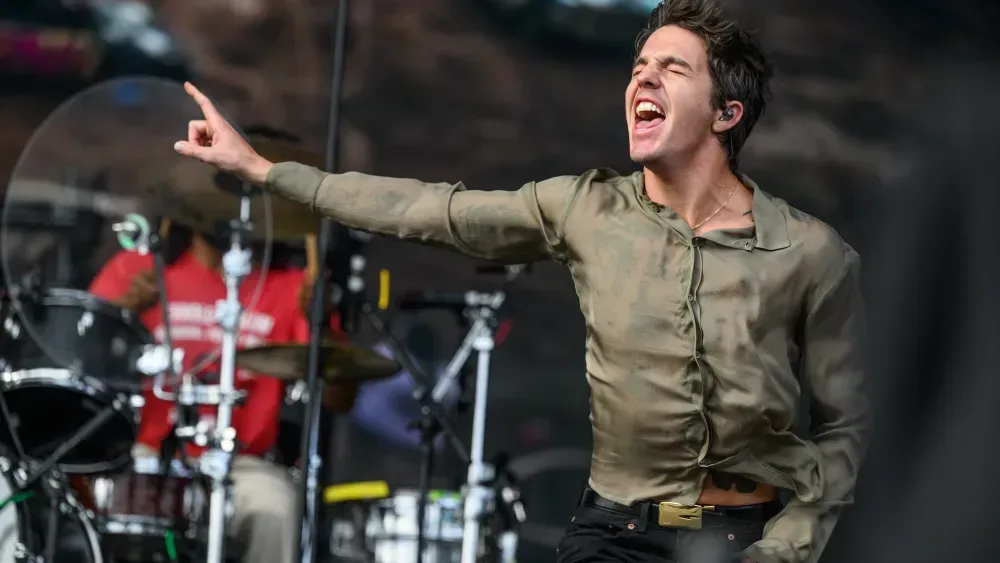
Role Model brought the Chuck Timely character to Los Angeles’ Greek Theatre for the second of two local dates on the North American Chuck on Tour run, delivering a 90-minute show that framed a broad set of songs around a deliberately playful new persona. The concert supported his third studio album, Chuck Timely & the Hourglass, and its combination of character work, loose crowd banter and catalogue-spanning setlist made the evening feel bigger than a simple album-cycle performance.
There was also an unexpected sense of finality around the date. It had been slated as the penultimate North American stop, but the following night’s Berkeley show was subsequently canceled because of illness. Nothing in the Greek Theatre performance suggested a subdued night: Role Model, whose name is Tucker Pillsbury, kept the momentum high after a brief technical interruption at the opening.
Chuck Timely turns a concert into a character piece
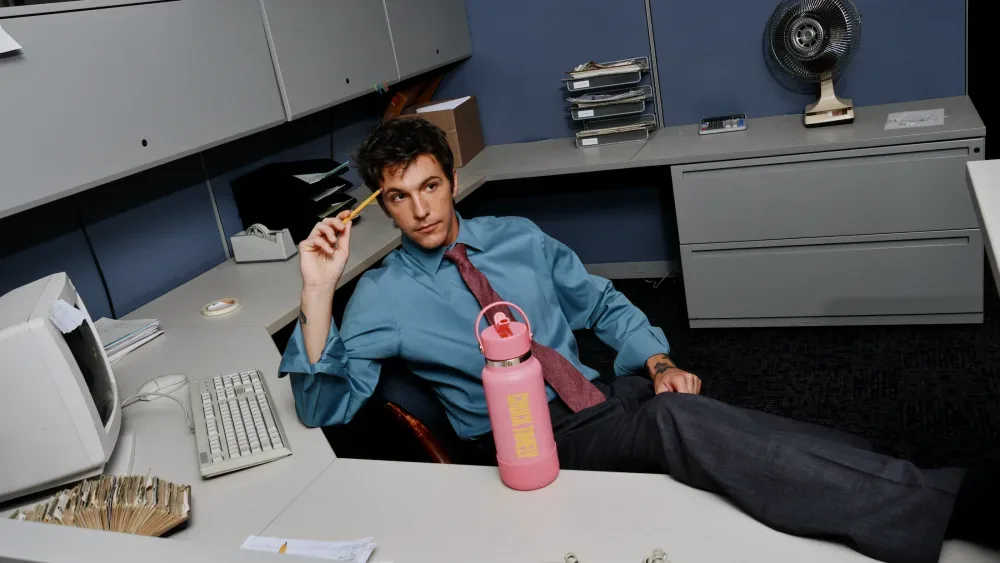
Chuck Timely is the latest onstage identity associated with Pillsbury’s music. For the 2024 album Kansas Anymore, he used the Saint Laurent Cowboy persona; the new character is presented as a time traveler who has moved through multiple eras, collecting pieces of each along the way. That premise gives the album and tour a thematic framework without requiring the show to become a rigid narrative.
In practical terms, a persona can provide a concert with recurring visual language, an opening premise and an excuse to place material from different periods beside one another. It is less a claim that the artist has become a fictional person than a performance device: a lens through which clothing, staging, jokes and song selection can be organized. Chuck Timely’s “been around forever” concept is particularly suited to a set that reaches backward into earlier Role Model releases as well as foregrounding the newest record.
At the Greek Theatre, the staging kept that idea grounded in comedy rather than spectacle. Band members had humorous position labels including “Bass God” and “Piano Man,” while Pillsbury’s own spot was labeled “Chuck.” A sign toward the rear of the stage instructed him to “Stand here for the drama.” The joke was clear: even a supposedly immortal time traveler has a marked place to go when a scene calls for heightened emotion.
That stripped-back approach matters. Instead of relying on an elaborate visual production to establish the character, the show used a few readable signposts and Pillsbury’s manner onstage. It left space for the songs, the band and an audience of roughly 6,000 people to remain the center of the performance.
A shaky opening gave way to an energized set
The entrance initially encountered a problem. Role Model emerged from darkness during the pre-recorded “Chuck’s Mantra” and moved into “High Hopes 3000,” but the playback dropped out briefly. The resulting silence understandably interrupted the intended grandeur of the introduction. When the track resumed, however, audience cheers surged as Pillsbury’s silhouette appeared in golden light, and the early awkwardness gave way to a far more animated room.
That recovery is a useful reminder of how live shows work beyond their plans. Pre-recorded audio, often called playback, can be used for an introductory spoken segment, a musical layer that cannot be reproduced by the players onstage, or a transition between songs. When it stops unexpectedly, the gap is obvious. But a crowd response can change the meaning of the moment quickly, turning a malfunction into a short detour before the shared energy returns.
Related coverage includes Role Model Brings Chuck Timely to Los Angeles Greek Theatre.
Pillsbury spent the remainder of the set alternating between acoustic and electric guitar. The change in instruments also helped shape the pacing: it created room for quieter material amid more forceful sections without flattening the concert into one consistent intensity. “The Longest Goodbye” and “Good Thing” were among the lower-key portions, with “Good Thing” prompting hundreds of attendees to lift phone flashlights.
The flashlights are a small but recognizable concert ritual, one that shifts visual participation from the stage to the crowd. Rather than being a production effect controlled by the artist’s team, it is a synchronized audience gesture. In a venue the size of the Greek Theatre, that means an intimate song can gain a wide visual scale without losing its quieter character.
New album material met earlier Role Model songs
The Chuck Timely concept did not limit the set to the new album. Role Model also reached into his earlier catalogue with “Writing’s on the Wall,” “Slipfast” and “Old Recliners,” while “Sally, When the Wine Runs Out” remained one of the evening’s most anticipated selections.
This kind of setlist construction has a clear fan-facing benefit. A tour in support of a new release naturally needs to establish that album’s identity, but a career-spanning selection acknowledges that audiences often arrive through different songs and eras. For longtime listeners, older tracks can connect the newest chapter to the music that came before it. For newer listeners, they offer a quick survey of how the project’s sound and songwriting have developed.
Chuck Timely’s time-traveler premise makes that blend feel especially appropriate. Earlier songs are not treated as a pause in the current campaign; they become part of a larger, deliberately mixed-era performance. The device is simple, but it lets the concert move between past and present without suggesting that one must be discarded for the other.
“Love I You” made the crowd part of the arrangement
One of the set’s most notable recurring ideas came with “Love I You,” the track featuring Dakota Johnson, who is now Pillsbury’s former partner. Rather than play Johnson’s recorded contribution in the live setting, Pillsbury invites an audience member to perform the song’s back-and-forth with him.
It is a smart solution to a familiar live-performance problem. A duet on a studio album has two distinct voices and, often, a conversational dynamic that cannot simply be replicated by one performer. Playing the absent collaborator’s vocal from the recording is one option. Recasting the exchange with someone from the audience is another, and it makes the song structurally different each night.
The approach also avoids pretending that the studio feature is physically present. The guest’s role becomes an explicitly live, temporary one. It introduces uncertainty—every volunteer will have a different delivery and level of confidence—but that is part of the appeal. The audience is no longer only reacting to a finished song; one person is actively helping construct its performance in real time.
Jake Shane and Reneé Rapp became part of the night’s banter
Role Model also made room for some celebrity-attendance humor. He told the crowd that his parents were present and spoke about friend and online personality Jake Shane attending the previous night’s Los Angeles show because singer Reneé Rapp would be at Friday’s concert. Pillsbury jokingly accused Shane of choosing Thursday to avoid being eclipsed by the attention Rapp would draw on Friday.
When the crowd began scanning for Rapp, Pillsbury quickly redirected the focus back to the stage, joking that he had dressed up for the audience. The exchange was a compact example of a performer managing a room’s attention: celebrity guests may create a burst of excitement, but the artist can turn that distraction into a joke that reinforces the connection with the people who bought tickets for the show.
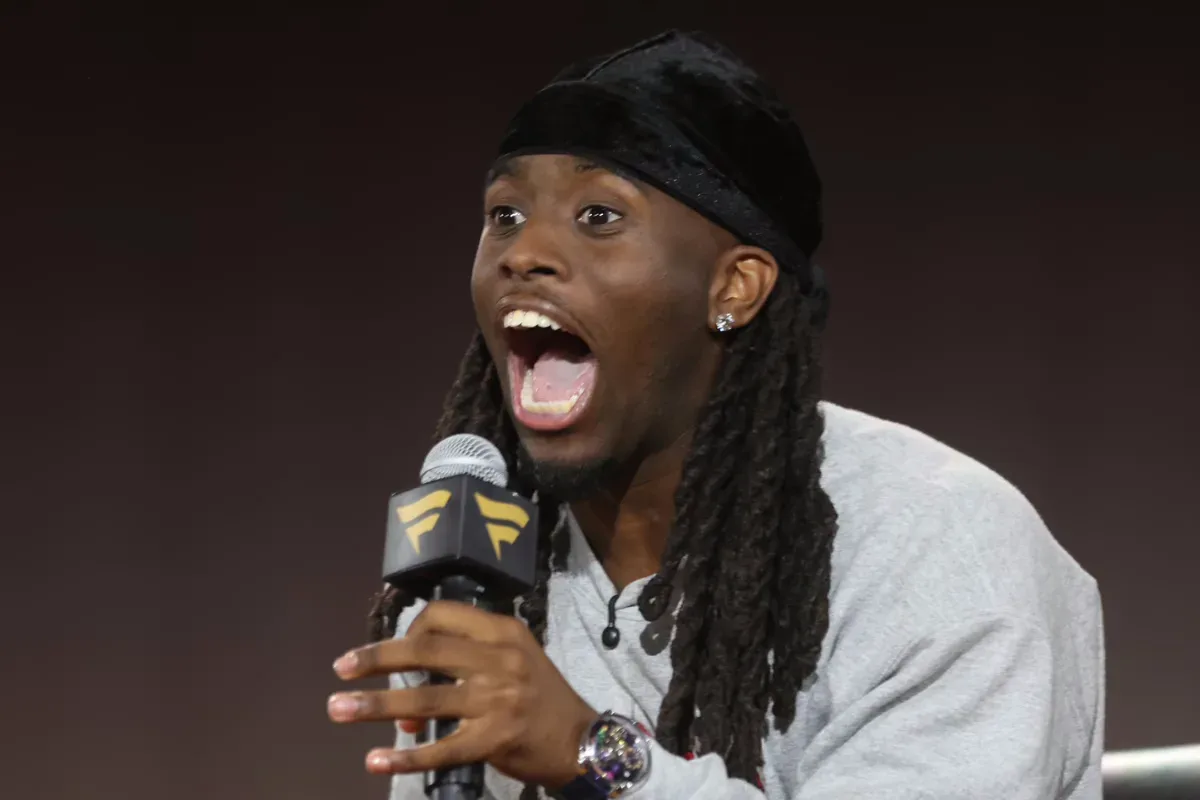
It also sits naturally within an entertainment culture where musicians, actors, streamers and internet personalities increasingly overlap in public spaces and online audiences. For more on that adjacent creator-and-streaming landscape, see Kai Cenat and Ray’s planned Japan stream.
Why the Los Angeles stop stands out
The Greek Theatre performance was not defined by a giant production pivot or an unannounced musical guest. Its impact came from smaller, more human elements: a malfunction that the room moved past, signs that lightly undercut the grandeur of the character concept, fans lighting their phones for a quieter number, and an audience member stepping into a duet normally associated with a featured vocalist.
Those details fit the Chuck Timely idea well. The persona supplies an exaggerated frame—the eternal time traveler with an hourglass—but the show’s actual character came from flexibility and direct communication. Pillsbury could switch from guitar-backed songs to deadpan set dressing, from a personal track’s altered live arrangement to gossip-adjacent jokes about familiar friends in the building.
With the Berkeley date canceled due to illness, the Los Angeles show ultimately became the final North American stop of this run. That unplanned change adds context, but it does not alter what the performance offered on its own: a lively farewell to the tour’s North American leg, built around Chuck Timely & the Hourglass while making room for the earlier songs and participatory moments that keep a Role Model set from feeling locked in time.