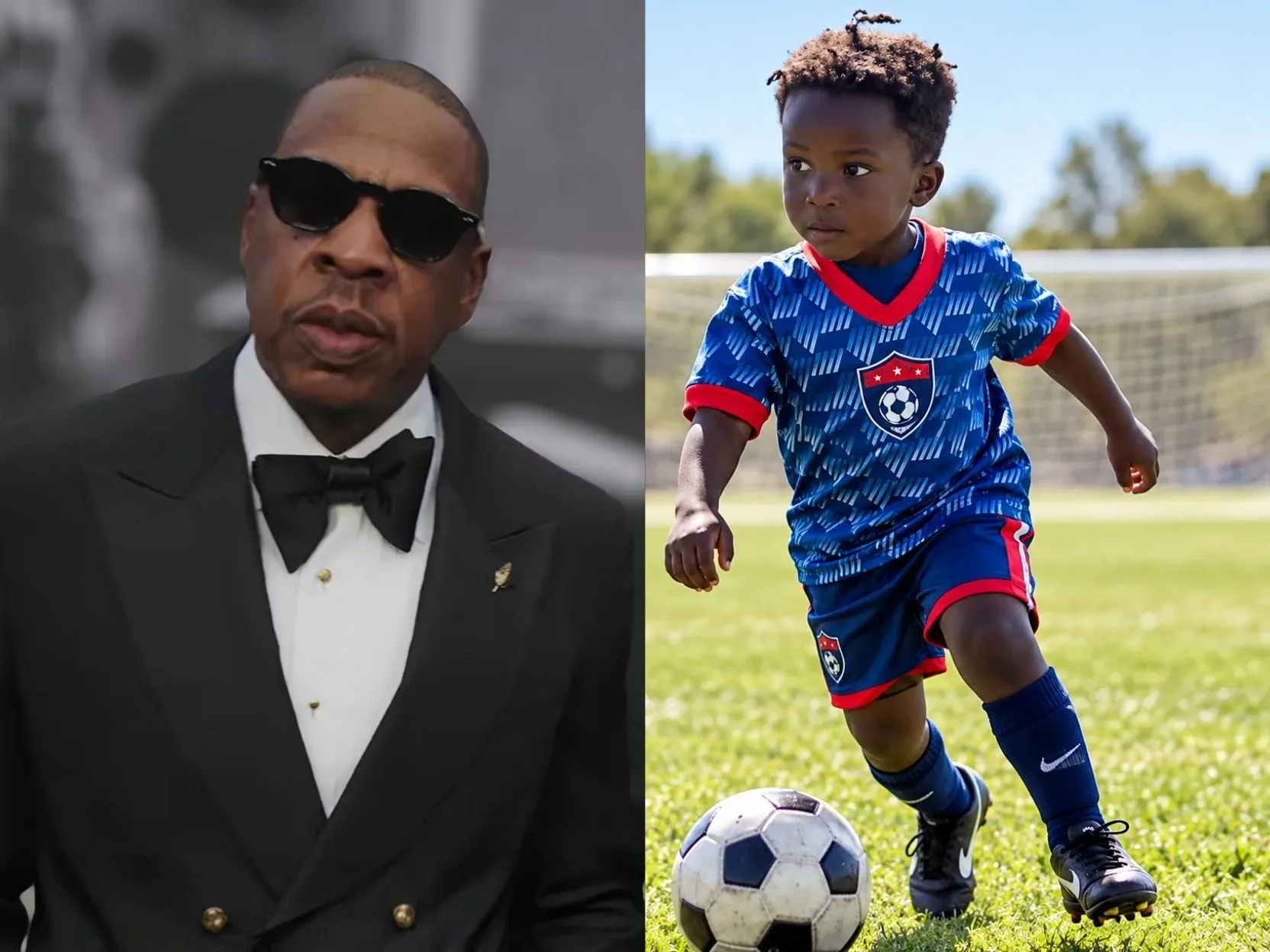
Three-year-old soccer player Nevada Pierre may be headed for an athletic experience in Spain after a youth-sports disagreement in Winter Park, Florida drew police to a recreational game and put an extraordinary spotlight on the child and his family.
Jay-Z and Roc Nation Sports have reportedly committed to sending Nevada to Spain in December 2026, with plans to work with his family on an experience meant to support the young player’s development. The prospective trip follows a highly public dispute involving Nevada’s participation in a children’s soccer league, competing alongside children older than he is.
The key word is reportedly: the Spain plan has been described as a commitment, but the available information does not lay out a detailed itinerary, specific training arrangement, or the full structure of the visit. Still, it represents a major change in tone from the events that unfolded on a Florida field only days earlier.
What happened at the Winter Park game
Police were called to Martin Luther King Jr. Park in Winter Park on Oct. 24 after an i9 Sports official requested assistance during a confrontation involving Nevada’s parents, Martasia Griffin and Don Pierre.
The family’s position was that Nevada was being treated unfairly because of his ability. Videos that circulated online showed the toddler moving around defenders and scoring with striking confidence for his age, helping turn a local youth-sports argument into a far wider online discussion.
League representatives presented a different account. An official acknowledged Nevada’s advanced skill level, while alleging that he had pushed other children during the game. The same official also alleged that the parents became disruptive during disagreements over playing time.
The Winter Park Police Department later clarified that officers had responded to a dispute between adults, rather than to an issue involving a child’s athletic talent. No arrests were made, and authorities classified the matter as civil.
That distinction matters. In the account provided by police, Nevada was not the subject of a criminal allegation or police enforcement action. The reported incident concerned a conflict among adults at a youth sporting event. It is an important clarification amid social-media discussion that often compresses a complicated dispute into a much simpler story.
A young player at the center of competing concerns
The incident has become a flashpoint because youth sports can require organizers to balance several interests at once: allowing children to learn and enjoy the game, maintaining rules and safety, offering equitable participation, and responding to an unusually advanced player without turning that child into a spectacle.
In this situation, each side raised concerns that cannot be treated as interchangeable. Nevada’s parents said their child was being penalized for exceptional ability. The league official’s account focused on physical contact during play and alleged parental conduct related to playing time. The police description, meanwhile, limited its explanation to a civil disagreement among adults.
Those accounts leave obvious unanswered questions about how the league’s game was managed and whether its participants, parents and officials had a shared understanding of expectations. The available details do not establish a broader policy failure, nor do they settle every disagreement between the parties. They do show how rapidly an ordinary recreational setting can become overwhelming when a viral video, parental conflict and police response converge.
For a player who is only three, the stakes should not be confused with a professional pathway. A child displaying unusual coordination, confidence or scoring instincts is noteworthy, but it is not a completed prediction of future sporting success. Development at that age is still development: an opportunity to play, learn movement, gain comfort with teammates and enjoy the sport.
That is also why the reported Spain trip is best understood as an experience intended to encourage Nevada’s interest, rather than evidence of a finished career plan. Its value will depend on how thoughtfully it is shaped around the child and family.
Support offers follow the viral attention
Roc Nation Sports was not the only group or figure to respond after the incident gained attention. Former U.S. national soccer player Eddie Johnson offered to train Nevada through EJE7 Soccer Academy in Orlando.
Johnson also used the moment to criticize what he characterized as long-running barriers in youth soccer, particularly for children of color. In a social-media post, he argued that a three-year-old’s ability should be praised rather than diminished.
“We should be praising a three year old with his ability instead of tarnishing it,” Johnson wrote.
That response gives the story a larger cultural dimension, although it should not erase the immediate details of the disputed game. There can be a legitimate discussion about access, recognition and who gets nurtured in youth soccer, while also recognizing that recreational leagues have a duty to keep games orderly and safe for every child involved.
Johnson’s offer provides a potentially more local avenue for guidance than the reported overseas experience. The available information does not say whether Nevada’s family has accepted training, how often it might occur, or what a program would involve. What it does indicate is that the family now has an offer of instruction from someone with high-level soccer experience.
Roc Nation Sports’ reported involvement also places Nevada’s story in a broader entertainment and sports-business conversation. Jay-Z’s name carries cultural reach well beyond soccer, so any support associated with his sports organization is likely to attract attention of its own. That attention can create opportunities, but it can also intensify public expectations around a child who should not have to carry the weight of a viral narrative.
For a related look at news where music figures and public statements drive wider conversation, see J. Cole’s comments on not ruling out another project.
What the family says the attention has cost
Griffin said that Nevada was frightened by the police encounter and worried that he might be removed from another soccer program. That detail is one of the most consequential parts of the story.
Children can understand adult conflict in simple but powerful terms: whether they are welcome, whether they did something wrong, and whether an activity they enjoy might be taken away. In a story built around talent and opportunity, Nevada’s reported fear is a reminder that the central priority is his sense of safety and enjoyment, not the scale of the attention surrounding him.
The family also launched a GoFundMe campaign to cover training, equipment, registration and travel costs. Griffin said the campaign had raised more than $40,000 as supporters responded to the incident.
Those categories illustrate the practical side of youth sports. Training is only one part of participation. Equipment, league registration and transportation can all shape whether a family can pursue opportunities consistently. The crowdfunding response may help relieve some of those pressures, though the available information does not specify how the funds will be allocated or whether they are connected to any particular program.
What comes next remains unclear
Much of Nevada Pierre’s immediate future remains unsettled in the public account. There are no detailed public terms for the reported Spain experience, no outlined timetable for any work with Johnson’s academy beyond his offer, and no resolution described between the family and the recreational league.
There is, however, a clearer contrast between the first viral images and the current possibilities. What began with a contentious youth-game scene and a police call has led to fundraising support, an offer of training in Orlando and a reported international opportunity through Roc Nation Sports.
The most constructive outcome would be one that keeps the focus proportional: celebrate a young child’s apparent enthusiasm and ability, ensure adults handle disagreements without escalating them, and give Nevada space to develop at a pace appropriate for him. The episode has already prompted a necessary conversation about talent, access and conduct in youth soccer. Its next chapter should be less about viral conflict and more about letting a three-year-old enjoy the game.