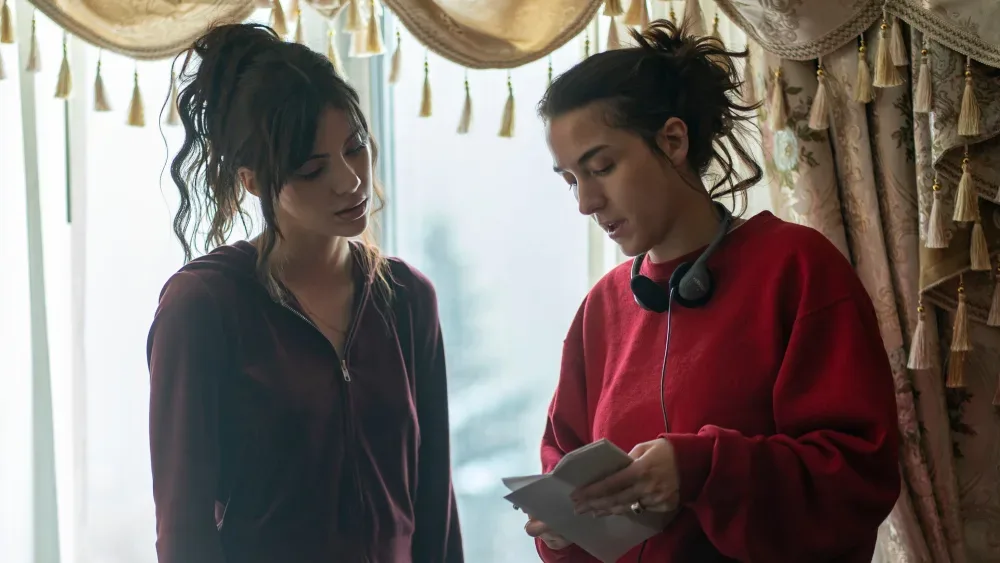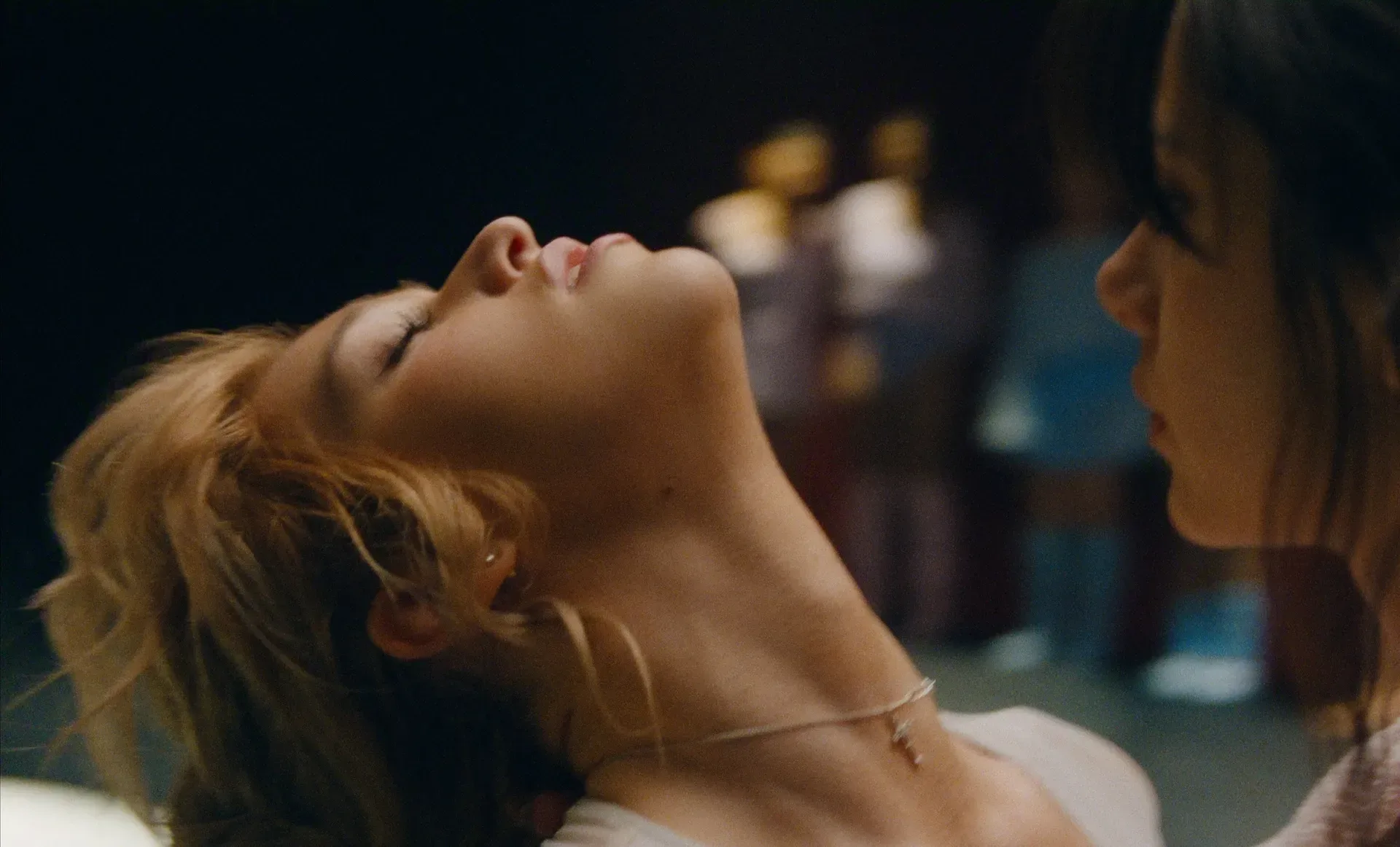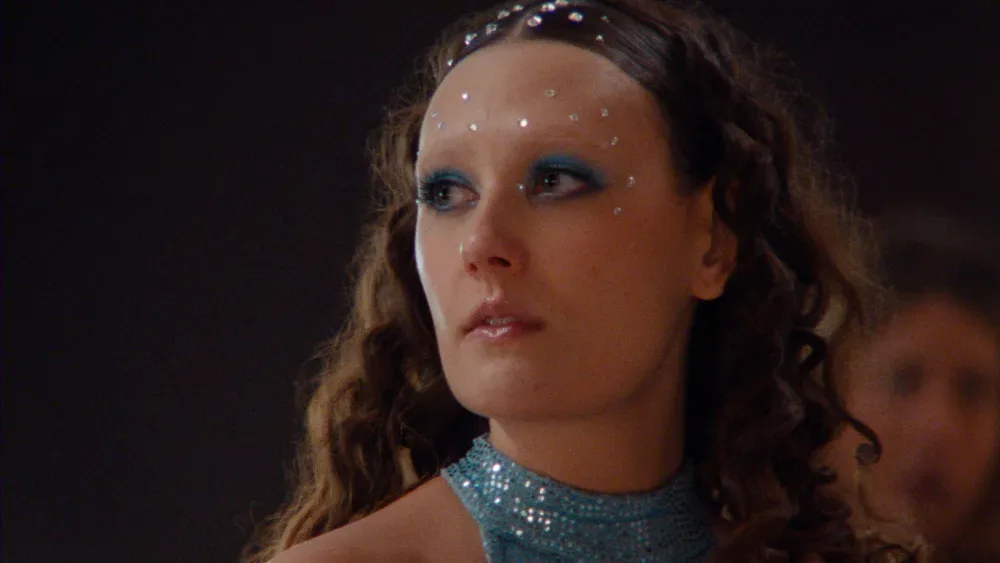
Quinn Shephard’s The Body starts with an emergency, then lets that emergency become a belief system. Set at a Catholic high school in 2004, the Netflix psychological drama follows Grace, played by Sofia Wylie, after she falls into a coma following a Halloween party. Her dance teammates had pressured her to take Ecstasy, and their fear over what happened gives them a powerful motive to conceal the truth. What begins as secrecy soon expands into something much stranger: the girls claim to receive religious visions of Grace, and a wider community begins to accept her as a divine presence or messenger.
That escalating premise puts several tensions in the same pressure cooker: adolescent guilt, collective denial, spiritual longing, social conformity and queer self-discovery. Shephard has described religious horror as a particularly useful language for exploring the collision of desire and repression in a queer girl’s coming-of-age. The result, in concept, is not simply a story in which faith is treated as a frightening aesthetic. It is a drama about why people seek faith, how people can be harmed by structures built around it, and how a community’s need for meaning can make an extraordinary claim feel emotionally necessary.
A school scandal becomes collective belief
The central movement of The Body is from a specific private crisis to public mass hysteria. Mass hysteria, as the show uses the idea, describes fear and conviction spreading through a group until the shared response takes on a life of its own. Here, Grace’s friends do not merely have something to hide. Their apparent visions offer a way to reshape the event, turning culpability into mystery and helplessness into a role within a larger sacred story.
That distinction matters. A secret ordinarily isolates the people keeping it: every conversation carries the risk that somebody will expose the truth. Belief, by contrast, can recruit witnesses. Once others find comfort in the idea that Grace has a spiritual significance, the claim is no longer sustained only by the girls who originated it. It is supported by people who may genuinely need it to be true.
For more context, explore NBC’s 100th Anniversary Party Looks Back From Radio to Streaming Ahead of Dec. 10 Special.
The show’s premise therefore leaves room for two different questions that do not necessarily have the same answer. Are the girls knowingly performing visions to protect themselves? And why are so many others willing to receive those visions as meaningful? The first is about responsibility. The second is about longing. Shephard’s interest appears to be in the uneasy overlap, rather than in reducing religious feeling to a simple trick or reducing the characters’ guilt to a mere plot device.
Grace’s coma is the catalyst, but the idea of Grace becomes the real force in town. That is a potent horror mechanism because it shifts attention from a single unknowable event to the social consequences of interpretation. An unexplained occurrence can create uncertainty; a community’s answer to that uncertainty can create an institution, a hierarchy and a new way of deciding whose voices count.
Faith-positive, institution-critical
Shephard has characterized the creative perspective behind The Body as faith-positive but system-critical. Those terms are useful for understanding the show’s likely target. Being faith-positive does not mean treating every religious claim as correct, nor does it mean glossing over real conflict. It means acknowledging that prayer, ritual, song, fellowship and spiritual language can offer sincere comfort and meaning. Being system-critical means scrutinizing the organizations, customs and power arrangements that can turn belief into exclusion, shame or control.
Related coverage includes Quinn Shephard’s ‘The Body’ Turns Faith, Fear and Desire Into Queer Horror.
That nuance is especially important in a series situated at a Catholic school and centered on queer young people. Shephard has spoken about associating Christianity with the oppression of queer people and the rejection of difference, while also remaining moved by worshipful communal experiences. Her own relationship to faith was not a straight line: as a child, she attended church at times with an evangelical grandmother who worked as a deliverance minister; later, she experienced a separation from Christianity that was personal as well as political. Yet she says religious spaces and charismatic services can still affect her deeply.
That is a more complicated emotional starting point than straightforward religious satire. The series can regard sacred experience as real to the people having it while remaining alert to the ways institutions channel, limit or weaponize that experience. In practical storytelling terms, that gives the town’s believers interiority. They are not automatically gullible villains. They may be grieving, frightened, isolated or seeking a framework for pain that ordinary explanations cannot satisfy.
“The Body” positions worship, repression, shame and ecstatic feeling as connected forces rather than easy opposites.
For viewers, that framing also clarifies why the premise belongs in psychological drama as much as horror. The menace is not necessarily limited to whether Grace is supernatural. It includes what happens when emotional need becomes social certainty, and when an institution already associated with moral authority gains a purported miracle around which to organize itself.
Why queer horror fits the material
Queer horror is not a single formula. Broadly, it is horror that uses queer characters, desire, history or perspectives to reshape the genre’s concerns. It often pays close attention to secrecy, surveillance, the body, forbidden feeling, social punishment and the fear of being cast out. Those themes are readily present in a story about Catholic-school students whose frightening circumstances become entangled with public notions of sin, purity and sanctity.
Shephard has connected the genre to feelings of shame, passion and ecstasy. That trio describes an emotional contradiction many coming-of-age stories circle around: the intensity of wanting love, sex, approval, power or certainty, alongside messages that such wanting is dangerous. Horror gives those conflicts external form. A sensation that cannot be safely spoken becomes a vision; guilt becomes a haunting; social pressure becomes a ritual; desire becomes a force people label corrupt, holy or both.
In The Body, the word “body” itself carries several possible implications within the supplied premise. There is Grace’s incapacitated physical body, the vulnerability of teenage bodies at a party, the discipline imposed on students at a religious school, and the “body” of a town that begins to move together around a belief. The story’s setting makes these associations especially charged: authority, girlhood and morality are all already in conversation before the alleged visions begin.
The show does not need to declare a simple verdict on religion for its critique to land. The more unsettling possibility is that the yearning for transcendence is genuine, even if the structure built around it causes harm. Shephard has compared religious searching with other efforts to connect to something larger than oneself, arguing that they arise from a shared human impulse. That observation helps explain why the town’s response to Grace can be emotionally persuasive inside the story even as it is alarming from the outside.
A long-developed idea finds its moment
Shephard wrote an earlier version of The Body roughly a decade before the series arrived, initially without what she now sees as a fully formed thesis. Time and collaboration with the show’s other writers helped her articulate its relationship to spirituality and identity. That long gestation is notable because the drama’s ideas are not presented as a sudden response to one trend. They developed alongside Shephard’s own evolving ability to talk about faith, queerness and the difference between a belief system and the institutions that administer it.
Her route to the project also reflects a career built on making work early and taking unusual creative risks. Shephard began acting as a child, made short films through a public arts program from around age 12, and wrote the script that became her writer-director feature Blame as a teenager. She shot that film at 20, with Chris Messina among its cast, after an expected investment failed to arrive. Shephard and her family used her college fund and saved child-acting earnings to finish production, while later acting work helped finance elements of post-production.
Blame ultimately premiered at the Tribeca Film Festival, where Nadia Alexander received a best-actress honor in the U.S. narrative feature competition. Afterward, Shephard stepped away from acting, explaining that she had not consciously chosen that career for herself in the first place. Her second film, 2022’s Not Okay, brought a larger production context but reinforced a basic filmmaking reality: more resources can change the available tools, not eliminate time and budget pressures.
Shephard also created the 2024 true-crime series Under the Bridge. Across those projects, there is an evident interest in young women navigating systems that claim to explain them or protect them. In The Body, that preoccupation becomes overtly supernatural—or at least socially supernatural. The characters’ private fears become the raw material for a civic mythology.
The period setting and the stakes of community
The 2004 setting places the series in a pre-social-media environment, based on the information available, but the premise is still about a network effect. Rumor and belief do not require a feed to spread. Schools, churches, dance teams, families and small-town social ties can transmit information quickly while also attaching consequences to dissent. In this setting, questioning Grace’s status may mean questioning not just an extraordinary story but the comfort and cohesion others have found in it.
That is why the show’s focus on a small town is vital. The alleged miracle does not exist in a vacuum. It emerges in a community where people are close enough to monitor one another, where a school can be a central institution, and where a shared spiritual narrative can reorganize relationships. The town’s belief offers solace, but it may also make the original girls’ silence harder to break. The more emotionally useful the story becomes, the more difficult it is for its participants to confront the event from which it grew.
Netflix released The Body on Nov. 11, and it reached No. 3 in the service’s weekly viewership rankings. Its cast includes Sofia Wylie as Grace, alongside Sara Boustany, Kristina Bogic, Sarah Abbot, Emily Roman, Kyra Pierce, Phallon Pierce, Michela Luci and Julia Lowe. Its subject matter is thorny by design: a show about faith that neither dismisses spiritual hunger nor overlooks the damage repression can cause; a queer coming-of-age story that treats desire as profound and frightening; and a horror premise in which the scariest transformation may be a community deciding it needs a miracle.