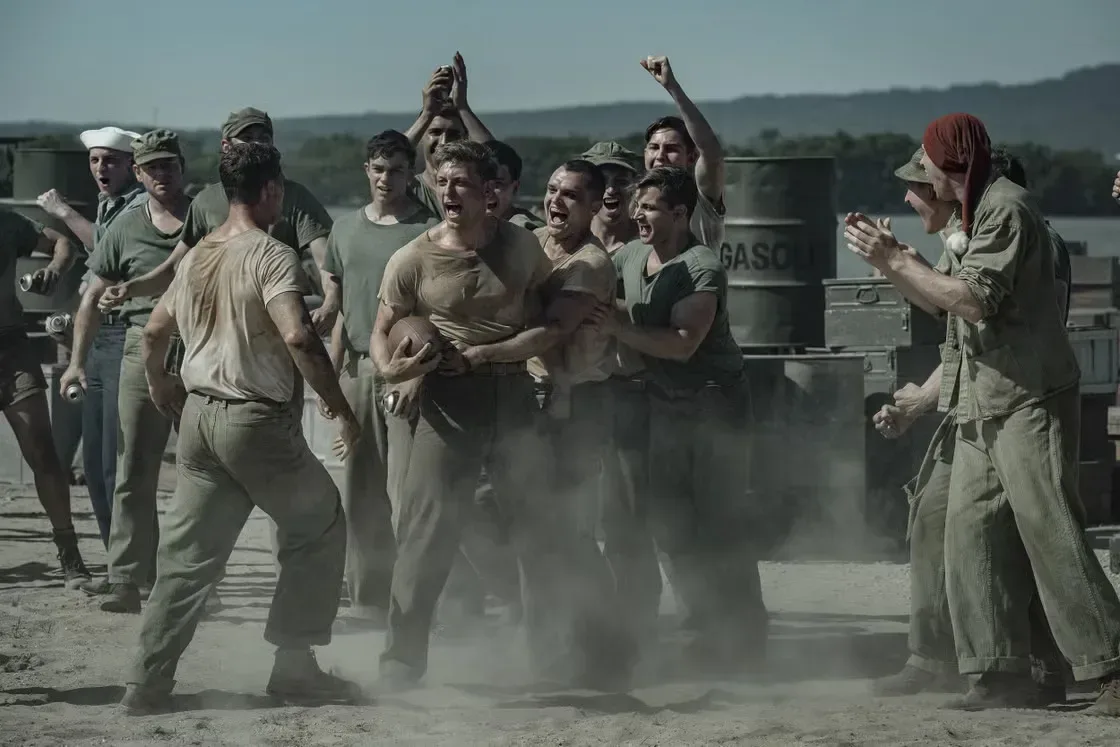
War movies are built around logistical complexity: difficult terrain, large crews, period costumes, military staging and emotionally demanding material. Yet for Peter Berg, one of the most nerve-racking moments during the Queensland, Australia production of The Mosquito Bowl came down to a single parrot.
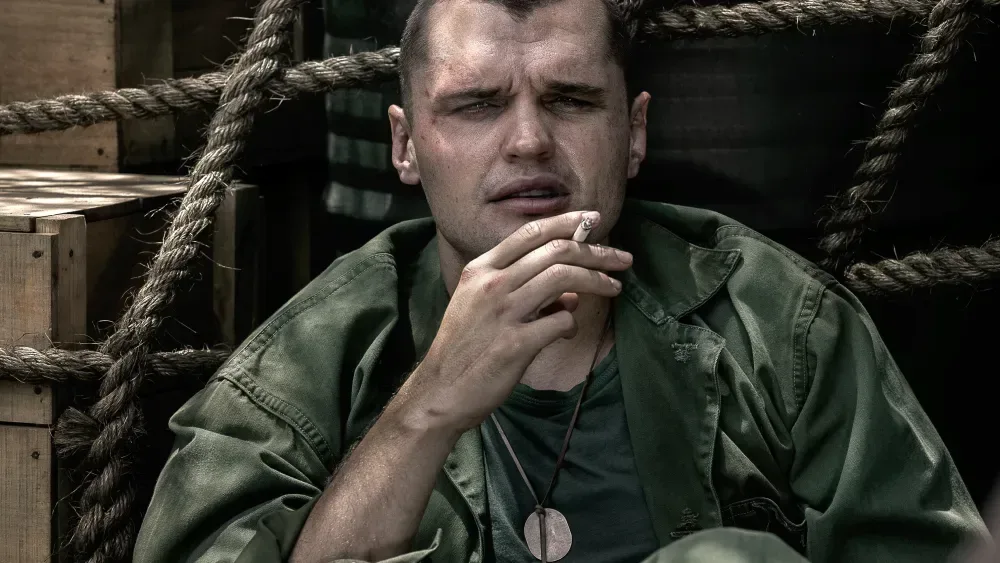
The film, adapted from Buzz Bissinger’s book, follows four college football players who enter the Marines during World War II: David Schreiner, played by Tom Francis; John McLaughry, played by Nicholas Galitzine; Tony Butkovich, played by Ray Nicholson; and Bob Baumann, played by Bill Skarsgård. The story moves from football camp to the Pacific war, but a quieter detail in the book required its own unusually high-stakes piece of filmmaking. Tony sends his parents photographs of a parrot sitting on his shoulder, and Berg decided the screen version needed that moment too.
That choice created a basic production problem. The scene was being shot in the woods in Queensland, where the team had to locate an appropriate bird and work within the requirements of its handlers. Berg handed the search to producer Alex Gayner so filming on the rest of the production could continue. By the day before the sequence was due to be filmed, the team had found a trained parrot.
A tiny story detail with a large set of constraints
On a normal set, the director gives performers direction, the crew prepares a shot, and the camera rolls. An animal scene changes that chain of command. The welfare and handling of the animal come first, particularly when a bird can be frightened by noise, unfamiliar people or sudden movement.
For more context, explore Boosie Badazz Disputes Robbery Claim in Son Ray Ray’s Louisiana Arrest, Calls It a Fight.
In this case, the parrot arrived with four handlers. Berg said their supervision was serious and that the animal’s safety was closely guarded. The director was not free to simply step in and direct Nicholson in the usual way; the handlers controlled the bird’s placement and guided the actor through the process. The crew also had to remain silent while the animal adjusted to the environment.
That waiting period is not empty downtime. “Let the parrot settle” was the essential instruction before the take. For a production, it means the desired camera setup, performance and timing all have to yield to a living participant’s behavior. The practical aim is straightforward: keep the animal calm enough to perform the limited action the scene requires without causing it distress.
Nicholson’s task was therefore more technical than it may appear in the finished movie. He used hand signals rather than spoken direction in order not to startle the bird, and Berg praised the actor’s professionalism in working within those restrictions. In a scene meant to feel like a natural character moment, the actor had to make room for an animal whose comfort set the schedule.
The parrot’s unscripted exit
The planned take did not go as expected. Berg had been told the parrot had been clipped and would not fly away. But once he called action, the bird flew into the surrounding jungle and landed high in a tree, estimated at about 100 feet.
The immediate issue was not whether the crew had missed a take. It was finding the parrot safely. Berg described panicking over the possibility that the production could be blamed for losing or harming the bird. That concern underscores why animal sequences carry a different kind of pressure from an ordinary missed mark or equipment problem: the priority is the welfare of the animal, not the day’s shot count.
Filming paused for several hours while the handlers searched. The bird was eventually located in a tree and coaxed back down. Once recovered, the parrot was fitted with what Berg described as a friendly string tied to its leg, and the crew was able to capture the scene.
The anecdote is amusing because of the mismatch between the movie’s broad canvas and the obstacle that briefly stopped it. The Mosquito Bowl covers football players becoming Marines and enduring the Pacific theater of World War II; a parrot on an actor’s shoulder is a much smaller image. But it was included because it connects directly to a documented personal detail about Tony Butkovich in the underlying book, rather than being an arbitrary bit of jungle decoration.
Why the bird belongs in the story
Period dramas often face a tension between compression and specificity. A feature film cannot include every part of a real person’s history, so any retained detail has to earn its place. The parrot anecdote offers a human-scale counterpoint to the story’s football and wartime elements. Tony’s photographs for his parents suggest an attempt to communicate something personal from a far-away setting.
That does not mean the scene needs to be large to be meaningful. A visual of a soldier with a parrot can establish a particular memory, a brief sense of companionship, or the oddity of everyday life in an extreme setting without a lengthy explanation. Berg’s decision to stage it with a real trained bird also points to the importance placed on that small historical texture.
There is a useful distinction here between historical adaptation and strict reproduction. An adaptation reshapes a book into a different medium, selecting events and images that can carry character and mood on screen. The supplied details do not establish how much of Bissinger’s book appears in the film or how the scene is framed. They do establish that this parrot image originated in the book and that it mattered enough to the production to pursue it on location.
The irony is that a moment intended to be intimate and controlled became its own miniature wilderness adventure. It also demonstrates why animal handling protocols are not mere formality. The crew’s silence, the handlers’ authority, the delay while the bird settled, and the eventual retrieval were all parts of working with a live animal rather than a prop.
A Queensland location challenge, not a digital shortcut
The production shot in Queensland, Australia, in a wooded setting that could support the jungle atmosphere needed for the film. Locations can offer visual authenticity, but they introduce variables a controlled soundstage may reduce: weather, distance, natural surroundings and—in this case—a parrot that could vanish into the trees.
The facts available do not say why the filmmakers did not use a visual effect, nor do they describe the final shot’s construction. It would be speculation to claim the parrot was used for a particular realism strategy or to assume no effects work was involved. What is clear is that the production worked with a trained live bird, and that this choice created a real-world interruption that had to be resolved before filming resumed.
The circumstances also show the division of responsibilities behind a seemingly simple image. Gayner took on the assignment of finding the animal. The handlers managed its care and on-set process. Nicholson adjusted his performance to their direction. Berg waited for approval to roll camera, then dealt with the disruption when the bird departed. A few seconds of screen time can rest on that many specialized jobs.
There is a broader practical lesson for viewers in stories like this: when a film includes an animal, the animal is not simply another cast member expected to hit a mark on command. Its needs shape the filming plan. In this instance, a scene that required quiet, patience and nonverbal communication ultimately also required a jungle search and a second attempt.
Where to watch ‘The Mosquito Bowl’
The Mosquito Bowl is now in theaters and is scheduled to debut on Netflix on November 25. For another account of the production detour, see this report on the parrot scene’s jungle detour.
As for the difficult take, the ending was considerably happier than Berg feared in the moment: the parrot was recovered, the set-up was adjusted, and the production got the shot.