Major spoilers follow for “Twelfth Night,” the Season 2 finale of Outlander: Blood of My Blood.
Outlander: Blood of My Blood has placed a baby named William at Lallybroch, in the care of newlyweds Brian and Ellen Fraser. For viewers who know the larger Fraser family history, that is not a simple act of rescue. It is a deliberately loaded development that could connect Claire Beauchamp’s previously unknown brother to Willie Fraser, Jamie Fraser’s older brother.
Importantly, the show has not confirmed that the infant William and Jamie’s book-established brother Willie are the same child. The creative team is preserving that uncertainty. But the Season 2 ending creates the exact circumstances that make the theory difficult to ignore: Claire’s infant brother is separated from his birth parents and entrusted to the couple who will become Jamie’s parents.
It is the kind of complication this universe relishes—part tragic survival story, part time-travel paradox, and part family-tree grenade with the pin already out.
What happens to William in the finale?
William Beauchamp’s fate has been one of the prequel’s most significant open questions. In the source novels, Claire’s parents, Julia and Henry Beauchamp, die in a car accident when Claire is five. The television prequel instead uses a separate continuity in which Julia and Henry travel through the same mystical stones that will later carry Claire across time. The pair wind up in 1710s Scotland, leaving the series free to explore an entirely different fate for them and for the child Julia was carrying.
That child is William. Earlier in the season, Julia learns that she is not herself capable of time travel; rather, she had been carrying someone who possesses the relevant inherited ability. The implication is that William, through Henry, has the “mystical” connection to the stones. With William born, Julia cannot simply return to her original time. The only apparent route described to regain that ability would involve another pregnancy, a prospect the story treats as an ethically fraught problem rather than an easy plot device.
Events become much more immediate before that question can be resolved. Henry is shot by Lord Lovat after being mistaken for someone else. Julia’s attempt to escape Lord Lovat’s men ends with her apparently lifeless at the bottom of a waterfall. With William suddenly left without his parents, Julia’s confidante Davina takes responsibility for protecting him.
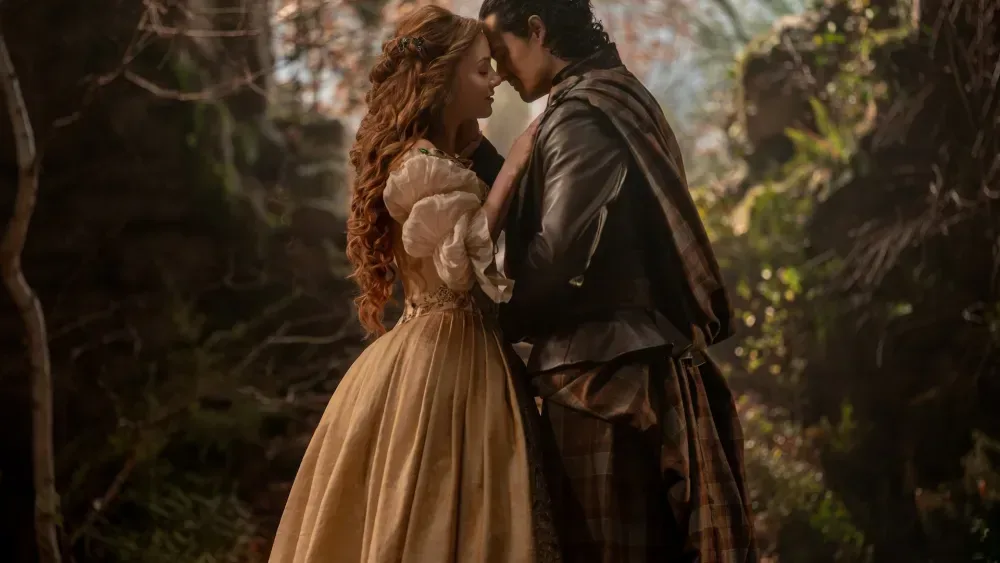
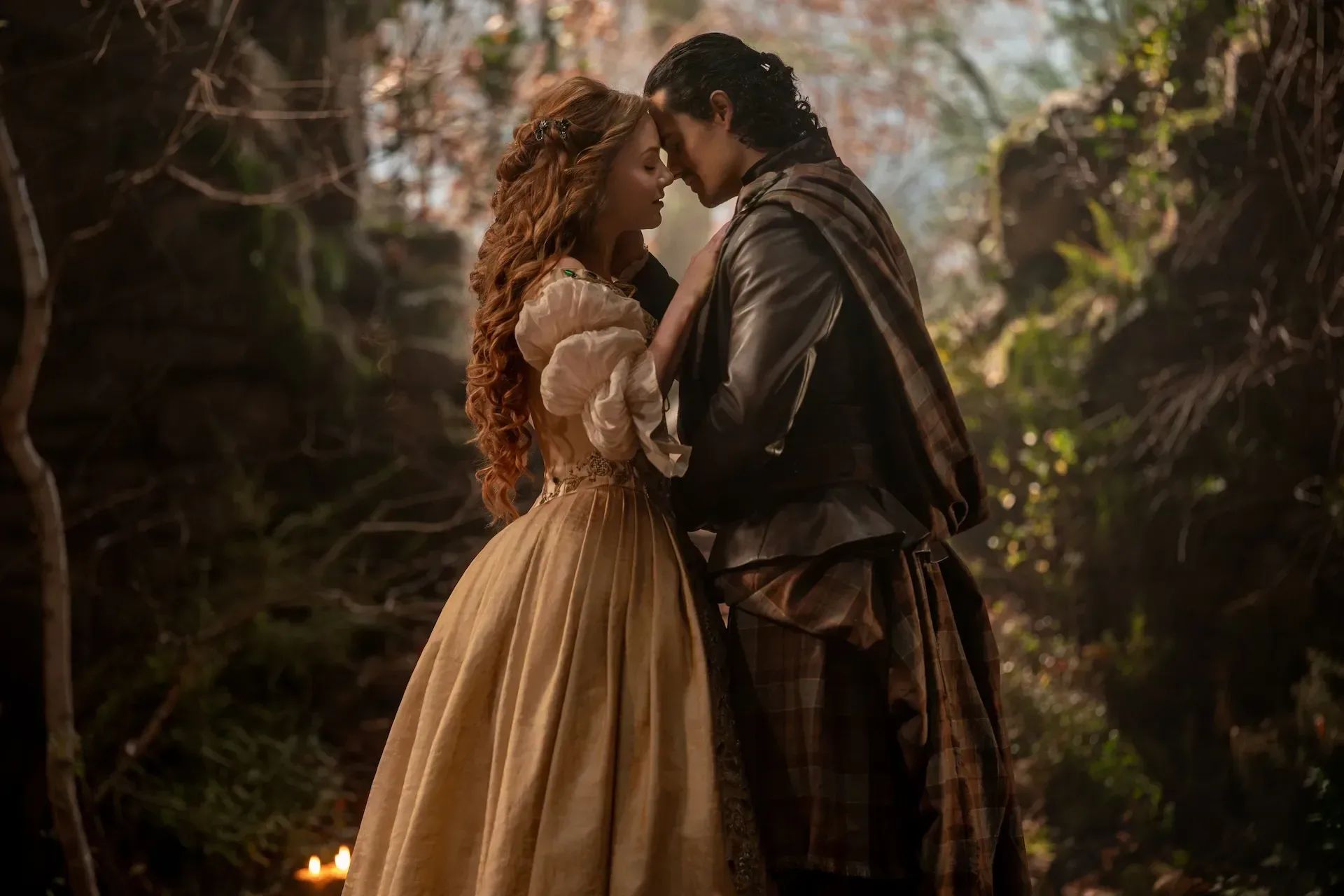
Davina’s choice is the finale’s pivotal move. She brings William to her son Brian and his new wife, Ellen, just after their wedding. The baby therefore enters the Fraser household at Lallybroch at the precise point where the show wants audiences to begin connecting names, dates and future generations.
Why the name William matters so much
Brian and Ellen Fraser are the future parents of Jamie Fraser. In Diana Gabaldon’s established book history, Jamie has an older brother named William, usually called Willie. Willie dies while Jamie is young, and that loss matters deeply to the way Jamie understands care, family and vulnerability.
The prequel’s final image does not merely introduce a child sharing a common name. It places an infant called William with the parents of the very William whose absence looms over Jamie’s childhood. In the show’s continuity, the implication could be extraordinary: Claire’s younger biological brother may have grown up as Jamie’s older adoptive brother.
That would not make Claire and Jamie blood relatives. The potential connection is through William’s upbringing, not through shared parentage. Still, it would make their already improbably interwoven lives even more tightly bound: their parents’ stories overlap in the eighteenth century, and Claire’s brother could become part of Jamie’s childhood family.
That is the emotional force of the cliffhanger. The series is not only asking whether this baby survives; it is inviting viewers to reconsider the meaning of a character who, in the wider mythology, has long been defined by his absence.
The show is holding back a definitive answer
There are reasons to resist calling the mystery solved. The people behind the series have declined to explicitly verify that William Beauchamp is Willie Fraser. Their public framing leaves room for the possibility that the two Williams are distinct people, while still emphasizing how strongly the development entwines the Beauchamp and Fraser stories.
The production also filmed alternate versions of the ending. In one unused variation, Ellen tells Brian that she is pregnant again before the baby is brought to them. That scene could have opened the door to two separate children named William: the Beauchamp infant and a future Fraser son.
However, the alternate ending should not be treated as an equal piece of current canon. It was filmed as part of an effort to protect the finale from leaked scripts and to preserve surprise. The episode viewers received is the relevant text, and that version contains no immediate confirmation that Ellen is expecting another child.
In television terms, this is a classic ambiguity rather than a continuity error. An ambiguity is information intentionally withheld so that more than one reading remains viable. The show gives the audience enough evidence to form a compelling conclusion, but not enough to turn that conclusion into an uncontested fact. The distinction matters, especially for a franchise whose television adaptations and novels do not always follow identical narrative paths.
A separate TV timeline creates room for the twist
The prequel has operated independently of the novels’ exact chronology and events since it began. That separation is central to understanding why the William question can exist at all. A strict adaptation would face much less freedom: Claire’s parents are not wandering eighteenth-century Scotland in the books, and William Beauchamp is not part of that established family record.
Instead, Blood of My Blood treats the premise as a television-specific “what if.” What if Julia and Henry lived beyond the fate written for them in the novels? What if their journey through the stones placed them in the orbit of the Frasers decades before Claire meets Jamie? And what if a child missing from the books became the mechanism that physically links those two families?
That approach can be rewarding for longtime fans because it supplies an active mystery rather than simply illustrating events whose result is already known. But it is also risky. The greater the alteration to a legacy character’s history, the more careful a show must be about the emotional logic behind it. Willie is not a blank name in the family ledger; he carries meaning in Jamie’s established backstory. Any reveal that makes him Claire’s brother would change the texture of that loss.
The finale’s restraint may be the sensible part. By stopping at the handoff to Brian and Ellen, the story lets the possibility land without yet defining every consequence. The infant has reached safety, but the identity he will grow into remains unresolved.
The timeline leaves a limited but meaningful runway
The dates attached to the wider saga add another useful layer. If the series remains broadly aligned with the book timeline at this point, Willie is born in 1716, the same year as Brian and Ellen’s wedding depicted in the finale. Jamie’s birth follows in 1721.
That creates roughly five years of story space between the Season 2 endpoint and Jamie’s arrival. It is enough time to explore a young family at Lallybroch, William’s place in it, and the continuing effects of Julia and Henry’s disappearance without immediately colliding with stories centered on Jamie himself.
The creative team has indicated that it does not want to move too directly into material involving a young Jamie. That boundary makes sense for a prequel designed to establish Brian, Ellen, Julia and Henry as protagonists in their own right. Bringing Jamie on-screen too early could shift attention toward a character already defined elsewhere, while reducing the room available for the show’s original timeline and its unresolved William mystery.
For now, there is no announced third-season renewal. That makes “Twelfth Night” a particularly sharp stopping point: it works as a major reveal if the show continues, but it also leaves viewers with a haunting possibility if it does not. William has been saved, but nobody watching can yet know whether he has also been renamed by history.
What the twist changes about Claire and Jamie
Even before the finale, the prequel had drawn Claire and Jamie’s family histories unexpectedly close. Their parents become connected by circumstance long before Claire and Jamie’s own relationship begins. The possible William reveal intensifies that idea from an alliance between parents into a shared domestic history between the children.
There is an important caveat: the twist changes interpretation more than it changes Claire and Jamie’s actual relationship. They would still meet as adults with no knowledge of this possible tie, and they would not be genetically related. But for viewers, it would recast the mythology surrounding them. Jamie may have mourned a brother who began life as Claire’s brother; Claire may have unknowingly been linked to Lallybroch before her own arrival in the past.
That is a very Outlander proposition: fate is not presented as a straight line but as a knot. Time travel does not simply transport people to historical events; it creates hidden attachments that only become visible generations later.
Elsewhere in television, shows are continuing to use changing alliances and escalating personal stakes to reshape familiar genre formulas, as seen in this look at the shifting central relationship in The Hunting Wives Season 2. Blood of My Blood takes a more genealogical route: its big complication is not a new enemy or a new destination, but a baby whose identity may redraw what audiences thought they knew.
Could the franchise go further?
The broader franchise has additional material available beyond this prequel. Lord John, portrayed in the original series by David Berry, has his own companion novel series and remains a possible subject for future screen exploration. An earlier attempt to develop that direction did not proceed, but it is still under consideration as a potential avenue.
For Blood of My Blood, though, the immediate question is much smaller and more consequential: who will William become? The finale has purposefully placed the pieces in position without locking them together in public. Brian and Ellen have a child in their home. The child is named William. Jamie’s history includes an older brother named Willie. And Claire’s family has just lost a son to the chaos of time.
Until the series supplies an answer, the strongest reading is also the cautious one: William Beauchamp may be Willie Fraser, but the show has not made that identification official. The mystery is now part of the prequel’s core promise, and any continuation will have to decide whether the emotional payoff lies in confirmation, reversal, or a complication nobody has yet calculated.