Teenage isolation is rarely tidy on screen. Jannis Lenz’s Oasis, a German-language debut feature set around a German high school and the nearby woods, approaches it as something more tangled: a private ecosystem made by three students who do not fit comfortably into the public one around them. Their friendship provides refuge, but the film’s premise refuses to label that refuge as uncomplicatedly healing.
Shown in the Horizons section at the Venice Film Festival on September 5, 2026, Oasis runs 117 minutes. Lenz directs from a screenplay written with cinematographer Alexander Dirninger, who also shot the picture. The central cast includes Florian Geißelmann as Lukas, Anton Petzold as Andi and Mathilda Smidt as Maya, alongside Godehard Giese, Britta Hammelstein and Ioana Iacob.
Three teenagers looking for somewhere to belong
Lukas is quiet, artistic and reserved. He lives with his father Martin, a teacher at his school, following the relatively recent death of his mother. That personal loss informs the texture of his home life, even when the story does not spell every emotion out. Martin and Lukas still share dinners and occasional Guitar Hero sessions, yet a widening gap begins to form between father and son.
At school, Lukas is not initially an outcast. His standing shifts after he connects with Andi, a larger, emotionally wounded boy whose father has recently been stationed at a nearby military base. Andi becomes the target of a humiliating video shared among classmates, and the aftermath of that cruelty drives much of the film’s tension. He sometimes responds with anger, which puts him under greater scrutiny from school officials while doing little to stop the harassment aimed his way.
Lukas does not consistently step in to defend Andi. Fear of becoming a target himself seems to help explain his hesitation. Still, he introduces Andi to Maya, his closest friend. Maya attends a specialized music school and appears to have a striking degree of freedom in an expansive home. Her vocal exercises, built around the repetition of consonant sounds, establish an unusual rhythm early in the film.
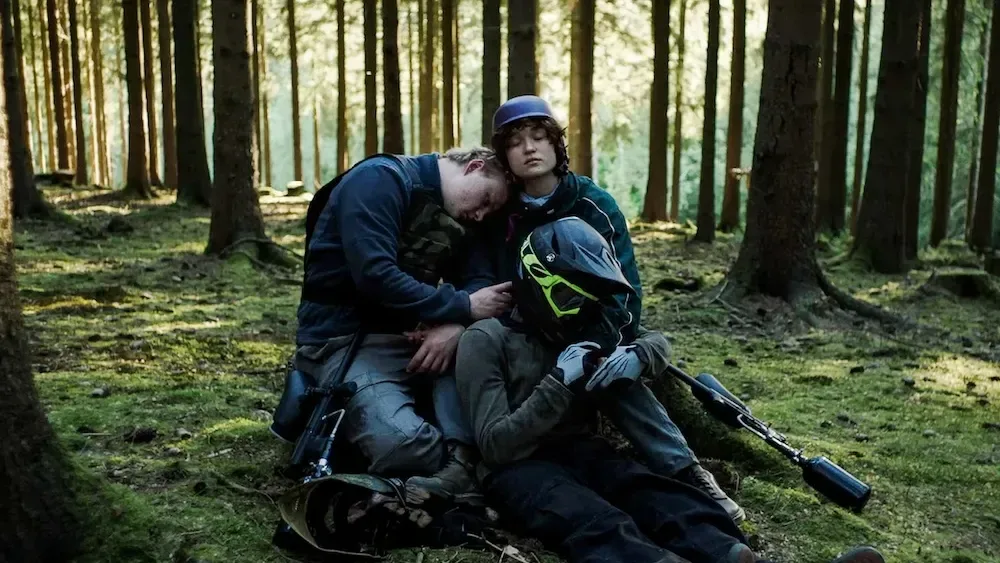
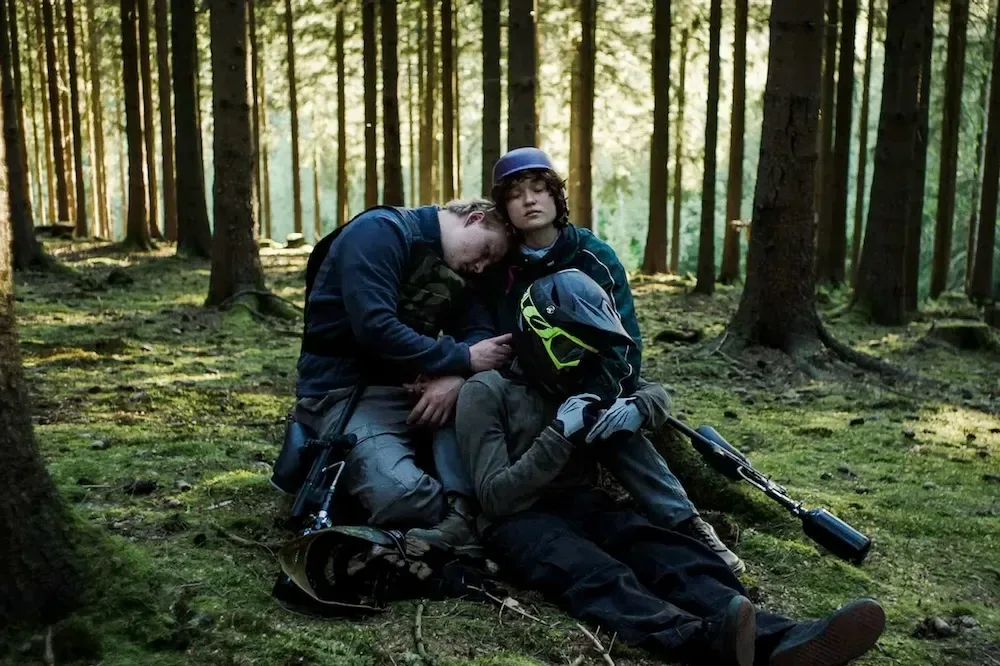
The three teenagers gradually form a unit. Their shared trips to the woods become a place apart from classrooms, parents and the rules of the school’s social order. The bond is sincere, but it is also formed amid grief, humiliation, anger and withdrawal. Oasis uses that contradiction to ask a difficult question: when a group offers acceptance that no one else will provide, how can its members tell the difference between care and dependence?
Ritual, risk and the forest beyond school
The woods are more than a backdrop. They create a separate territory where Lukas, Andi and Maya can invent behaviors and rituals without immediate adult supervision. At first, Lukas and Andi’s connection includes paintball games. One telling detail has Lukas repurposing shoulder pads from his late mother’s clothing, taping them beneath his shirt as improvised protection before facing Andi in the forest. The makeshift armor does not prevent a severe bruise.
That moment captures the film’s uneasy tone. The teenagers are not simply playing at danger, nor are they presented as easily categorized threats. Their actions can be affectionate, punishing, exploratory and alarming at once. As the trio grows closer, their rituals involve physical contact, biting, bruising and other boundary-testing behavior. The film keeps these encounters nonsexual while recognizing their intimacy and their potential to disturb.
Related coverage includes ‘Oasis’ Review: A Chilling Teen Drama About Isolation and Dependence.
Rather than treating those scenes as a straightforward path to either catharsis or catastrophe, Lenz leaves the meaning unsettled. The group may be channeling feelings they cannot otherwise articulate. Their games may offer a temporary pressure release. They may also intensify the isolation that made the friendship necessary in the first place. That ambiguity is central to the drama: the same acts that make the teenagers feel seen may further separate them from everyone else.
A scene after the first paintball pursuit places Lukas and Andi in a field, smoking and sitting largely in silence as nearby wind turbines make their heavy, repetitive noise. Sound plays a substantial role in defining the atmosphere. Nora Czamler and Benedikt Palier handle sound design, while Palier also composed the score. The combination of environmental sound and an echoing musical presence gives the teenagers’ world an unnerving, suspended quality.
Adults who see the symptoms, not the whole story
Oasis does not reserve its examination of group cruelty for teenagers. Martin, school staff, a principal, parents and a counselor all believe they are acting in young people’s interests. Yet the adults operate with incomplete knowledge of what the students are doing and why they are drawn to one another.
The counselor, played by Britta Hammelstein, attempts to turn Lukas away from Andi by framing victimhood as a personal choice. The remark is profoundly misguided, especially in a situation involving a classmate publicly humiliated by peers. It also illustrates the institutional blind spot explored by the film: adults may recognize that trouble exists while still misunderstanding its cause, its scale or the way exclusion pushes vulnerable students toward one another.
There is a parallel between the teen social hierarchy and the adult response to it. In each case, belonging can become tied to identifying a weaker person and treating them as a problem. The grown-ups have more authority and more polished language, but that does not automatically make their judgments more perceptive. Their interventions repeatedly risk making the trio’s private world feel like the only place where they can be accepted.
That theme gives the film a broader relevance without reducing its characters to a message. Bullying is not presented merely as a plot device to trigger rebellion. It is a force that changes the terms on which Andi, Lukas and Maya understand companionship. Grief is similarly not treated as a neat explanation for Lukas’s choices. The film instead places each character inside a web of pressures—family absence, school status, social media cruelty and emotional uncertainty.
A controlled debut that leaves room for discomfort
Lenz and Dirninger’s screenplay is deliberately spare, and the camera’s detached observation withholds easy answers. Viewers are often asked to sit with behavior before receiving enough context to interpret it. That formal distance suits a story about teenagers whose inner lives are largely inaccessible to the adults watching them. It also means the middle portion can feel extended, as the film insists on its cool, patient pace.
Still, the approach gives small gestures unusual weight: a taped-up shirt, a missed chance to speak up, a shared cigarette, the throb of turbines beyond a field. In a story where the characters struggle to say directly what they need, those details become the language of the film.
The final stretch moves toward an open-ended register rather than delivering a simple judgment on the trio. Are their rites an attempt to survive a hostile social environment, or preparation for something worse? Can a friendship built through pain remain a sanctuary? Oasis leaves those questions unresolved, emphasizing how fragile a private haven can become when it is built from the same wounds it is meant to protect.
For another recent look at a very different kind of cinema rooted in observation and patient craft, read our coverage of Boatbuilders.
Key credits and festival details
- Director: Jannis Lenz
- Screenplay: Jannis Lenz and Alexander Dirninger
- Cinematography: Alexander Dirninger
- Editors: Jannis Lenz and Melisa Krasniqi
- Music: Benedikt Palier
- Cast: Florian Geißelmann, Anton Petzold, Mathilda Smidt, Godehard Giese, Britta Hammelstein and Ioana Iacob
- Production: Zeitgeist Filmproduktion, Third Picture and Wega Film
- Language: German
- Running time: 117 minutes