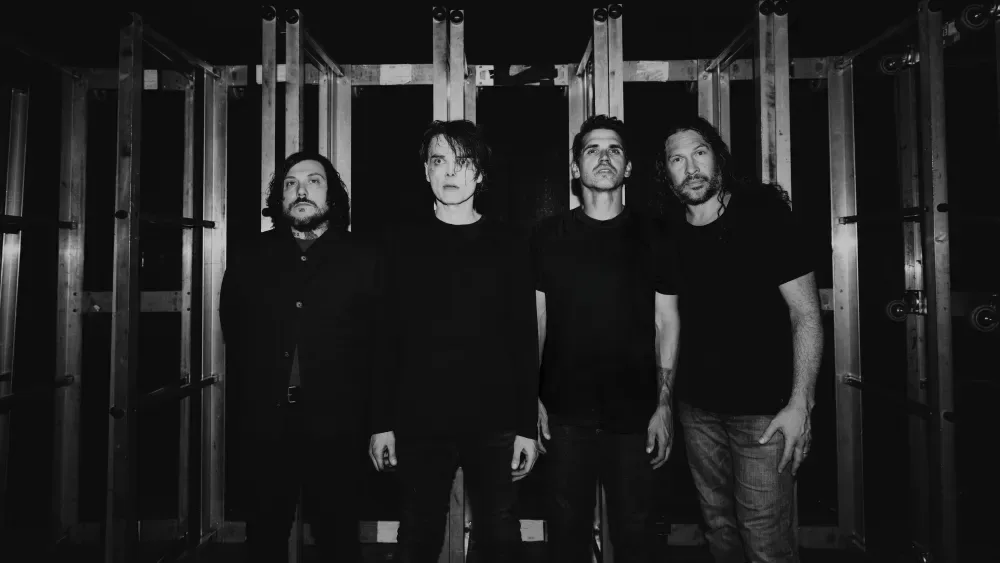
My Chemical Romance have reached the top of the Billboard 200 for the first time, with The Black Parade vaulting from No. 139 to No. 1 following a deluxe 20th-anniversary reissue. The album earned 78,000 equivalent album units in the tracking period, turning an anniversary campaign into an unusually large chart event for a record first released in 2006.
The result is striking on its own: The Black Parade originally arrived on October 23, 2006, and peaked at No. 2. It was already the group’s highest-charting album before this resurgence. Now, two decades later, it is both their first No. 1 and the album that has delivered the longest wait for a return to the summit in Billboard 200 history.
It also marks the first anniversary album to debut at No. 1. That distinction captures what makes this week different from a routine nostalgia bump. This was not merely an older record drifting upward on renewed attention; its deluxe edition, the scale of its anniversary celebration and its durable identity as an album-length work all converged into a major commercial moment.
From No. 2 to the chart summit
When The Black Parade first peaked at No. 2, it represented a significant step forward for My Chemical Romance. The quartet expanded the scope of its prior work with a theatrical rock opera that built songs around a shared world and a larger dramatic sensibility. “Welcome to the Black Parade” and “Teenagers” became its best-known songs, but the record’s reputation has long rested on the way its pieces fit a broader album experience.
That distinction matters when considering why a 20-year reissue can mobilize listeners and buyers on this scale. A hit single can find new life independently, especially in the streaming era. But an album designed to be approached as a complete statement has another route back into culture: it can be revisited, re-presented and celebrated as a full work. The Black Parade has had that kind of staying power.
The current No. 1 is therefore not a rewrite of what happened in 2006. The original peak remains No. 2, and that release still defines the moment the album first met the public. Instead, the new chart position documents a second, distinct moment in its life: one in which a deluxe reissue gave audiences a reason to engage with the record again, while the anniversary put a clear frame around its legacy.
What “equivalent album units” means
The 78,000 figure is expressed in equivalent album units, the measurement used by the Billboard 200 to combine several forms of music consumption into one album-chart total. In practical terms, it does not refer solely to traditional album purchases. The metric also accounts for consumption through streaming and individual song activity using chart formulas that translate those activities into album-scale units.
That makes equivalent units a useful measure for understanding an album’s overall commercial footprint in a given week. A deluxe reissue can be especially suited to this framework because it gives multiple types of listeners a reason to participate. Longtime fans may return to the album in full; listeners who know its biggest songs may explore more deeply; and people interested in the anniversary edition have a newly defined version of the record around which to focus.
Related coverage includes My Chemical Romance’s The Black Parade Reaches No. 1, 20 Years After Release.
The supplied chart result does not break down the 78,000 units by format or consumption type, so it would be speculative to assign the No. 1 to one particular behavior. What is clear is that the reissue was substantial enough in total to move The Black Parade 138 positions in a single week, from No. 139 to first place.
A record-setting wait, and why it stands apart
The gap between the album’s original release and this No. 1 makes the achievement historically unusual. My Chemical Romance have now set the longest wait for an album to return to No. 1, overtaking the nearly 16-year gap associated with Toby Keith’s 35 Biggest Hits after his death in 2024.
There is an important difference between an artist having a first No. 1 decades into a career and an individual album reaching the summit long after its initial run. In this case, the same album that stopped at No. 2 in 2006 has eventually made the final step to No. 1. The delayed victory belongs specifically to The Black Parade, not just to My Chemical Romance’s catalog as a whole.
The chart accomplishment also gives the album an unusual dual identity. It is a product of its original era, with a legacy tied to the songs and visual world that made it resonate in 2006. At the same time, it is now a contemporary chart leader, competing in the same current-week ranking as new releases and recent albums. Few anniversary campaigns can make that transition so visibly.
The Hollywood Bowl shows put the album’s world back onstage
My Chemical Romance marked the 20th anniversary with five shows at Los Angeles’ Hollywood Bowl. At those concerts, the group performed The Black Parade in its entirety and brought its fabled world to the stage.
Performing an album in full is significant for a work described as a rock opera. A rock opera is broadly an album that uses rock music alongside an overarching narrative, characters or dramatic conceit, rather than operating only as a disconnected collection of songs. The form encourages audiences to take in sequencing, atmosphere and recurring ideas, not simply wait for a few familiar tracks.
That context helps explain the importance of staging the full album rather than a standard greatest-hits set. The Hollywood Bowl run positioned the anniversary around the scale and continuity of The Black Parade. For people discovering it now, that offers a clear invitation to hear the album as a designed whole. For listeners who have carried it with them for years, it supplies a communal way to revisit the record’s theatrical ambition.
Anniversary events cannot by themselves explain every chart movement, and the available information does not quantify their separate impact. Still, the concerts and deluxe reissue point in the same direction: the campaign treated the album as an active piece of culture rather than a museum object. The No. 1 result suggests that approach found a substantial audience.
Why the distinction matters for an anniversary reissue
Reissues often prompt a narrow conversation about nostalgia. That is part of the picture, but it does not fully describe an album climbing to the top of a major current chart 20 years after release. Nostalgia can reopen the door; a record still needs an identity strong enough to make people enter.
The Black Parade has that identity in its music, its high-concept presentation and the continuing recognition of songs including “Welcome to the Black Parade” and “Teenagers.” Its original success established the foundation. The 20th-anniversary edition and live presentation provided the occasion. Together, they demonstrate that legacy releases can function as more than archival products when the underlying album remains meaningful to listeners.
The moment also reinforces a basic point about music charts in the streaming-and-reissue era: release dates tell only part of an album’s story. A record can have its initial commercial peak, a long period of catalog life and then a powerful new chapter when an anniversary, expanded edition or live event brings it back into focus. The Billboard 200 reflects that renewed attention alongside brand-new projects.
Elsewhere in the current top 10, Olivia Rodrigo’s You Seem Pretty Sad for a Girl So in Love moves from No. 1 to No. 2. Morgan Wallen’s I’m the Problem, Ella Langley’s Dandelion and Noah Kahan’s The Great Divide follow at Nos. 3 through 5. Taylor Swift’s The Life of a Showgirl, Zach Bryan’s Young Manhood and Other Donatable Organs, Kahan’s Stick Season, Drake’s Habibti and Olivia Dean’s The Art of Loving complete the top 10.
For My Chemical Romance, however, the central number is one. Twenty years after The Black Parade first reached No. 2, the album has completed an extraordinarily delayed climb to the position it never held in its original release cycle. For another look at how artists can connect personal history and new music, see Bktherula’s family-centered “JEVITAS” collaboration.