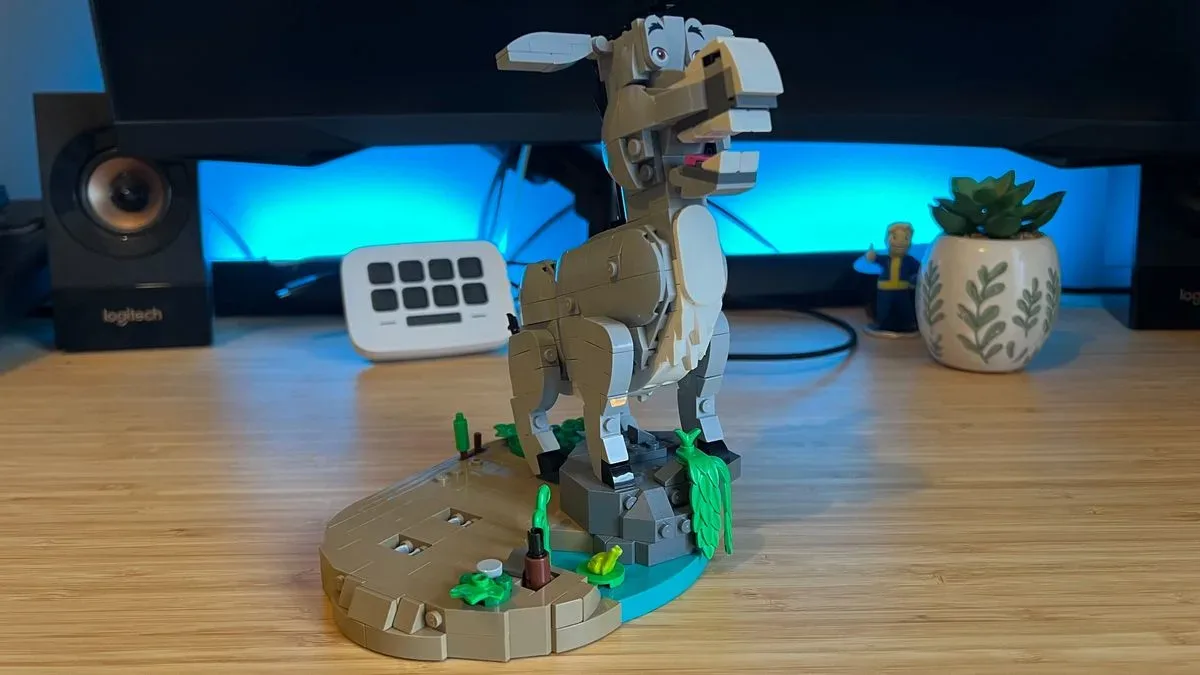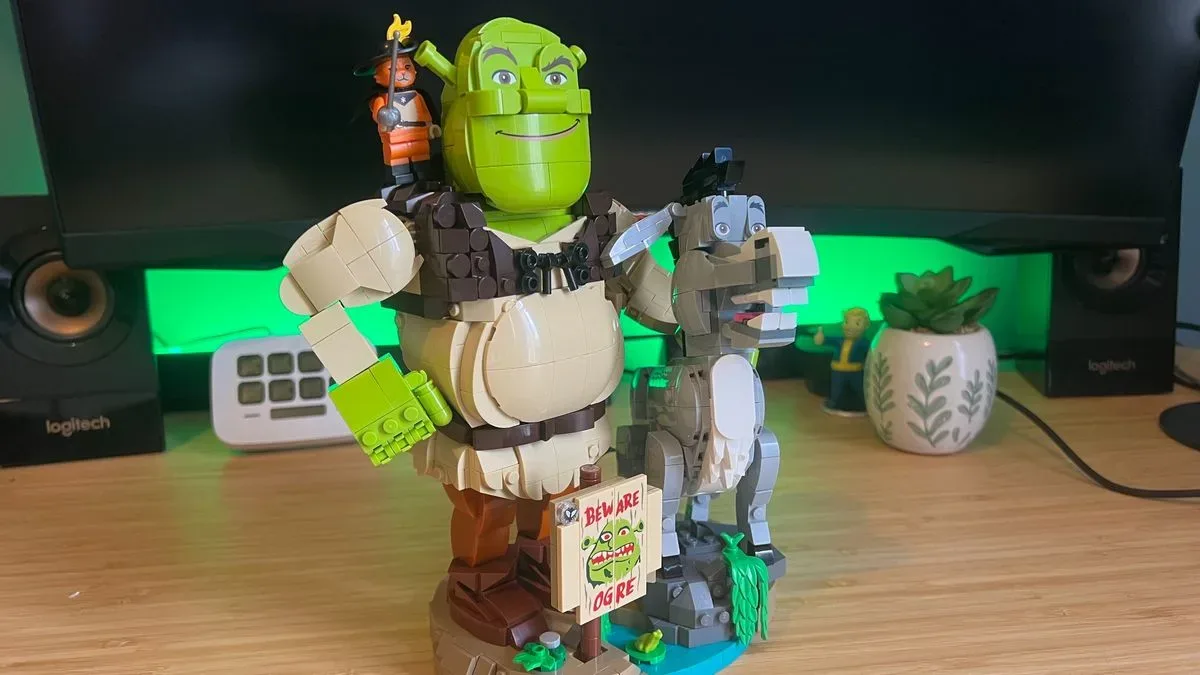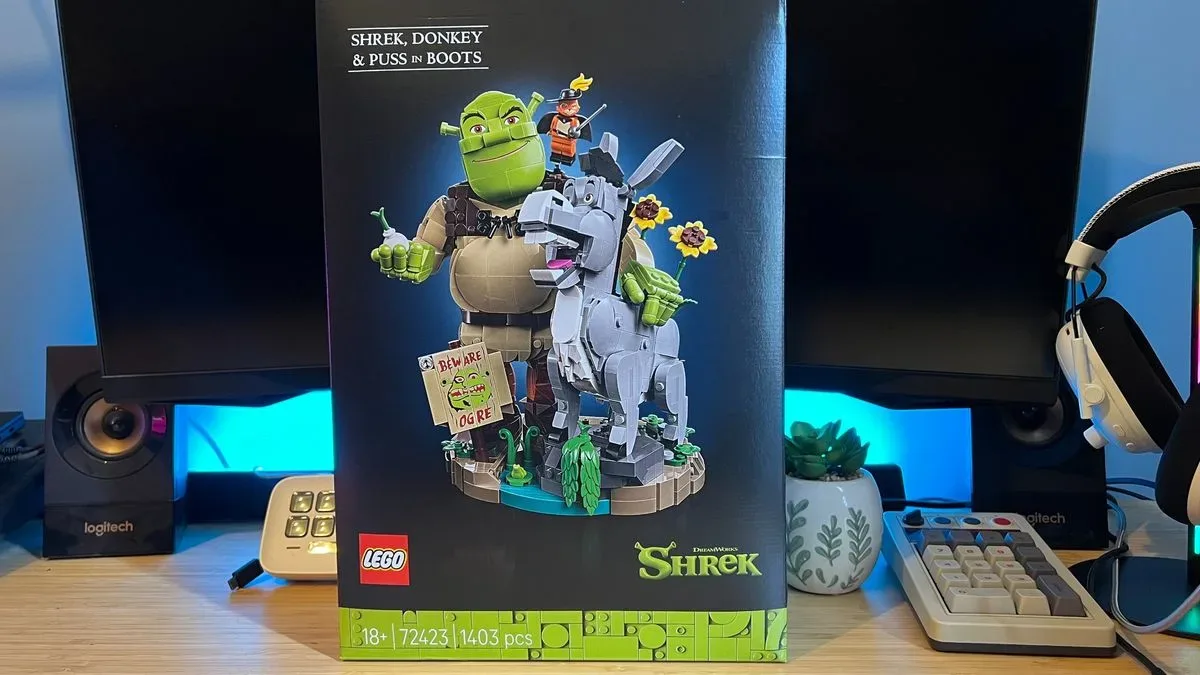
LEGO’s Shrek, Donkey & Puss in Boots set is built for the sort of fan who wants an unmistakable slice of swamp on a shelf rather than an action-heavy playset. Set number 72423 contains 1,403 pieces and depicts Shrek alongside Donkey on a compact environmental base, with Puss in Boots represented as a minifigure. The finished model measures approximately 9.5 inches high, 8.5 inches wide and 6 inches deep.
At $129.99 in the US and £109.99 in the UK, it occupies a display-oriented price bracket. LEGO lists the set for ages 18 and up, and the construction is described as medium complexity, with an estimated build time of four to five hours. Its appeal is not sheer scale or mechanical movement: it is the effort spent making famously rounded, expressive characters read convincingly through plastic bricks, curved elements and small scene details.
A compact diorama with a lot of Shrek-specific detail
The central challenge of a build like this is simple: Shrek and Donkey are not naturally block-shaped. A successful brick-built character has to use slopes, curved corner components and small texture pieces to soften the rigid grid of the medium. This set reportedly leans hard on those parts, especially around corners, joins and the figures’ outlines, giving the scene more visual texture than a simpler large-piece sculpture could achieve.
That density is important to the final effect. Although the display’s footprint is modest, its 1,403 pieces are not devoted merely to making it bigger. Many are smaller elements intended to break up flat surfaces and create texture in Shrek’s clothing, Donkey’s mane and the surrounding swamp setting. In practical display terms, it is a set designed to reward viewing up close rather than from across a room.
For more context, explore AI Game Mashup Mods Are Going Viral, but a Clever Clip Isn’t a Playable Game.
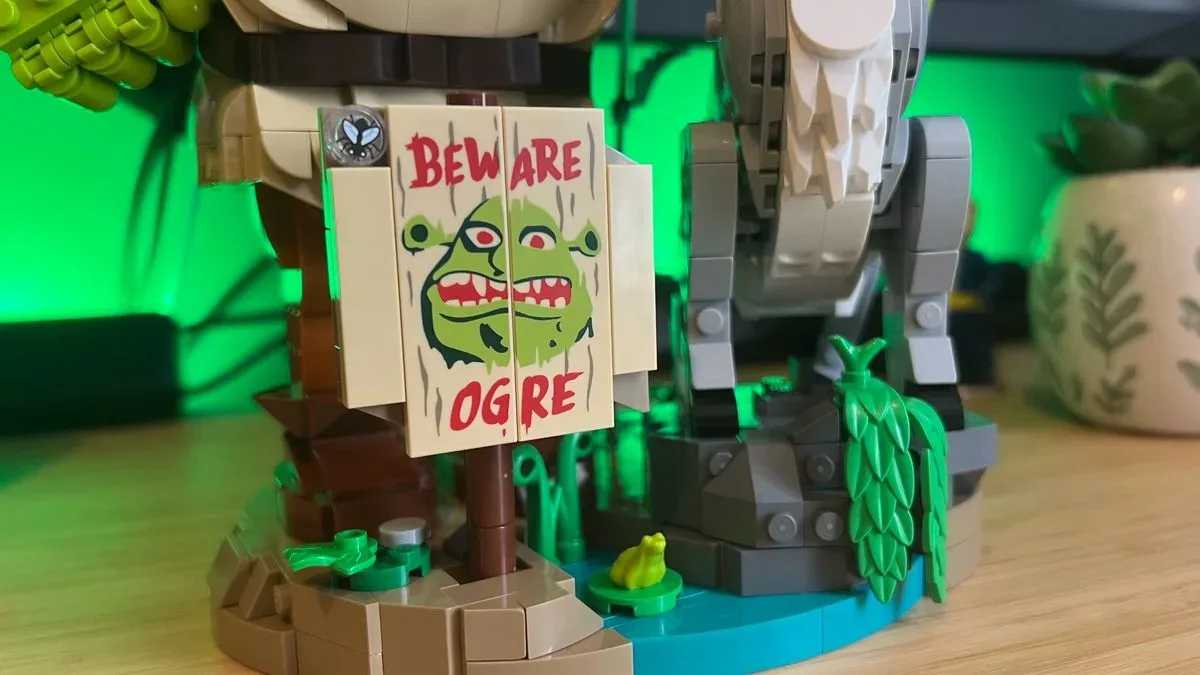
Seven printed elements are included, with prints developed for the characters’ faces and the front-facing “Beware Ogre” signpost. Printed elements are bricks or pieces whose decoration is applied during manufacturing, rather than graphics supplied on a separate adhesive sheet. For a display model, that means the important facial and sign details are integrated components rather than stickers that need careful alignment. The set reportedly contains no stickers.
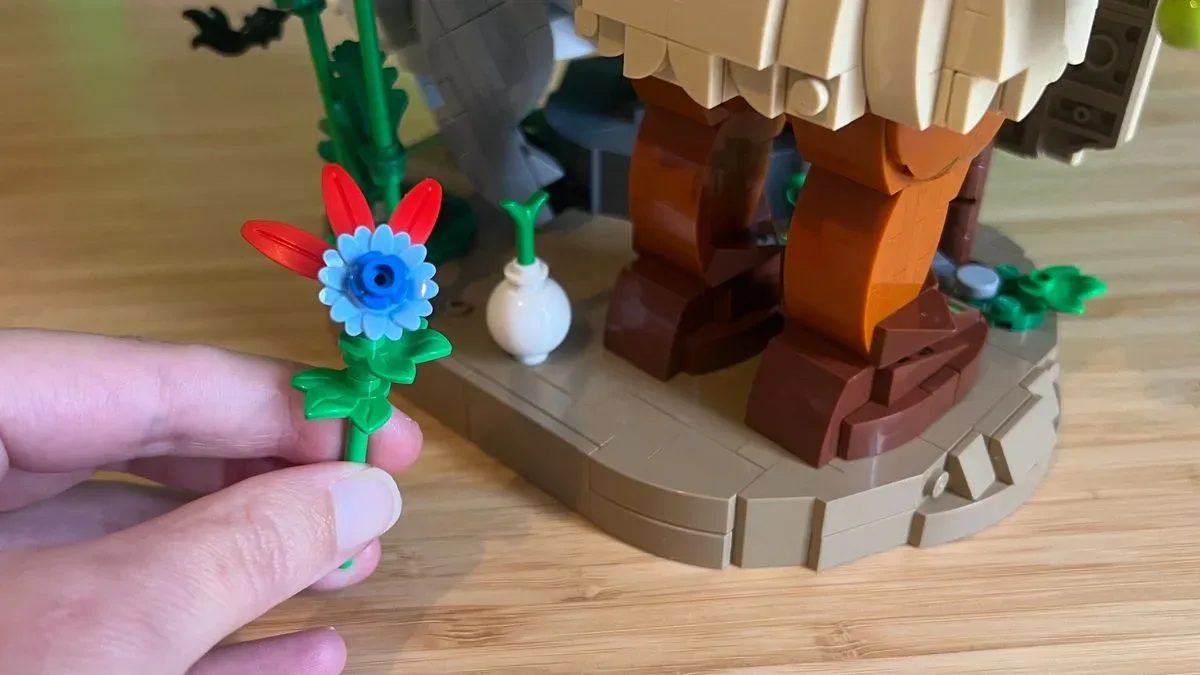
The environmental references are doing considerable storytelling work. A blue flower with red thorns, a hidden onion near the back of the base and the signpost provide small callbacks for viewers who know the first film. They also help prevent the build from becoming a plain character statue: the swamp is part of the joke, setting and identity of the display.
How the build is structured
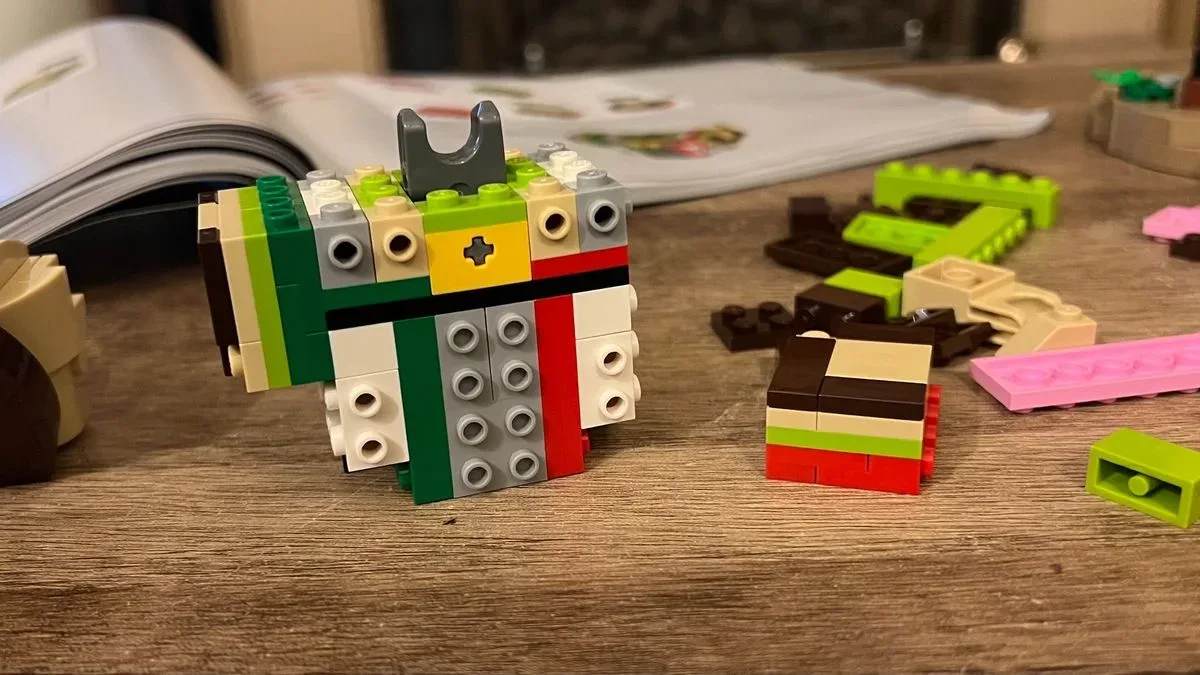
The assembly process moves through the base and Donkey first before turning to the larger Shrek figure. Bags one through four cover the swamp environment and Donkey, while bags five through 10 focus on Shrek. That organization means builders see the diorama form in stages rather than repeatedly hopping from one distant section to another.
Related coverage includes LEGO Shrek, Donkey & Puss in Boots Review: A Surprisingly Charming Swamp Display.
Most of the construction is reported to be approachable, but the legs are a more demanding section. Similar assemblies, multiple rotations in the instructions, and work on both the upper and underside of the base make that area easier to misread than the rest of the model. A bright building space may also be helpful around the darker brown pieces used for Shrek’s clothing, whose shading can be harder to distinguish in printed instructions.
There is also a thoughtful visual aid for orientation: internal components that need to be treated as left or right are separated with red and green coloring. That does not affect the finished exterior, but it can reduce a common problem in symmetrical character builds, where a correctly assembled section can still be attached on the wrong side or in the wrong direction.
One of the more inventive reported part uses is around Shrek’s tunic. Black mechanical claws combined with horizontal bar plates form the apparent strings on the garment. This is a good example of the model’s core design approach: familiar LEGO parts are used less for their literal real-world identity than for their shape, silhouette and ability to create small visual flourishes.
Shrek is the display’s strongest component
Shrek appears to be the set’s main success. Character builds can become uncanny when eyes, brows and mouths are translated too directly into hard-edged bricks. Here, the mix of printed facial pieces, curves and smaller components reportedly helps the ogre retain a recognisable expression without looking like an oversized, squared-off approximation.
The model is also engineered primarily for stability on its base. Shrek is supported by two ball joints beneath his feet and is connected to Donkey’s side by studs. Ball joints are spherical connectors that allow parts to rotate; in this case, they help position the feet while keeping the character anchored. The arrangement leaves the figure secure when displayed, although some movement at the feet can produce a slight wobble when the entire diorama is carried.
That distinction matters for prospective owners. A model can be stable on a shelf without being ideal for frequent relocation. Anyone planning to move it between rooms, conventions or changing displays should treat it as a compact sculpture rather than a rigid, grab-and-go object. Donkey is built directly into his boulder, which gives that part of the composition a more fixed foundation.
The trade-off for that anchored construction is limited posing. Shrek’s left arm can move, while Donkey’s mouth and ears offer some adjustment, but the larger figures are not built as freely articulated toys. That is not necessarily a flaw in a display-first release, though it does clarify what the premium buys: texture, character likeness and references, rather than a wide range of alternate poses.
Donkey delivers texture, while Puss feels secondary
Donkey has a different visual problem from Shrek. His narrow body sits beside the much larger ogre, and his form reportedly reads slimmer and flatter than expected in comparison. Still, the build includes detailed texturing around the white front stripe and mane. Jagged pieces, including 1x2 Rock Claw elements, add a rougher surface than ordinary studs would provide.
In LEGO terminology, a stud is the small raised connection point commonly found on top of a brick. A surface built only from visible studs can feel uniform. By mixing in pieces with claws, slopes, edges and other irregular profiles, designers can suggest fur, fabric ruffles or rugged terrain without changing the fundamental brick system. The same Rock Claw parts reportedly contribute to the detail in Shrek’s tunic, making them a recurring part of the set’s textural language.
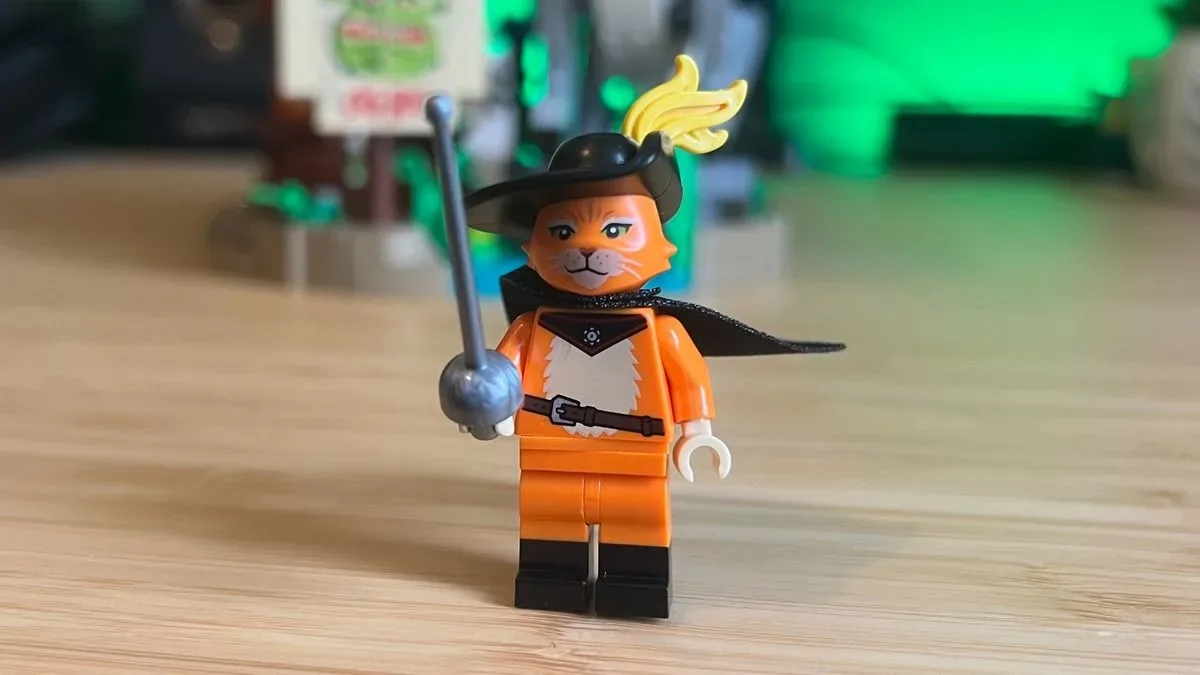
Puss in Boots is the comparative weak point. Instead of receiving a large brick-built treatment alongside Shrek and Donkey, he arrives as the set’s sole minifigure, equipped with his hat, sword, cape and printed boots. The accessories establish the character clearly, but the different scale is especially conspicuous: his head and much of his torso are roughly comparable with one of Shrek’s eye-and-brow areas. His brighter coloring also stands apart from the greens and browns that dominate the main scene.
For buyers, the key question is whether Puss is a bonus or the reason for purchase. As an extra character and an appropriately themed minifigure, he broadens the package. As a fully equal part of a three-character display, he is far less substantial than the set name might imply.
Who this set best suits
This is most naturally a purchase for adult Shrek fans who value references and finished presentation. The onion, flower, signpost and printed faces provide more value to someone who recognizes the visual language of the films than to a builder looking purely for advanced techniques or abundant articulation.
- A strong fit for: collectors seeking a compact licensed display, builders who enjoy dense character texturing, and fans who appreciate film-specific environmental details.
- Less suitable for: buyers wanting broad poseability, anyone who regularly transports their models, or shoppers primarily interested in a large-scale Puss in Boots build.
- Worth noting: the 18+ label, 1,403-piece count and four-to-five-hour estimate point toward a relaxed display build rather than a quick toy assembly session.
The result is a set with a focused identity. Its best ideas are not huge mechanisms or a sprawling backdrop, but the calculated use of curves, printed pieces and carefully chosen details to sell an unlikely brick interpretation of Shrek. The limited articulation and undersized Puss make the value proposition more specific, not universal. But for an owner whose priority is a recognisable, reference-rich swamp scene, LEGO set 72423 has the right ingredients.