
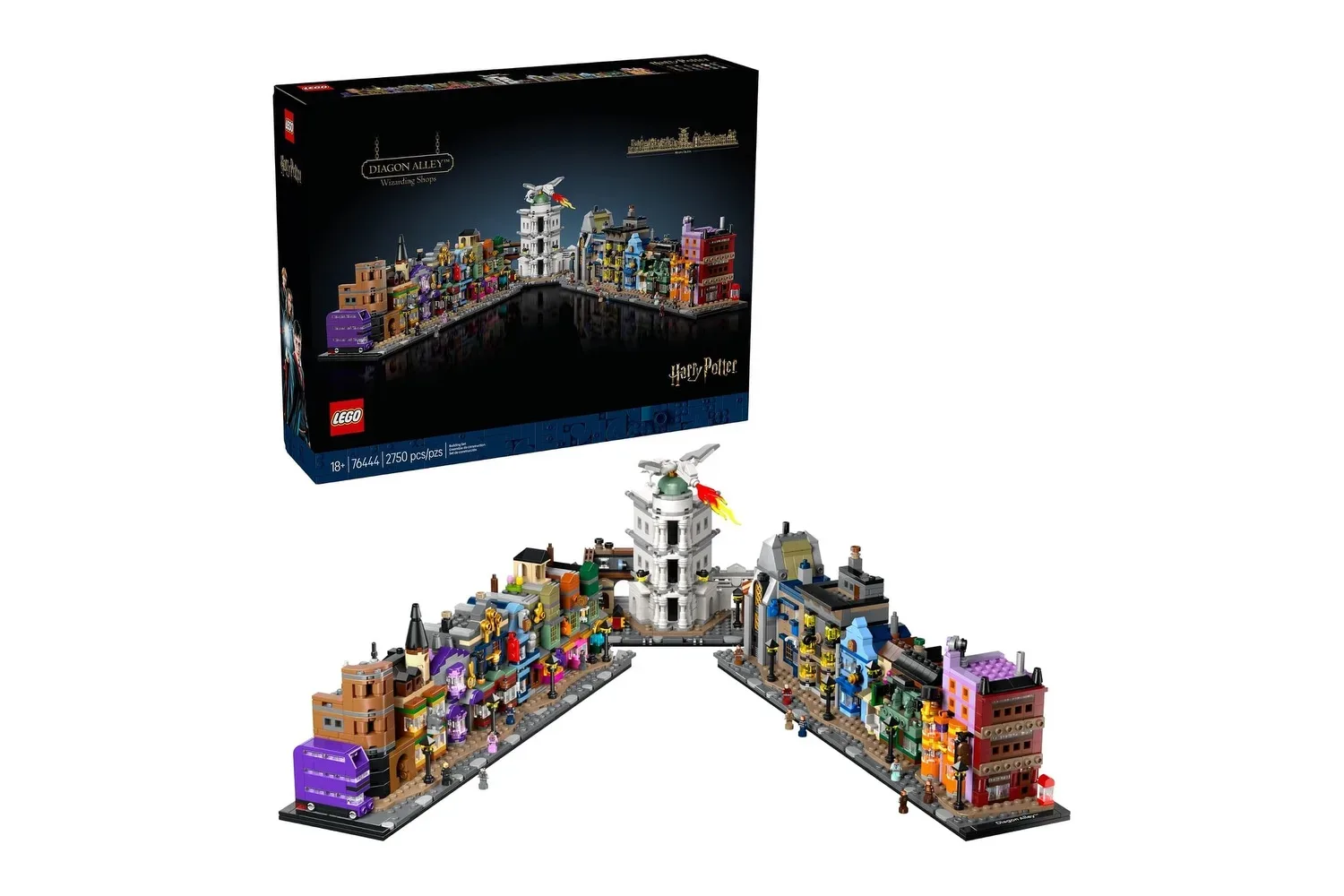
LEGO’s Harry Potter Diagon Alley Wizarding Shops was listed at $160, down from $200. That is a $40 reduction, or 20% off the stated regular price, for a 2,750-piece display model built around the wizarding world’s shopping street.
The set is aimed at builders aged 18 and over and takes a deliberately different approach from a single, large minifigure-scale building. It uses micro-scale: a smaller model scale in which the street’s architecture and vehicles are compressed to make a broad location practical as one shelf display. The trade-off is clear in a good way. Individual shops are miniature representations rather than full room-by-room structures, but the completed model can depict a much wider slice of Diagon Alley at once.
Its 12 included microfigures provide character-level detail at the same scale as the shops. Harry Potter, Ron Weasley and Hermione Granger are joined by Fred and George Weasley, Ginny Weasley, Draco and Narcissa Malfoy, Lavender Brown, Mr. Borgin, Madam Malkin and Mr. Ollivander. The purple Knight Bus is also part of the street scene.
A compact take on a very crowded wizarding street
Diagon Alley works particularly well for this format because its appeal comes from density: a long line of unusually shaped storefronts, competing signs and instantly recognizable destinations. The model includes Gringotts Wizarding Bank, Ollivanders, Weasleys’ Wizard Wheezes, the Leaky Cauldron and Florean Fortescue’s Ice Cream Parlor. Other represented locations include Eeylops Owl Emporium, Flourish and Blotts, Quality Quidditch Supplies, Madam Malkin’s Robes for All Occasions, Mr. Mulpepper’s Apothecary and The Daily Prophet Headquarters.
That list helps explain the set’s purpose. This is less a recreation of one scene than a location-focused display that brings together places associated with wand shopping, joke-shop visits, books, robes, banking and the surrounding magical bustle. Recognizable exterior details do much of the storytelling at this scale, while references to the films are tucked within the model.
The bank sits at the end of the alley in its street configuration, making Gringotts a visual destination rather than just another storefront. Meanwhile, the Knight Bus gives the largely shop-fronted display a distinct vehicle and a contrasting burst of purple.
What “modular” means for this display
The key feature for prospective owners is the set’s modular design. A modular model is constructed in separable sections rather than as one permanently fixed block. Here, the entire street can be divided into five modules. That matters more than it may initially seem for a model with a large footprint, because collectors can alter the presentation without needing to rebuild the whole thing from loose bricks.
There are three stated ways to arrange it:
Related coverage includes LEGO Harry Potter Diagon Alley Wizarding Shops Drops to $160 on Amazon.
- Double-sided street: Shops face one another, with Gringotts at the end of the alley.
- Long single row: The buildings form one extended display, approximately 34 inches long.
- Five separate modules: Individual areas can be spread across a shelf or arranged to make particular storefronts easier to see.
For a display purchase, that flexibility is practical rather than merely decorative. A 34-inch line needs a long, uninterrupted surface. Splitting the model gives owners more options when a shelf, desktop or media console cannot accommodate that width. The opposing-street setup also changes the way the set is viewed: it emphasizes the feeling of moving through an alley rather than surveying a façade from one side.
Microfigures support those layouts by maintaining proportional consistency. Standard LEGO minifigures would visually overwhelm micro-scale buildings; the smaller characters instead read as inhabitants of the miniature street. They can be used to suggest familiar activities such as visiting Ollivanders for a wand or browsing Weasleys’ Wizard Wheezes, without turning the display into a full-scale playset.
Build structure and digital instructions
The build is divided across 21 bags. For a set of this size, staged bagging is useful because it breaks a large project into manageable construction phases and helps builders keep the parts for each section separated. The model is positioned as an extended, display-oriented build rather than a quick afternoon assembly.
Instructions can also be viewed through the LEGO Builder app, which offers three-dimensional instructions and progress tracking. In practical terms, 3D instructions allow a builder to rotate and inspect the digital representation of a step. That can be especially handy on a densely detailed micro-scale project, where the orientation of a small part may be harder to identify in a fixed image alone.
Nothing in the listed details suggests that the digital tools replace the central appeal of the physical build. Instead, they are an optional way to follow the construction while the model moves from its early modules into the finished street.
Who this set makes sense for
The strongest case for Diagon Alley Wizarding Shops is for an adult Harry Potter fan who wants one substantial, adaptable display piece rather than a model devoted to one building or character. Its value is in the collection of locations and the ability to decide how much of that collection is shown together.
It may also suit LEGO builders who enjoy architectural detail at a reduced scale. Micro-scale does not mean a lack of complexity; it means details need to communicate a location with less physical space. In this case, the set relies on shop silhouettes, façades, the terminating bank and the Knight Bus to make the alley legible.
Buyers primarily seeking large, poseable character figures should recognize the format before deciding. These are microfigures, designed to belong within the street rather than operate as standalone, standard-size minifigures. Conversely, that is exactly what makes the set cohesive as a cityscape-style display.
For fans tracking screen-franchise collectibles beyond the wizarding world, there is also plenty happening elsewhere in pop culture, including recent discussion around Anthony Mackie, Paul Bettany and Avengers: Doomsday.
The price point in context
The reported $160 listing represents 20% off the stated $200 price, reducing the upfront cost by $40. As with any retailer listing, availability and pricing can change, so the figure is best treated as a snapshot of the listed offer rather than a permanent price.
At that price, the package includes 2,750 pieces, 12 microfigures, the Knight Bus, numerous named wizarding-world businesses and a five-module layout system. The decision is therefore less about adding one more small Harry Potter scene and more about whether there is room for a configurable, location-driven Diagon Alley display.
Shop the products
Check current price, model and availability at the retailer.