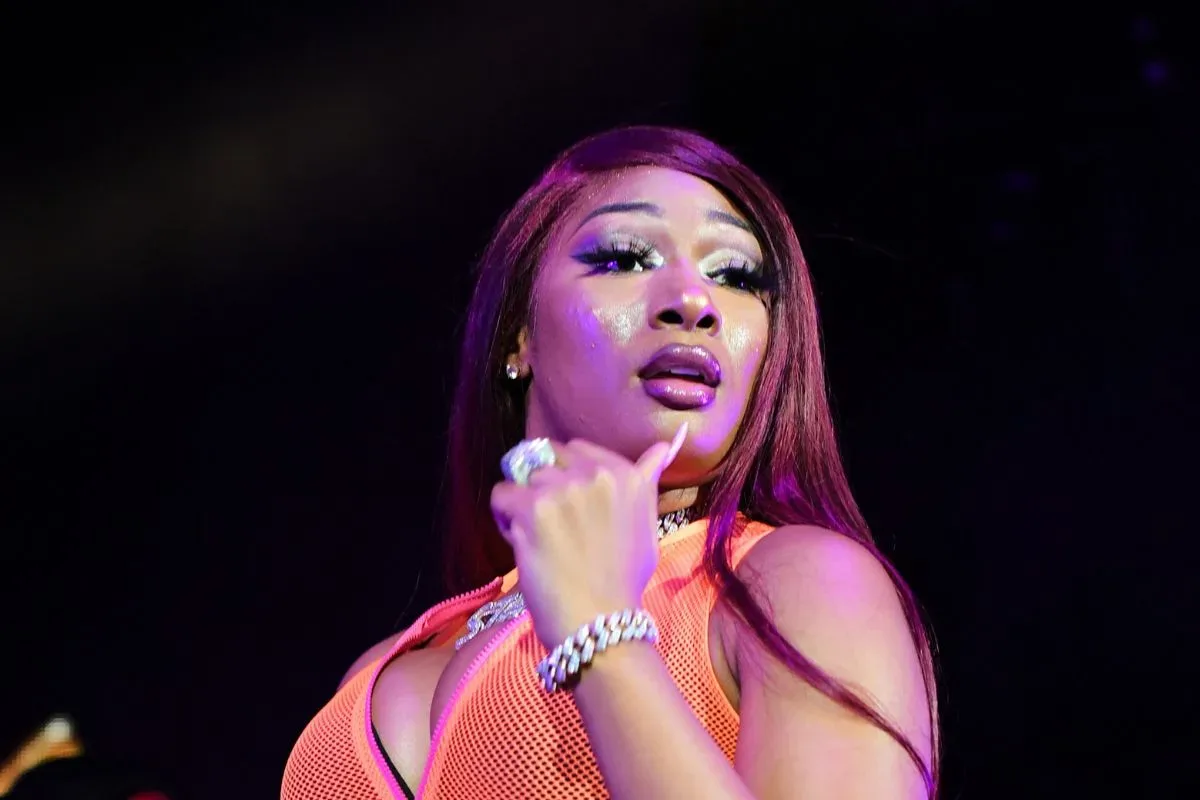
Megan Thee Stallion has challenged Instagram after an AI-related label appeared on photographs from the 2026 CFDA Awards, arguing that the platform had mistakenly treated a documented red-carpet look as computer-generated imagery.
A fan-shared screenshot showed the rapper’s succinct response to the designation:
“AI couldn’t generate this lol @instagram fix this please.”
The disputed images were taken at Monday night’s CFDA ceremony at the American Museum of Natural History in New York. Megan wore a custom Kim Shui gown featuring lacing, cutouts and crystal embellishments, styled by Isiah Ahmad with Lorraine Schwartz jewelry and Jimmy Choo pumps. The setting, event and outfit matter because this was not an unattributed picture moving through social media without context. It was professional event photography from a highly visible fashion occasion attended by entertainers including Travis Scott, PinkPantheress, Keke Palmer and Lupita Nyong’o.
As of early Thursday, there was no public explanation for why those particular photos received the label. That missing explanation is central to the dispute: viewers can see the warning, but not necessarily the technical signal or workflow that led Instagram to display it.
Why an AI label can mean more than users think
An AI label is intended to help people assess what they are looking at. In the simplest case, it signals that artificial intelligence played a role in creating or altering an image. That is a reasonable goal at a time when generated pictures can be convincing enough to circulate as ordinary photography.
The complication is that “AI” is not a single, self-explanatory production method. A picture can be wholly generated from prompts, assembled from multiple elements, retouched with software tools, or captured as a conventional photograph and then subjected to relatively minor editing. Those scenarios carry very different implications for authenticity, authorship and what a viewer should infer about the subject in the frame.
Megan’s objection draws attention to that distinction. A label applied to authentic red-carpet photography can be read as a suggestion that the event, outfit, environment or person shown did not exist as photographed. Yet the available context points to a real appearance at a known public event. Even if a photograph has been edited in some way, that is not equivalent to saying it was fabricated from scratch.
For a public figure whose visual presentation is intertwined with music, fashion partnerships and public-facing work, the wording and accuracy of a label are not merely cosmetic concerns. The designation may shape comment-section assumptions before audiences have a chance to verify the image’s origin themselves.
Related coverage includes Megan Thee Stallion Questions Instagram AI Label on CFDA Photos.
The difficult gap between generation and editing
Instagram’s labeling system has already created uncertainty around this boundary. Previous testing found cases in which original photographs were marked with AI labels while fully generated images did not receive them. The reported reasons behind potentially misleading flags have included small edits, background-removal features and metadata introduced by editing software.
Metadata is information stored alongside an image file. It can include details relating to the file or the software used in its production. In this context, metadata can function as a signal that a platform interprets when deciding whether to show an AI disclosure. The limitation is straightforward: a signal associated with an editing process may not clearly communicate the scale of that process to the eventual viewer.
Background removal is a useful example. It can be used to isolate a person or product from its original surroundings. That may be part of a practical publishing workflow, but viewers who see only a broad AI label may reasonably assume something much more dramatic: that the image is entirely synthetic. A label can therefore be technically connected to a tool or signal while still being unclear about what actually happened to the image.
Meta has said that its labels rely on industry-standard signals placed into files by other companies. That approach helps explain why a platform may be working from information it did not originally create. It also means the platform’s public-facing label has to translate complex file-level or software-level information into a brief statement that ordinary users can understand.
That translation is where trust can break down. A notice that is too vague risks grouping together a fully AI-generated portrait and a real photograph that has had a limited adjustment. A notice that is too narrow could fail to alert people when an image was actually generated. Megan’s CFDA photos place that tension in a particularly public setting, where the evidence surrounding the image is unusually easy to understand.
Why wording matters for photographers and subjects
Meta previously changed its wording after photographers raised concerns that a “Made with AI” label could make a lightly retouched photo appear to be completely artificial. That concern is not just semantic. Photography often involves an editing stage, while the degree and nature of editing can vary widely. A blanket phrase can obscure the difference between an image’s source and the tools used after it was captured.
For photographers, an inaccurate or overly broad designation can affect how audiences view their work. For the people photographed, it can alter how their appearance is interpreted. And for viewers, it can make it harder—not easier—to decide whether a viral image deserves skepticism.
In Megan’s case, the risk is easy to see. The images show a carefully assembled fashion look: a custom gown, named jewelry and footwear, a recognized venue and a major awards event. A generalized AI marker can flatten all of that documentation into an implication of unreality. It can invite questions over whether a body, garment or location has been digitally invented even when the photograph’s underlying scene is grounded in a public appearance.
That does not mean disclosures are unhelpful. It means the disclosure must be useful at the point where people encounter it. If an audience cannot tell whether the platform is referring to full generation, an edit, embedded file information or a mistaken detection, the label becomes difficult to interpret responsibly.
Transparency is part of the product
Instagram is attempting to address a real online-trust problem: generated images can be shared quickly and presented without context. Labels are one way to offer context at scale. But the effectiveness of a warning depends on both accuracy and clarity. A system that marks ordinary photographs incorrectly can reduce confidence in the system itself; a system that misses generated images can produce the same result from the other direction.
There is also an accountability question. When a label appears on a post, creators and subjects need some understandable route to know why it is there and, where appropriate, to seek correction. A public challenge such as Megan’s can make an issue visible, but it should not be the only practical way for a photographer or artist to question a potentially misleading designation.
Her response was brief rather than a detailed technical argument, but its target was clear: Instagram, not the people looking at the photos, should resolve an apparent error. The post asks for a basic outcome that is increasingly important across platforms—an accurate distinction between real-world photography and content that is actually generated by AI.
What audiences should take from the dispute
The incident is a reminder that content labels are pieces of context, not substitutes for all context. A platform tag may indicate that it detected a particular signal, but it does not necessarily explain the origins of every pixel or establish that the scene itself was invented.
- Check the surrounding context: a documented public event, identifiable attendees and professional photography can all provide relevant information.
- Avoid treating every AI marker as identical: an image may have been generated, substantially altered, minimally adjusted or incorrectly labeled.
- Look for clearer disclosures: the most helpful labels explain the nature of AI involvement rather than leaving viewers to guess.
- Remember who is affected: ambiguous designations can affect photographers’ work and the public image of the people pictured.
The broader cultural question is not whether audiences deserve transparency; they do. It is whether platforms can deliver transparency without replacing one kind of confusion with another. Megan’s CFDA photos show how quickly that question becomes personal when an automated designation lands on an image tied to an artist’s appearance and professional identity.
For more music-world news on artists’ upcoming projects, see our coverage of Lil Yachty’s comments about a new album.