
Matt Damon has identified one of the more unusual near-misses of his career: the lead human role in Ted, the 2012 comedy built around a foul-mouthed living teddy bear and his lifelong friend John.
Damon said he was offered John, the part ultimately played by Mark Wahlberg, and that his reaction to the screenplay was exceptionally enthusiastic. He recalled taking the script to dinner and reading sections aloud to friends because it made him laugh so much. Yet he ultimately turned it down after second-guessing how the movie’s attention might be distributed between John and its talking-bear premise.
His concern, as he described it, was that the teddy bear might be the more compelling part. In hindsight, Damon sees that judgment as a case of overthinking rather than a clear-eyed read of the project. “I got too clever by half,” he said of the choice.
A lead role in a high-concept comedy
Ted is a useful example of what is often called a high-concept comedy: a movie whose central idea can be conveyed quickly and whose premise does a substantial amount of the initial audience-facing work. Here, that premise is a teddy bear that came to life and grew into an unruly adult companion.
But a high-concept hook does not eliminate the need for a human anchor. John is the character who gives the outlandish setup a recognizably personal dimension, and the role calls for an actor who can make the friendship work without trying to overpower the premise. Damon’s initial thought that the bear was “actually the best part” was not an unreasonable observation about the movie’s attention-grabbing hook. His regret stems from treating that observation as a reason not to play the character beside it.
That distinction matters. In ensemble and concept-driven comedies, the flashiest character is not always the only essential one. A lead can serve as the audience’s way into a bizarre scenario, provide timing and contrast, and create stakes that let the jokes land. Damon’s account is less a claim that he misunderstood the quality of the script than an admission that he talked himself out of a role in a movie he already believed was very funny.
The Boston opportunity he now sees differently
The decision also carried a personal element. Damon noted that Ted filmed in Boston, which would have allowed him to spend about six months at home. Looking back after his father’s death, he said that period near family now feels especially meaningful.
It is an unusually candid part of an otherwise familiar “role I passed on” story. Casting decisions are frequently discussed through career strategy: the chance to headline a hit, the potential of a franchise, or the possibility of an acclaimed performance. Damon’s reflection frames the missed opportunity differently. The loss he describes is not simply a part in a successful movie, but time in a place that mattered to him.
Related coverage includes Matt Damon Explains Why He Passed on Ted’s John Role.
That is not a suggestion that he could have known how the future would unfold. Instead, it explains why an ordinary professional decision can acquire a heavier emotional weight years later. A filming location is usually a logistical detail in a movie’s production, but for an actor it can also shape how much time is spent near home and loved ones.
Damon credits Wahlberg rather than rewriting the movie in his head
Crucially, Damon did not present the story as an argument that he would have made Ted better. He said Wahlberg was great in the role, called the movie great, and concluded that the right actor got the job.
That view avoids the usual alternate-casting trap. It is easy to turn a casting what-if into a fantasy version of a finished film, as though swapping one star automatically preserves every other piece of chemistry, performance and tone. Damon’s comments take the opposite approach: he regrets his decision while accepting the result.
That is especially sensible for comedy, where casting cannot be reduced to a résumé. Delivery, rhythm and the balance between performers all matter. The John role may have been available to Damon at one point, but the completed film is inseparable from Wahlberg’s performance. Damon can recognize the personal opportunity he gave up without claiming ownership over the movie that emerged.
The film’s subsequent expansion also shows that its premise had staying power. Ted led to a sequel film and a Peacock prequel series. For Damon, that broader success likely makes the decision more visible, but it does not alter his assessment of Wahlberg’s fit.
What “overthinking” means in this context
When performers say they overthought a role, that can mean many things: worrying about career perception, focusing on an isolated script detail, or imagining how an audience may respond before a movie has even been made. Damon’s explanation is unusually specific. He loved the script, then reasoned himself away from it by zeroing in on the possibility that Ted—not John—was the standout.
The lesson is not that actors should accept every screenplay that makes them laugh. A role choice involves scheduling, creative interest and personal circumstances, all of which are legitimate considerations. Rather, Damon’s memory illustrates the limits of trying to optimize every element of a decision. The fact that a supporting concept or character is magnetic does not necessarily diminish the value of the actor playing opposite it.
It also underscores a point for viewers who treat casting news as a simple interchangeability exercise. A movie is not merely a script plus a famous name. The actor who is eventually cast can become part of why the screenplay works on screen. Damon’s final verdict embraces both sides of that reality: he wishes he had taken the chance, and he believes Wahlberg helped make the right version of the movie.
From a missed comedy to a current epic
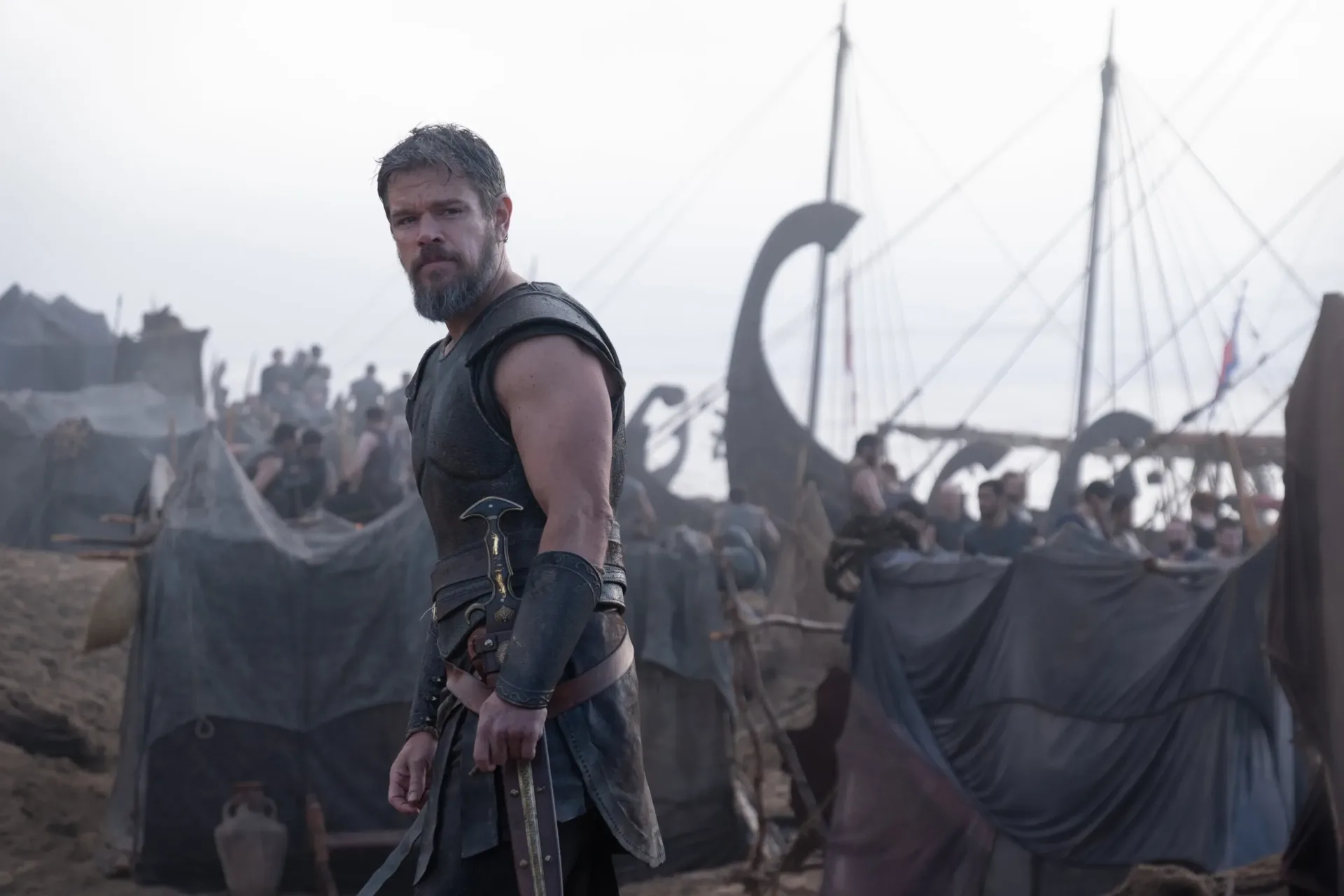
Damon’s Ted reflection arrives while he is appearing in Christopher Nolan’s The Odyssey, a Greek epic that has surpassed $652 million worldwide. The film is set to return to theaters in Imax 70mm in December, and Damon’s performance has placed him in the conversation for this awards season.
The contrast between the two projects is striking on paper: one is a broad comedy about an uncouth teddy bear, while the other is a large-scale adaptation of Greek epic material. But Damon’s comments about Ted do not suggest that he sees his career as a simple series of wrong turns and corrections. He speaks of the comedy with real affection, makes room for the personal regret attached to Boston, and still gives full credit to the actor who took the role.
For more on Damon’s recent personal reflections, read his comments about Luciana’s surgery before the 2024 Oscars.
In the end, the most revealing detail is that Damon did not dismiss Ted because he failed to see its appeal. He says the reverse happened: he saw the appeal immediately, laughed at it intensely, and then let analysis outweigh his own reaction. Years later, he can call that decision a regret while still appreciating the movie—and Wahlberg’s place in it—for exactly what it became.