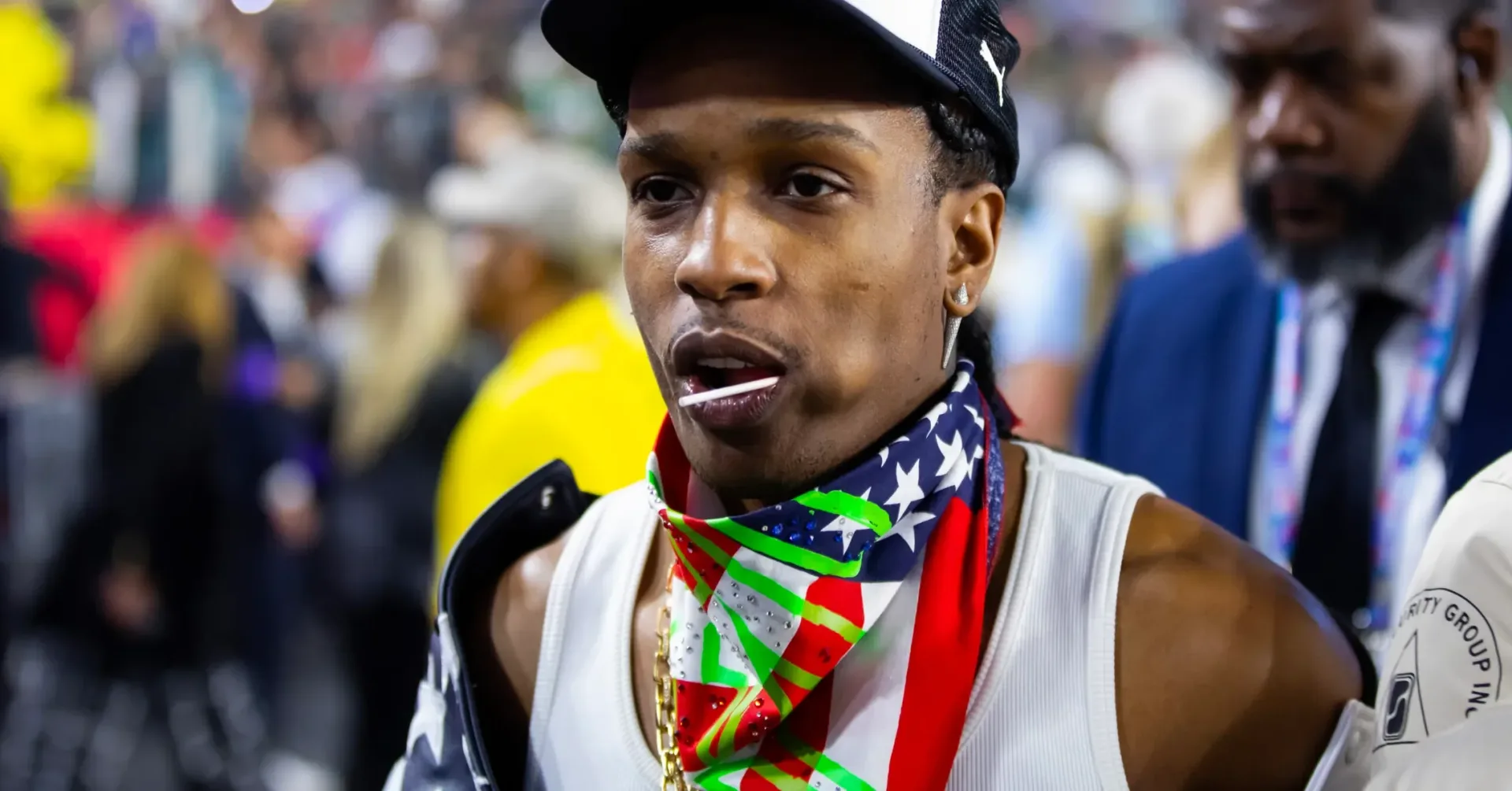
Football shirts have long since escaped the touchline. They are concert outfits, city uniforms, collector pieces, streetwear staples and, when the timing is right, little wearable flags for a particular moment in music. Manchester City, PUMA and A$AP Rocky are leaning all the way into that overlap with a limited-edition collection connected to Rocky’s 2026 album Don’t Be Dumb.
The release arrived around A$AP Rocky’s September 5 Co-op Live concert in Manchester, making its rollout as local as the graphics on the garment itself. Rather than treating the club badge as a simple logo placement on a celebrity capsule, the project frames Manchester, its football culture and Rocky’s AWGE design identity as parts of the same visual conversation.
There is an important limitation for anybody viewing the collection from afar: the pieces are exclusive to Manchester and offered on a first-come, first-served basis. The availability model makes this less like a broad global kit launch and more like a city-specific drop with a deliberately narrow window—an approach likely to matter to collectors just as much as fans of the club, PUMA or Rocky.
The black-and-gold PUMA King jersey is the centerpiece
The focal point is a long-sleeve PUMA King jersey in black and archive gold. The design carries “DON’T BE DUMB” down one sleeve, incorporates AWGE branding, and places an oversized “MANCHESTER” graphic across the back. It is a club-adjacent football top with a distinct music-world identity rather than a standard match shirt with only a small co-brand mark.
That distinction is meaningful. A conventional football kit is usually built around a season, a team and the familiar logic of home and away colors. This shirt instead turns a PUMA football silhouette into a canvas for the album title and the city name. Black and archive gold give the piece a more fashion-oriented profile than Manchester City’s usual sky-blue visual language, while the long sleeves push it toward the kind of top that can live beyond a stadium gate.
It also makes the collection particularly legible at a glance. The sleeve text announces the album connection, AWGE indicates Rocky’s creative orbit, and the back makes the Manchester tie impossible to miss. In an era when limited drops are often reduced to a logo swap and a scarcity label, these details give the jersey a clear design thesis.
A$AP 11 personalization expands the drop to current City kits
The project is not restricted to the dedicated King jersey. Supporters can add limited-edition “A$AP 11” name-and-number printing to Manchester City’s current Home, Away and Third kits, while retail supplies last. That offers a second route into the collaboration for people who prefer the club’s existing shirt templates—or who simply want an officially styled personalization treatment tied to the release.
The number choice gives the collaboration a football-ready format without presenting Rocky as a member of the squad. Names and numbers are one of football’s most recognizable forms of identity, whether they represent a player, a personal nickname or a piece of pop culture. Here, “A$AP 11” lets the crossover sit directly within the visual rules supporters already know.
For collectors, the detail is worth separating from the dedicated limited top. The custom printing applies to the club’s current Home, Away or Third kits, whereas the black-and-archive-gold long-sleeve PUMA King jersey is its own distinct product. They share the same collaboration, but they are not interchangeable versions of one item. Keeping track of that difference will matter whenever fans document or trade items from this Manchester-only run.
The players-only shirt takes a different route
There is also a separate players-only version, and it is explicitly not for sale. Unlike the retail centerpiece, this one remains closer to Manchester City’s sky-blue identity. Its sleeve has “D.B.D.” detailing, while the back features a stop-sign motif containing the words “STOP SNITCHIN, MANCHESTER.”
Players-only apparel regularly becomes the most talked-about component of a collaboration because it is designed to be seen but cannot be purchased through ordinary retail. That does not make it a consumer product, and it should not be confused with the long-sleeve jersey or the A$AP 11 customization offering. In this case, it functions more as a creative extension of the campaign: a piece that merges the club’s established color language with Rocky’s album-era graphics.
The contrasting versions also reveal the collection’s two tracks. The retail long-sleeve piece uses black and gold to establish a standalone streetwear identity. The players-only shirt uses sky blue to speak more directly to the City side of the partnership. Both use Don’t Be Dumb references, but they approach the collaboration from different ends of the football-and-fashion spectrum.
A one-night Northern Quarter opening set the tone
The first public moment for the collection came on September 4, when PUMA transformed Black Milk in Manchester’s Northern Quarter into the Don’t Be Dumb Caff for a one-night pop-up. Attendees received early access to the long-sleeve jersey there, ahead of the wider retail rollout. The following morning, the numbered-kit option followed at the Manchester City Stadium Store.
This sequence matters because it gives the release a clear physical geography. The Northern Quarter pop-up placed the project in one of Manchester’s well-known cultural districts; the stadium store then brought it into the club’s direct retail environment. Music, football and street culture were not merely used as campaign keywords—the rollout put all three in locations associated with those communities.
Some jerseys included Golden Tickets connected to the Co-op Live concert or Saturday’s match. Not every item carried one, and the collection’s first-come, first-served nature remains central to the release. Still, the possibility of a ticket turned a garment purchase into something with an additional event element, extending the drop beyond the clothing itself.
Why the Manchester-only model fits the collaboration
Limited sportswear collaborations often try to manufacture a sense of place through slogans. This one was physically anchored to the city. The “MANCHESTER” back graphic, the Northern Quarter pop-up, the Stadium Store sales and the concert timing all reinforce the same idea: this was built as a Manchester event, not a generic international capsule that happened to use a club crest.
That regional focus has a practical consequence. Anyone who did not attend the pop-up or shop in Manchester should avoid assuming a conventional online or worldwide release. The stated setup is exclusive Manchester retail, with stock handled in person and on a first-come, first-served basis. Scarcity can create confusion fast, especially when player-only garments and personalized shirts are circulating alongside a dedicated limited jersey, so precision is more useful than hype.
It is also a reminder that the collectible appeal of contemporary apparel frequently comes from context. A shirt’s long-term interest is not only about fabric or color; it can be shaped by where it appeared, which event surrounded it and whether there were multiple versions. This release has all of those ingredients: a named album tie-in, a concert, a club collaboration, a limited local retail setup, a one-night activation and a non-retail player edition.
Music and football continue to share the same wardrobe
A$AP Rocky has positioned the project as one that retains his own creative language while respecting Manchester City’s legacy. PUMA’s teamsport leadership has similarly characterized the work as a meeting of those identities. The result is a collection that does not pretend either party disappears into the other: Rocky’s AWGE and album messaging remain prominent, while Manchester City’s name, retail ecosystem and football-kit formats remain fundamental.
Rocky also had a related club collection with AC Milan around the same period, underscoring how normal the artist-football partnership has become. A musician’s design world can now move from an album cycle into sporting apparel without feeling like an accidental branding exercise. The strongest projects understand that football shirts already carry music, neighborhood and style associations before an artist ever joins the picture.
That wider cultural exchange is part of what makes a release like this relevant beyond a single fan base. There is no need to be a Manchester City supporter to recognize the appeal of a graphic long-sleeve built around album iconography, and no need to follow Rocky’s work to understand why a localized City drop has collector energy. For another look at music news where an artist’s next project is part of the story, see 9th Wonder’s update on his collaborative Black Thought album.
Manchester City, PUMA and A$AP Rocky’s Don’t Be Dumb release ultimately makes its strongest case through specificity. It has a particular album-era identity, a particular city, a specific PUMA King silhouette, defined personalization, a clearly separate players-only shirt and a rollout connected to real Manchester venues. In a market crowded with crossover logos, that level of detail is the difference between merchandise and a moment.