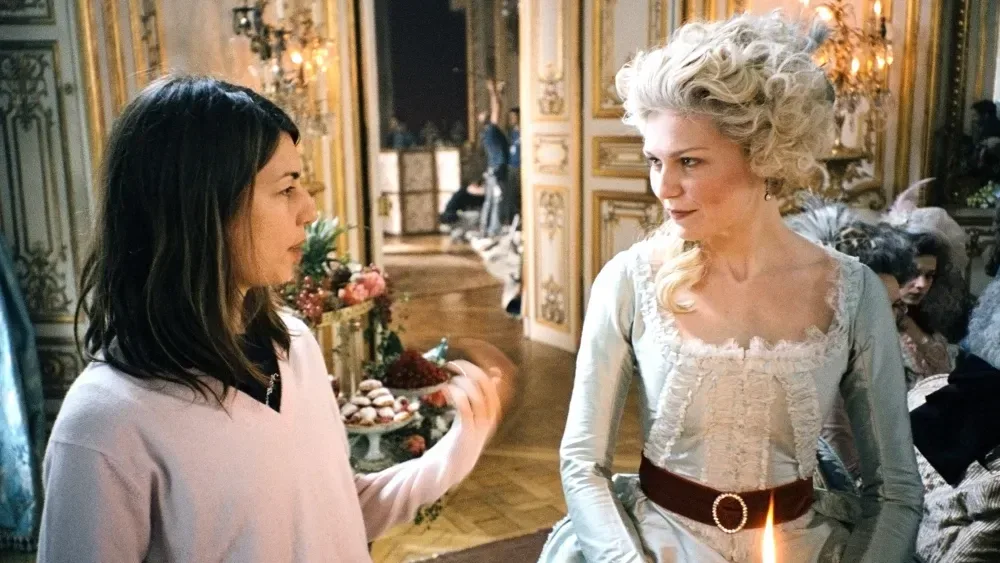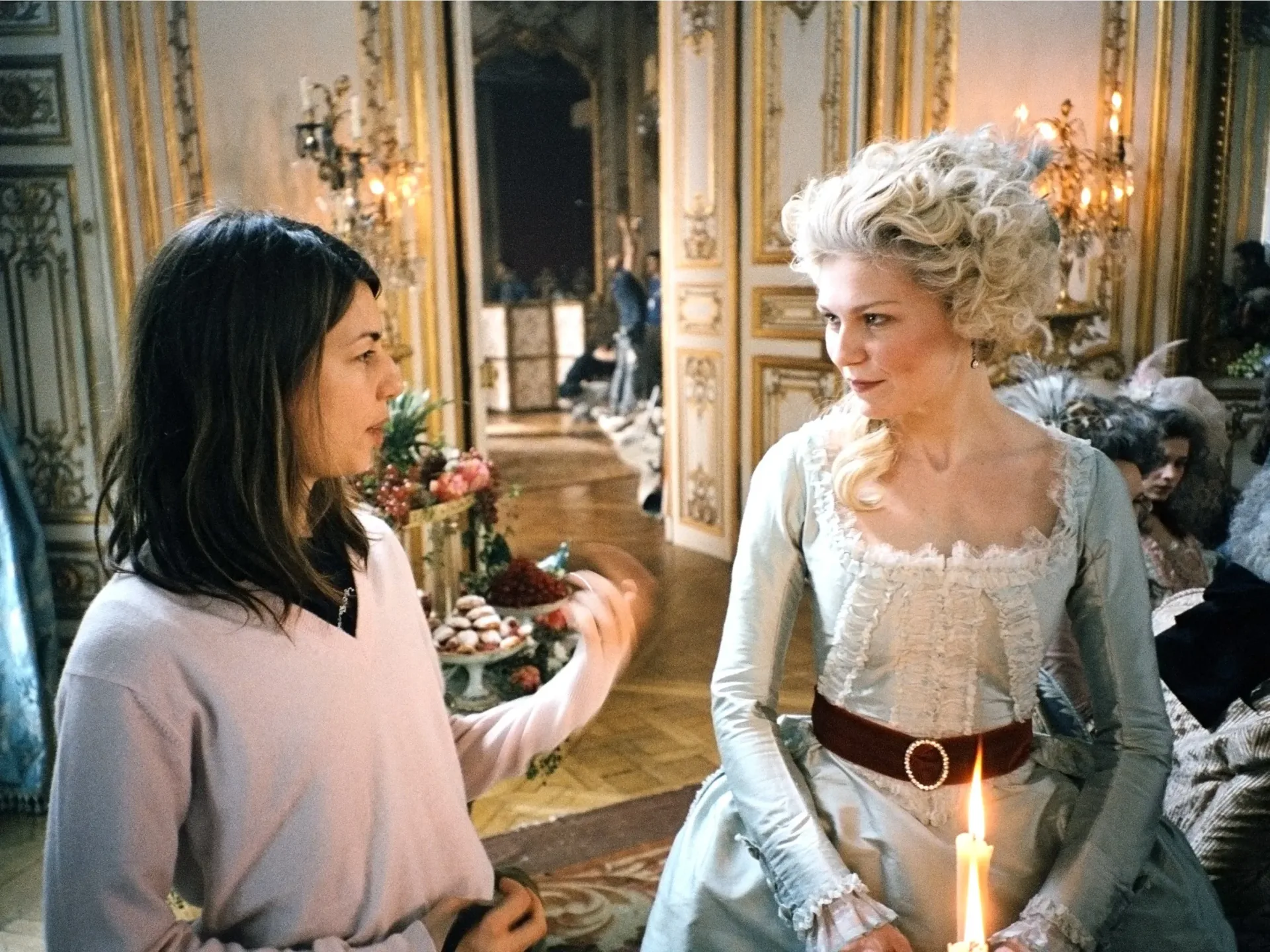
Some behind-the-scenes films are polished victory laps. Making Marie Antoinette appears to be something more revealing: a record of a director trying to make a highly specific movie amid the daily traffic jam of extras, wigs, fittings, locations and competing creative ideas. Built from roughly 80 hours of material shot by Eleanor Coppola during the production of Sofia Coppola’s 2006 Marie Antoinette, the documentary brings a long-unseen family archive into public view.
The film screened in the Spotlight program at the New York Film Festival and is scheduled to arrive on Mubi on October 23. Its immediate hook is obvious. Sofia Coppola’s Marie Antoinette, once met with mixed reviews and modest box-office results, has become a cult favorite. But the more compelling promise is the chance to watch its director before that reassessment had happened: 34 years old, making an ambitious period feature at the Palace of Versailles, and working out how firmly to defend a point of view.
Not merely a making-of feature
Eleanor Coppola filmed the production with an observational intent. That matters because “observational” documentary does not mean a retrospective explanation delivered after every difficult moment. It describes a method that watches people and processes unfold, rather than organizing everything around interviews, dramatic narration or a predetermined lesson. Eleanor had imagined a film in the tradition of Frederick Wiseman, whose work is associated with close attention to institutions and behavior.
That approach makes the material sound less like standard promotional bonus footage and more like a lived-in production diary. Diane Lane narrates Eleanor’s diary entries written during the shoot, adding the mother’s contemporaneous perspective rather than asking the archive to carry every emotional implication on its own. The result is also necessarily posthumous: Eleanor Coppola died in 2024 at age 87, and had been disappointed that the footage was never assembled into a completed film during her lifetime.
Sofia Coppola and editor Aaron Matthews ultimately completed the project. The arrangement gives the documentary an unusual double authorship. Eleanor was present with the camera and the diary while the original film was being made; Sofia later helped shape that record into a release. It is a document of a movie’s production, but also a daughter’s act of bringing a mother’s unfinished idea to the screen.
“I felt so lucky that [my mother] gave this to me, and to have this tribute to her and being with her again.”
That personal element does not appear to sand down the uncomfortable edges. Sofia has acknowledged that the footage includes moments when she is tired, irritable and reluctant to speak with her mother in her trailer. Leaving those scenes in is a meaningful choice. A documentary about work becomes less useful when it treats stress as an inconvenient outtake; here, strain is part of the evidence of what making the film required.
The difficult business of holding onto a point of view
The reported center of tension concerns Sofia Coppola and cinematographer Lance Acord. Acord wanted more images aligned with King Louis XVI’s perspective, while Coppola wanted to keep Marie Antoinette at the center. On paper, that may sound like a framing dispute. In practice, point of view governs how audiences experience a story: whose reactions establish the emotional stakes, whose uncertainty the camera stays with, and whose interior world becomes the default lens for an entire film.
A cinematographer, also called a director of photography, is responsible for the photographic execution of a movie: camera placement, lensing, lighting and the visual strategy that turns a director’s plan into images. That role is deeply collaborative, and creative disagreement can be part of a healthy process. Yet the documentary’s importance lies in Coppola’s decision to stand by the perspective she wanted. Her version of the story was not simply a matter of how many shots a character received. It was about refusing to reposition Marie Antoinette as a secondary presence in a film carrying her name.
Coppola has reflected that a female perspective being treated as unusual feels striking in retrospect. She also described herself then as still learning how to assert what she wanted on set, while feeling more comfortable doing so now. That makes the archival material valuable beyond celebrity access. It catches a director in the less tidy phase of authorship: not after confidence has become a reputation, but while confidence is being practiced under pressure.
There is a useful distinction here. Assertiveness is not the same as refusing collaboration. A director can listen to an alternative and still conclude that it leads the film away from its purpose. The footage seems positioned to show that distinction in action. Coppola’s authorship is not presented as effortless genius descending on Versailles; it is built through decisions, repetition and the willingness to say no.
Versailles, wigs and the logistics behind the fantasy
The 2006 film is known for its visual world, but Making Marie Antoinette also foregrounds the labor hidden inside that polished surface. Period filmmaking demands a great deal of coordination because costumes, hair, makeup, crowd scenes and locations are not isolated departments. A delay in one area can reshape the entire day’s schedule.
The documentary shows the crew confronting large numbers of extras and the long preparation involved in dressing performers. Hair work in particular emerges as a recurring practical obstacle. This is the kind of detail that can make a historical film’s visual beauty easier to appreciate without reducing it to an aesthetic mood board. The elaborate look was not automatic. It had to be organized, fitted, maintained and repeated across a demanding production.
Costume designer Milena Canonero’s contribution receives significant attention. Canonero created more than 70 original dresses for Kirsten Dunst’s Marie Antoinette alone, then went on to win the Academy Award for Best Costume Design for the film. The number helps clarify the scale of the undertaking, but it does not fully capture the work involved. Multiple costumes are not simply multiple outfits; they must serve character, scene, movement, continuity and the shooting schedule.
Continuity is the production discipline of ensuring details remain consistent when a sequence is edited together, even though scenes are often filmed out of story order. In a costume-heavy picture, it means tracking what a performer wore, how it was arranged and how it looked from one shot to the next. The documentary’s account of lengthy changes therefore points to an essential reality of movie production: spectacle depends on systems as much as inspiration.
People, not monuments
For all the grandeur of the Versailles setting, the footage reportedly has room for people acting like people on a long shoot. Jason Schwartzman, who plays Louis XVI and is Sofia Coppola’s cousin, is seen playing harpsichord and joking with a small dog. Dunst is shown approaching the work with energy. Asia Argento, playing Madame du Barry, is captured putting more force than expected into a confrontation with Dunst. Thomas Mars, then Coppola’s boyfriend and the singer of Phoenix, is introduced to Eleanor; Coppola and Mars are now married and have two children.
These snippets should not be mistaken for the documentary’s entire point, but they matter. Sets can become mythic in retrospective accounts, especially when the finished film gains an enthusiastic audience years later. Small, playful and awkward interactions puncture that mythology. They return the production to its human scale: a group of people negotiating demanding workdays, family proximity and occasional foolishness in an exceptionally ornate place.
They also complicate the notion that a creative legacy is built only from completed art. Eleanor Coppola’s footage waited approximately two decades to become a feature. During that time, Marie Antoinette itself changed cultural position, moving from a mixed initial reception to cult-classic status. The documentary benefits from that shift, but it is not merely asking viewers to celebrate a movie that “won” in the end. It asks them to look at the uncertainty and resistance that existed before anyone could know how the film would be remembered.
Why the documentary’s timing is meaningful
The release offers a chance to revisit a familiar title from a less polished angle. There is an understandable temptation to treat behind-the-scenes access as proof that every creative choice has one obvious correct answer. The richer lesson is the opposite: filmmaking is made from constraints, dissent and choices that must be defended before their later reputation is secure.
For viewers drawn to film craft, the practical material may be as interesting as the family story. The film gives visible weight to costume design, performer preparation, crew management and cinematography, all disciplines that can disappear beneath the final movie’s surface. For viewers interested in Sofia Coppola’s career, the creative dispute adds an unusually concrete example of how a directorial sensibility is protected. And for audiences moved by artistic inheritance, Eleanor Coppola’s camera and journals make the documentary a conversation across time rather than a conventional retrospective.
Most importantly, Making Marie Antoinette seems to resist the idea that creative work must look graceful while it is happening. The original production could be stressful, underprepared in places and personally difficult; it could also generate the images and identity that later made the film enduring. Both realities can coexist. That is a far more honest tribute than a spotless memory.
For another update on a forthcoming screen project, see Jennifer Lawrence’s newly reported lead role in Zach Cregger’s The Flood.