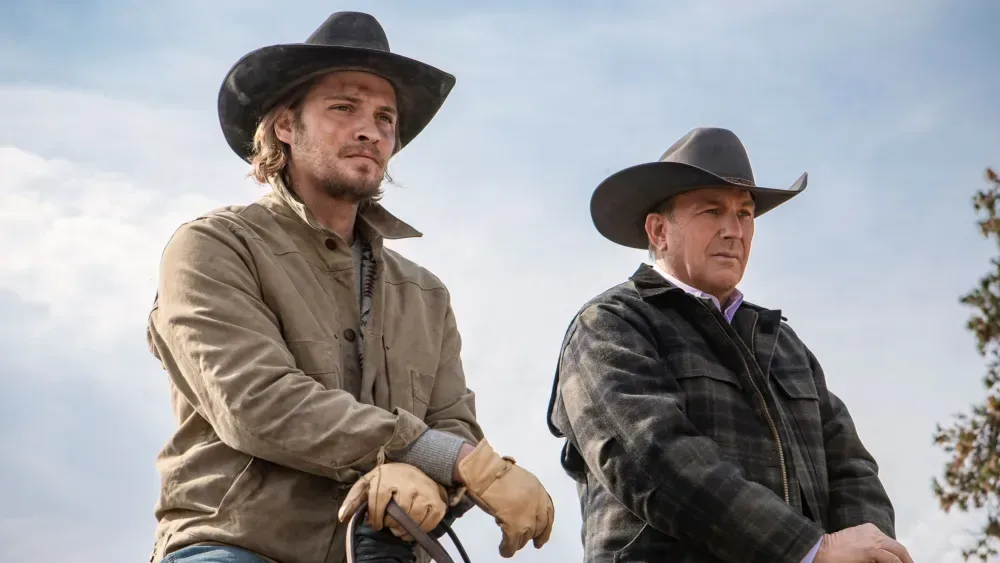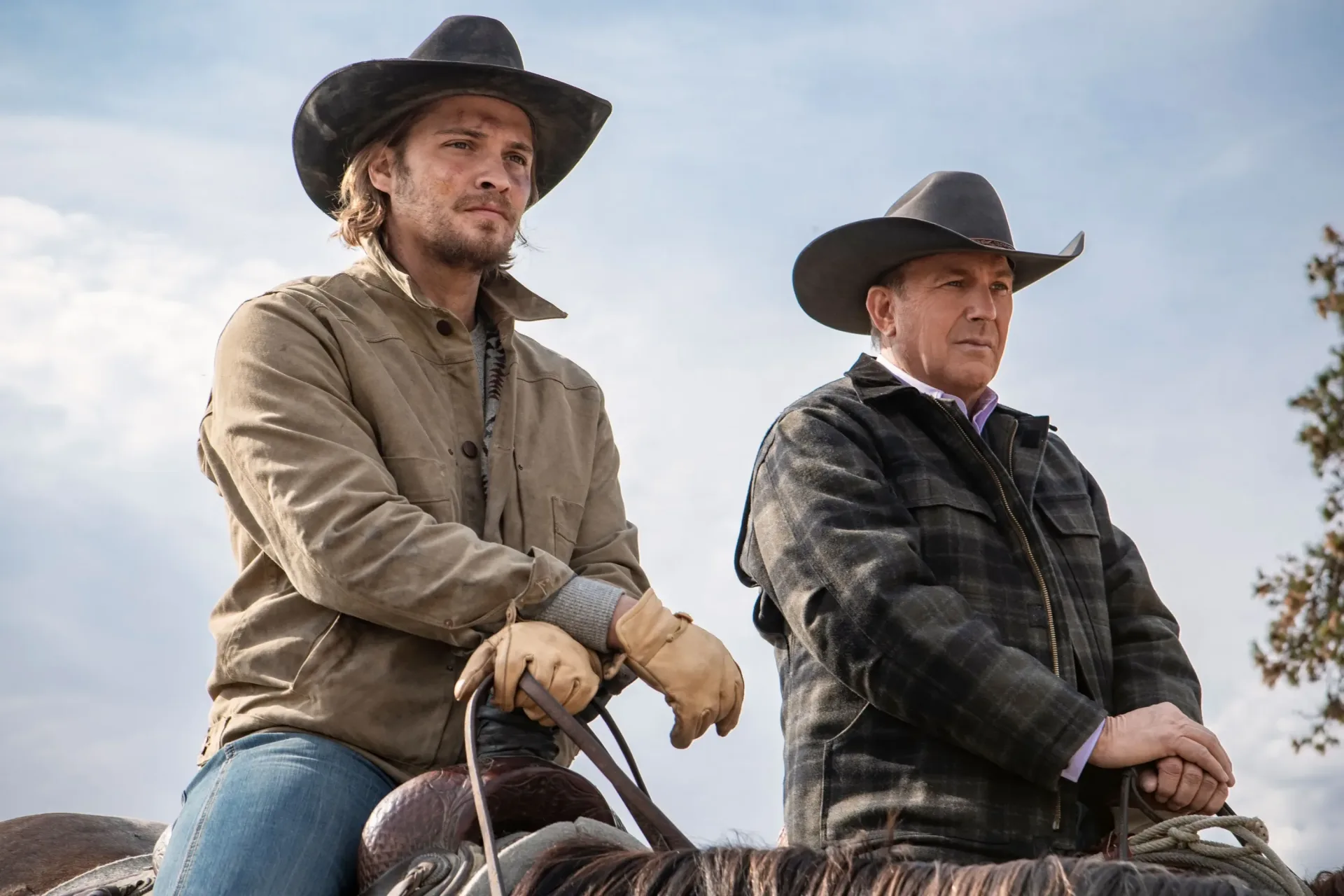
Luke Grimes has clarified the state of his relationship with former Yellowstone co-star Kevin Costner: there has been no post-series fallout to decode, no reported feud, and no suggestion that either actor is holding a Dutton-sized grudge. They simply have not spoken since they stopped working together.
Grimes played Kayce Dutton, the youngest son of Costner’s John Dutton, across all five seasons of the Western drama. The series ended in December 2024, though Costner did not appear in the final six episodes that comprised Season 5B after John was written out. Grimes now leads Marshals, a continuation centered on Kayce’s life beyond the Yellowstone Ranch.
Speaking about Costner, Grimes said he had not been in contact with him since their shared work ended, explaining that it was not for any dramatic reason: both are busy and life has moved on. That distinction matters. A lack of contact between co-stars can easily become an online mystery, particularly when one character exits a major franchise before its final episodes. Grimes’ comments instead present it as a routine professional reality after a long-running production wraps.
What Grimes’ comments do — and do not — mean
For viewers invested in the Dutton family, it is tempting to treat actors’ real-world relationships as a clue to what may happen on screen. Nothing in Grimes’ remarks supports that leap. He did not describe a dispute with Costner, nor did he say that communication between the two would determine the creative direction of Marshals.
What he did make clear is that a new John Dutton appearance seems unlikely from his perspective. Asked whether Costner might show up in Marshals, Grimes said such a return would be cool but that he doubted it would happen at this stage. That is an opinion from the actor playing Kayce, not confirmation of a future storyline or a formal statement about casting plans.
The distinction is particularly useful in franchise television, where a character’s death does not automatically erase every possible narrative use. A flashback is a scene set before the present-day timeline; it can bring back a dead character without undoing the death or changing the current continuity. But the mere possibility of a flashback is not an indication that one has been written, filmed, or approved.
Grimes did entertain the idea in broad terms. If Marshals were to revisit Kayce’s past, he said a flashback involving Monica Long Dutton would be more emotionally meaningful to Kayce than one with John. Monica is played by Kelsey Asbille, and Grimes said he would love to work with her again. He also stated that there has been no conversation about such a return.
Why Monica is the more personal flashback possibility for Kayce
The premise of Marshals gives Kayce a markedly different starting point from his years at the ranch. By the time the spinoff begins, Monica has died of cancer. The loss is therefore not just a piece of background information; it is part of the emotional condition in which Kayce begins this next chapter.
That helps explain Grimes’ reasoning. John’s absence is foundational to the broader Dutton saga, but Monica’s absence is tied directly to Kayce’s immediate family life and grief. A memory involving her could illuminate what Kayce has lost without requiring the series to pull its present-day story back toward the ranch or to reopen John’s arc.
Still, it is important not to turn that character reading into a prediction. Grimes’ preference signals what he believes would be poignant for Kayce, rather than an announced plan. The available information establishes only that he would welcome working with Asbille again and that no conversation about it has taken place.
That restraint is worth preserving because legacy-franchise speculation often turns a performer’s hypothetical answer into an expectation. In this case, the clearest takeaway is narrower: Grimes sees storytelling potential in Kayce’s memories of Monica, while he considers a Costner return improbable.
‘Marshals’ shifts Kayce out of the ranch orbit
The official premise positions Marshals as more than a simple change of scenery. Kayce leaves Yellowstone Ranch and joins an elite U.S. Marshals unit in Montana. The show combines elements already associated with the character — his cowboy background and Navy SEAL experience — with a law-enforcement role focused on bringing what the series calls “range justice” to the state.
In practical storytelling terms, that premise creates a new engine for episodes. Rather than centering every conflict on the Dutton family’s property, inheritance, and internal power struggles, the series can follow Kayce and his teammates as they confront violence across the region. The stated concept also keeps family and duty in tension, while foregrounding the psychological toll carried by people who operate as a final line of defense.
That phrase, psychological cost, points to consequences beyond the action itself: the strain, trauma, and difficult choices that can come with repeated exposure to dangerous situations. It does not tell viewers exactly which cases or conflicts the show will portray. It does indicate that Marshals intends Kayce’s new job to affect him as a person, not merely give him a badge and a new weekly assignment.
Kayce’s move also supplies a natural reason for the spinoff to stand independently. Franchises frequently carry familiar characters into a new setting to retain emotional continuity while building a different kind of story around them. Here, Kayce remains the connective thread, but the professional unit, Montana-wide cases, and the consequences of service form the new framework.
That balancing act is not exclusive to Western dramas. Across entertainment, a familiar character can provide an entry point while a new format or setting does the work of keeping the next chapter from being a simple repeat. The same broad question of creative reinvention comes up in other corners of pop culture, including this discussion of creative reinvention and history’s relationship to the present.
John Dutton’s absence is already part of the timeline
Costner’s John Dutton was the patriarch at the center of Yellowstone, while Kayce was his youngest son. Grimes appeared throughout the program’s five-season run. John’s death and Costner’s absence from Season 5B mean the story had already established a version of the Dutton world that continues without the character in the present day.
That history is central to why a Costner appearance in Marshals would require a particular narrative mechanism, such as a flashback. It would not be a conventional present-day reunion between John and Kayce. Grimes’ response recognizes that limitation without ruling out every theoretical way John could be referenced or seen.
It also reinforces the difference between a character’s importance and a character’s availability. John can remain significant to Kayce’s identity and past even if he never appears in the spinoff. A sequel or spinoff does not need to physically return every major figure from its predecessor in order to acknowledge the effect they had on its lead.
Where the series stands now
Marshals premiered its first season in March. Its second season premiered Sunday. With the new series now operating in its own present-day continuity, the immediate focus is Kayce’s role in the Marshals unit, his family responsibilities, and the pressures outlined in the show’s premise.
For fans looking for a definitive answer on whether Costner will return, Grimes has not provided one — and neither has the available information around the show. His view is that it would be cool, but unlikely. The more concrete point is simpler: he and Costner have not spoken since Yellowstone, and Grimes says there is no hidden dispute behind that fact.
As for the franchise’s past, Grimes has identified the kind of return he finds most resonant: not a surprise restoration of John Dutton to the present, but a potential look back at Kayce’s life with Monica. Until a creative decision is actually announced, that remains a thoughtful possibility rather than a promised episode.