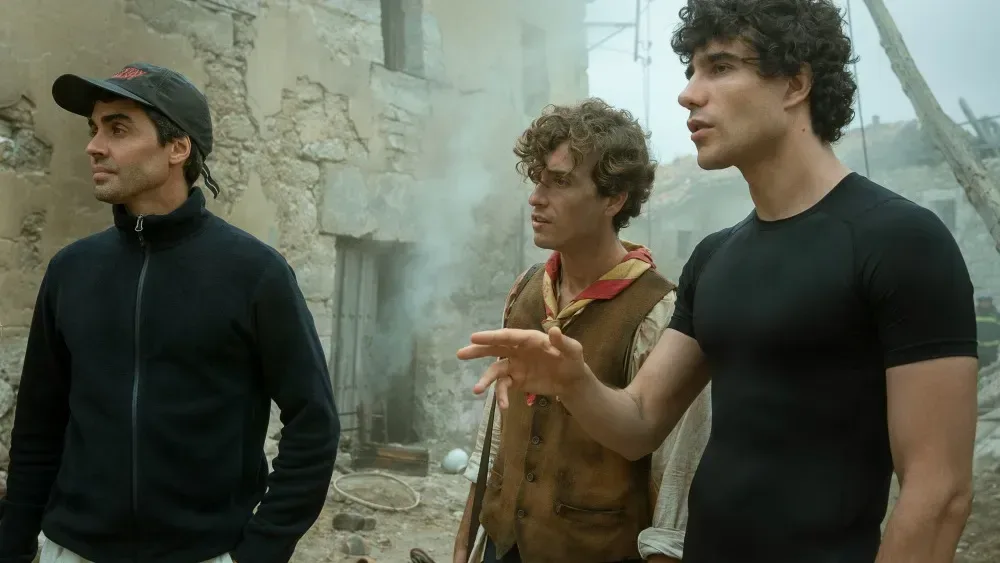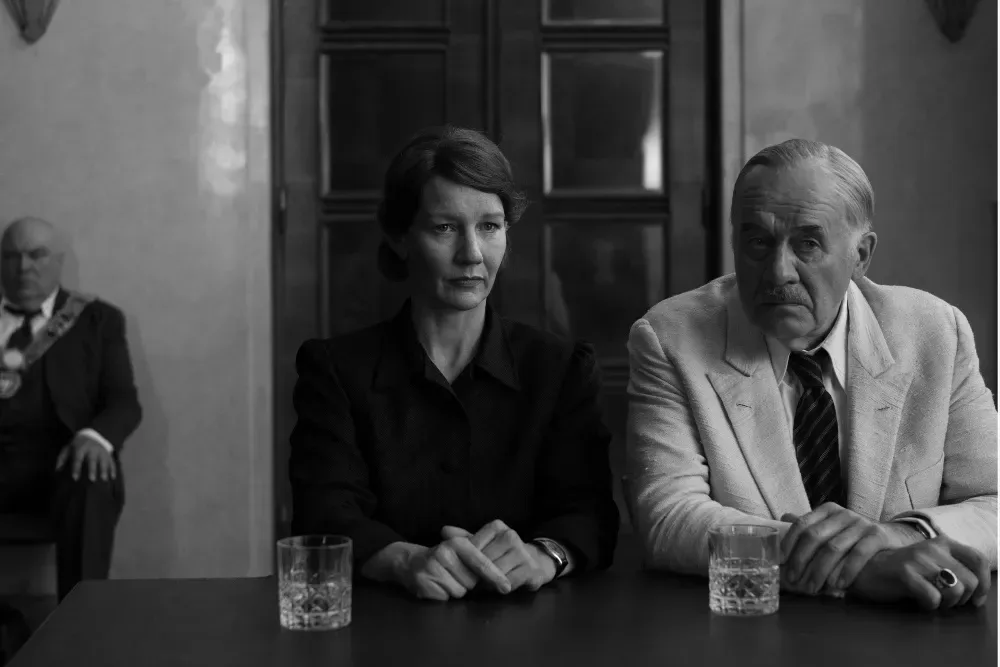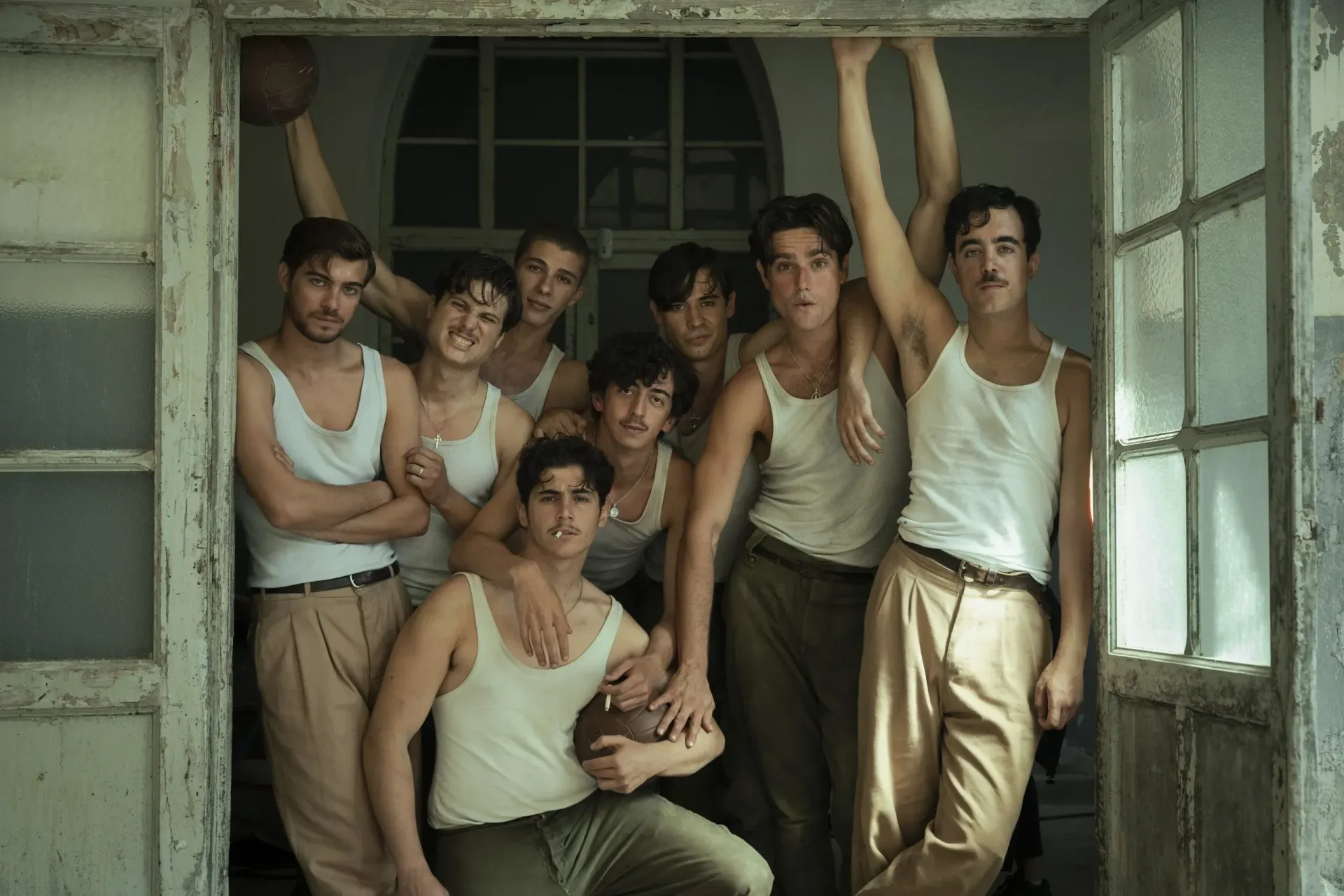
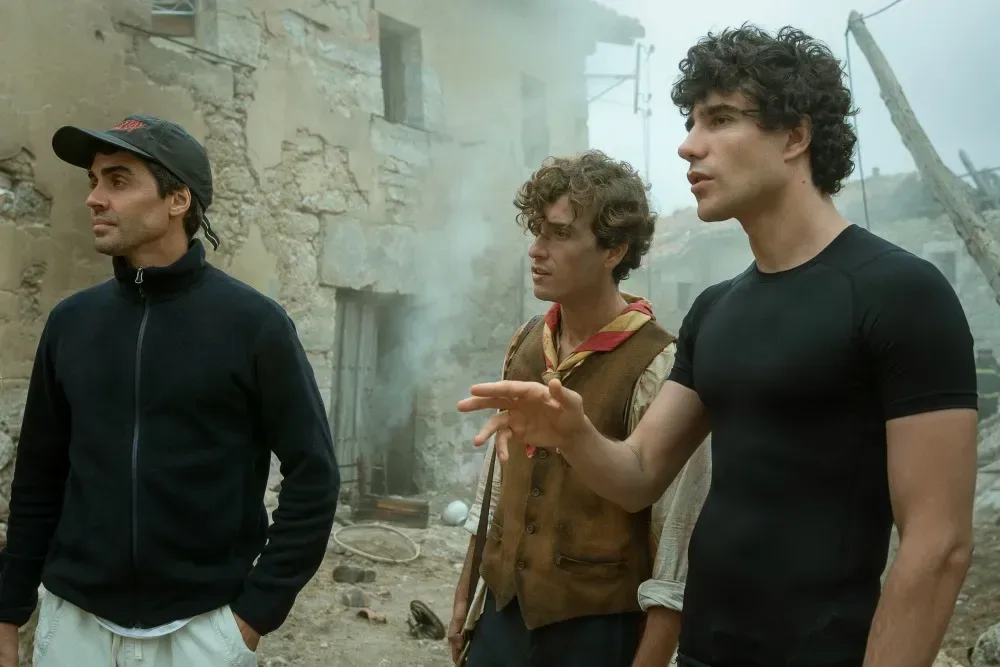
La Bola Negra is being framed by its filmmakers as something deliberately expansive: a queer Spanish epic that refuses the idea that LGBTQ+ stories should be made only for a narrowly defined audience. Directors Javier Calvo and Javier Ambrossi, the creative pair known as Los Javis, built the film around the relationship between Rafael, played by Miguel Bernardeau, and Sebastián, played by musician Guitarricadelafuente in his first screen acting role.
At a Miami Film Festival conversation, Calvo, Ambrossi and Guitarricadelafuente described a process that sounds less like simply assigning a performer to a completed part and more like allowing the performer, the script and the production to reshape one another. That approach extends from the way the directors outlined the film to the way they worked through scenes with actors on set.
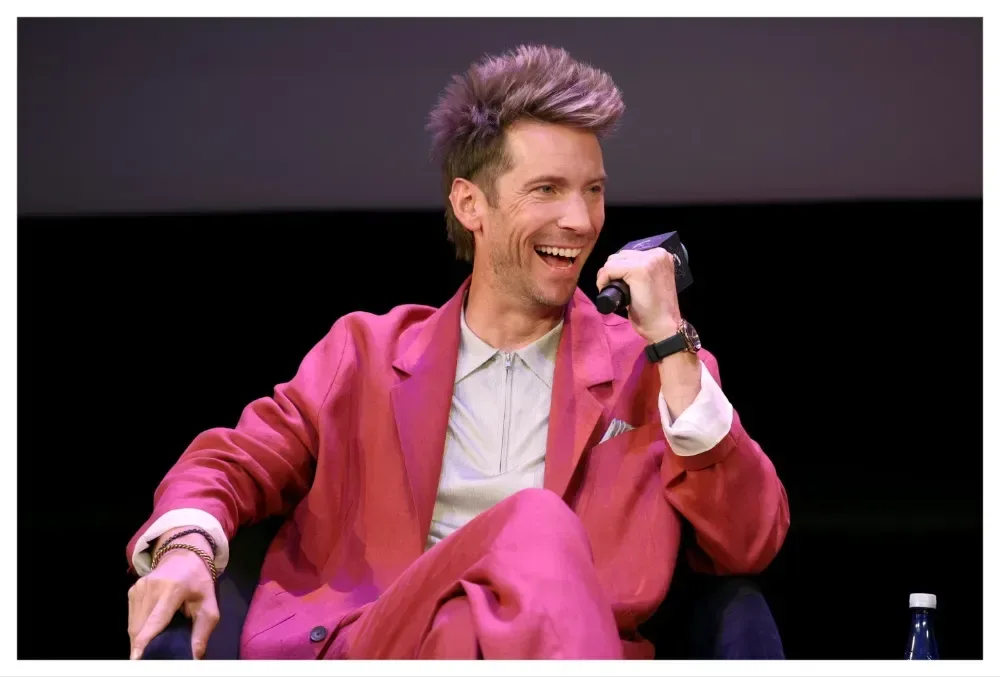
The result has attracted a major response. La Bola Negra premiered at Cannes in May, where it received a 20-minute standing ovation, and it has become one of the highest-grossing Spanish films in history. At the Miami event, Guitarricadelafuente received the Virtuoso Award while Los Javis received the Visionary Director Award.
A story built to reach beyond a niche
The film is inspired in part by a play by Spanish writer Alberto Conejero, who also co-wrote the screenplay with Calvo and Ambrossi. Its central relationship is between Bernardeau’s Rafael and Guitarricadelafuente’s Sebastián. The directors have described the movie in grand terms, with Ambrossi jokingly likening it to a gay Titanic while also making a more serious point about its intended scale.
The comparison is not a claim that the two films share plot or setting. It is a shorthand for ambition: a romantic drama with a large emotional canvas, designed to be broadly accessible without diluting its queer identity. Ambrossi’s stated aim was not to make a queer movie that treats its presumed audience as limited, but an LGBTQ+ film for everyone—and, in his formulation, an unapologetically gay war movie at that.
That distinction matters because “universal” is often used as an excuse to sand down specific perspectives. The approach described here moves in the opposite direction. The filmmakers are presenting specificity as the route to connection, rather than a barrier to it. Rafael and Sebastián are not being positioned as generic placeholders in a romance; their relationship is the foundation of the story.
Calvo and Ambrossi also discussed the movie’s woven structure. They used two whiteboards in the writing process: one for charting the characters’ progression and another for mapping the audience’s experience. The first board addresses what happens internally and externally to the people on screen. The second asks a different craft question: what does a viewer know, feel or need at a given point?
For a film that connects story threads, that second question can be as important as plot mechanics. A screenplay can have clear character arcs yet still lose an audience if revelations arrive without enough emotional preparation, or if parallel threads are not balanced. Treating viewer experience as a separate writing map suggests the directors were consciously managing both levels at once.
Related coverage includes ‘La Bola Negra’ Team Details the Making of a Queer Spanish Epic.
The pair spoke about The Hours, the adaptation of Michael Cunningham’s novel connecting three women through Virginia Woolf’s Mrs. Dalloway, as both an influence and a caution. That is an instructive way to talk about artistic reference points. A creative model can identify a formal possibility—here, interwoven lives and literary connections—without becoming a blueprint to imitate. Calvo indicated that the filmmakers were equally attentive to choices they wanted to avoid repeating.
Writing Sebastián around an emerging performer
Guitarricadelafuente came to La Bola Negra as a musician, not a working actor. His album Spanish Leather debuted in 2025, and he was finishing music when the directors approached him about Sebastián. Rather than presenting him with a fully locked screenplay character and a conventional audition process, Los Javis initially offered what they called the character’s essence.
There was no audition. The directors and performer developed the role collectively, with Calvo using the Spanish phrase “nos nutrimos”—they nourished themselves from his art—to characterize the relationship. Ambrossi said he needed Guitarricadelafuente’s face in order to write the movie and did not feel certain the film would work until the musician agreed to participate.
This is not a universal casting method, and it carries an obvious practical limitation: it depends on filmmakers finding a particular performer whose presence speaks directly to the material. But in a project centered on emotional intimacy, the benefits are easy to see. A role can be tailored to qualities a performer already brings instead of asking a first-time actor to simulate an identity constructed entirely in advance.
Guitarricadelafuente described a synchronicity between the narrative he was invited into and his own songwriting experience while finishing the album. That overlap helps explain why a musician’s first acting role may feel connected to, rather than detached from, his earlier artistic life. He called the experience a continuation of what he was doing through music.
The first meeting was notably informal. Calvo recalled making tortilla de patatas, a Spanish omelette, at the directors’ home as they discussed the part. The anecdote does not mean the work was casual. Instead, it illustrates the atmosphere the filmmakers sought: conversation before performance, trust before pressure, and the actor as a collaborator rather than merely someone who executes a predetermined plan.
Finding emotion instead of enforcing it
Calvo said the directing pair look for the truth in each person they work with. In Guitarricadelafuente’s case, he identified what he called “truthful exhaustion.” On one Friday night of shooting, Calvo asked the actor to give him a song. Gabo Ferro’s “Volver a volver” helped supply the emotional energy required to complete the scene.
This is a useful example of music functioning as an acting tool rather than background decoration. A song can establish rhythm, memory, tension or vulnerability before dialogue starts. It does not replace performance technique, but it can give a performer an immediate emotional entry point—particularly when the feeling needed in a scene is difficult to intellectualize.
Guitarricadelafuente spoke of Sebastián’s loneliness and sadness in terms of relinquishing control and erasing boundaries. His description points toward a performance process based on allowing emotional exposure instead of preserving a protective distance from the character. For a newcomer, that can be a formidable demand. The directors’ account suggests they saw their role as creating conditions where the actor could take that risk.
The screen test with Bernardeau was especially important. Their characters’ relationship could not rest only on individual performances; it required a bond that felt lived-in. Guitarricadelafuente said that the pair needed to experience a journey together and build it in their own skins alongside Rafael and Sebastián’s relationship.
That is another distinction worth making. Chemistry is often discussed as if it were an unexplainable spark that casting either discovers or misses. The account of La Bola Negra suggests a more active version: chemistry can begin with compatibility, but it is also cultivated through time, shared work and the willingness to make the relationship part of the filmmaking process.
A set designed for dialogue
Penélope Cruz appears as Nené Romero, and Calvo said Guitarricadelafuente had already “gone to war and back” by the time they filmed her scene. He credited Cruz with helping him become a better actor, while describing a reciprocal welcome into the environment he and the rest of the team had made their own.
The directors do not describe one rigid rehearsal policy. Sometimes they rehearse with performers; at other times, they believe a scene should be allowed to unfold. Calvo summarized the principle by saying that making a space one’s own can matter more than getting every line perfect. Friends and family were also used to help create organic moments.
That philosophy is not an argument against preparation. Rather, it recognizes that preparation has multiple forms. Memorizing dialogue and blocking a scene are essential technical tasks, but a performance can become overly managed if actors are denied room to respond to the people, setting and emotional circumstances around them. The sought-after “moment of truth,” as Ambrossi called it, is the point where planning supports spontaneity rather than smothering it.
Los Javis also placed their directing partnership at the center of this culture. Calvo said that when the two directors disagree, the actor wins. Ambrossi said having two directors can make leadership more flexible, dialogic and horizontal—meaning less top-down and more open to contribution across the team.
Calvo was direct about rejecting intimidation as a management method. In his view, shouting and anger do not produce the best work because frightened people do not have the freedom needed to give their best. The argument is practical as much as ethical: a motivated, secure team is more likely to contribute creatively, communicate problems and take the emotional risks a project like La Bola Negra requires.
That perspective makes the film’s development and its on-set method feel connected. A screenplay was shaped with the audience’s journey in mind. A new actor was brought in through collaboration rather than a standard audition. Scenes could be rehearsed or left open when openness served them better. Across each stage, the directors describe a process built around responsiveness.
Recognition, momentum and what comes next
Guitarricadelafuente’s work has drawn awards conversation for both acting and the original song “La Nieve.” He responded to the attention with gratitude, while acknowledging the unusual and temporary intensity of the experience. The film’s advocates include Sofia Coppola, Anne Hathaway and Madonna, who have voiced their appreciation.
For Calvo and Ambrossi, the film’s reception also lands within a wider moment for queer cinema receiving both awards attention and box-office success. Ambrossi said artists felt a need to speak because their voices were needed; Calvo characterized the impulse as a response to reality and to subjects that are already present in the air.
Those are broad claims about art’s relationship to the world, but they fit the making of La Bola Negra as the trio has described it. The movie’s ambition is not merely to tell a queer story at a larger scale. Its makers are arguing for a different production logic: one where identity is not minimized for accessibility, where a newcomer’s existing artistry can shape a role, and where creative authority leaves room for dialogue.
Los Javis have said they know what they will do next, though they did not reveal the project. For now, La Bola Negra stands as the clearest expression of their current method—and as Guitarricadelafuente’s unusually high-profile move from making songs to carrying a feature film.
For another look at performers crossing disciplines and the recognition surrounding their work, see the news on Troy Baker’s upcoming Andrew Yoon Legend Award.