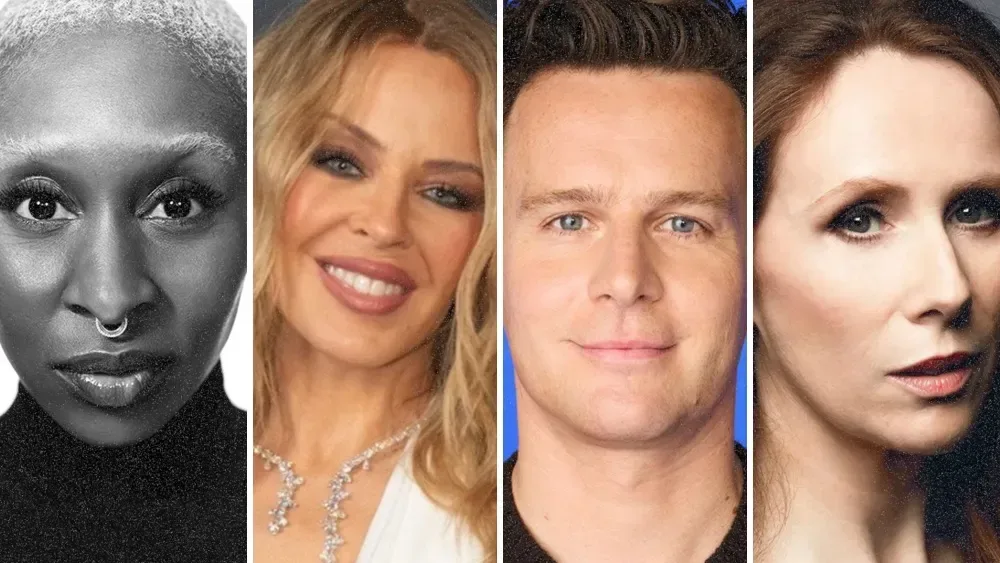
Bad Fairies is gathering a voice cast with enough musical theater power, comic timing and pop star shine to make its rule-breaking fairy premise feel suitably oversized. Kylie Minogue, Jonathan Groff and Catherine Tate have joined Cynthia Erivo in the animated musical comedy from Warner Bros. Pictures Animation and Locksmith Animation. The feature is scheduled to open on May 27, 2027, while production continues in London.
Erivo leads the film as Jayne Staplegun. Minogue will play Clowder, described as the Cat Witch; Groff takes the role of Robin Goodfellow; and Tate is the Fairy Gothmother. Those names alone point toward a fantasy world that is not chasing solemn storybook decorum. The film’s central group is described as delightfully defiant fairies who break rules, and the creative team’s comments make clear that mischief, comedy and emotional sincerity are intended to share the screen.
The additions were revealed during Erivo’s Hollywood Bowl concert, Let Me Sing to You. The show’s second half began with an orchestral treatment built around “Hard to Believe,” a song performed by Jayne in the movie. Erivo introduced Groff and Tate before revealing Minogue’s participation from the stage, with Minogue in attendance.
Who is playing whom in ‘Bad Fairies’?
- Cynthia Erivo voices Jayne Staplegun.
- Kylie Minogue voices Clowder, the Cat Witch.
- Jonathan Groff voices Robin Goodfellow.
- Catherine Tate voices the Fairy Gothmother.
- Serrana Su-Ling Bliss voices Fei Chang.
- James Acaster voices Stickers.
- Dee Bradley Baker voices Groundbeef.
- Ncuti Gatwa voices Butterwort.
Character names can be deceptive at this early stage: they offer flavor, not a plot map. Still, the newly confirmed trio provides a useful sense of the performance palette. Minogue is attached to a character who is both feline and witchy; Groff’s Robin Goodfellow is presented as someone requiring comedy and heart in equal measure; and Tate has been selected for a part whose title immediately promises a gothic twist on fairy-tale authority.
Minogue said the prospect of playing a character who is both a cat and a witch felt magical, mischievous and fun. Director Megan Nicole Dong described Clowder as requiring glamour and chaotic comedy at once, adding that Minogue’s energy in recording carries through to the character’s animated performance. That distinction matters in voice animation: performers do not simply supply lines after a character is complete. Their phrasing, pace and comic emphasis can guide what animators ultimately put on screen.
Co-director Olivier Staphylas similarly emphasized Groff’s ability to play both emotional truth and humor, while highlighting Tate’s comic strength. Staphylas said the animation team is using the cast’s instincts and timing to make the figures feel heightened yet believable.
A musical set in contemporary London
Bad Fairies is set in contemporary London, rather than in an unspecified medieval-style fairy-tale kingdom. That setting is one of the few firm pieces of world-building currently available, but it is potentially important. Modern London places a fantastical, rule-bending ensemble against a recognizable urban backdrop, giving the movie room to play with the collision between magical characters and contemporary life.
The story comes from an original screenplay by Deborah Frances-White. Dong directs, with Staphylas serving as co-director. The film’s stated premise centers on characters who disobey rules in order to do good—a useful thematic anchor, though it leaves many key questions intentionally unanswered. The available details do not establish the stakes, the nature of Jayne’s journey, or how Clowder, Robin Goodfellow and the Fairy Gothmother fit into the conflict.
Related coverage includes Kylie Minogue, Jonathan Groff and Catherine Tate Join Cynthia Erivo in ‘Bad Fairies’.
That uncertainty is normal for a film still in production. For now, the stronger signal is tonal: the project is being framed as funny, surprising and heartfelt, with characters who are not polished little fairy-tale role models. The “bad” in the title appears to be about rebelliousness rather than cruelty.
The musical team behind the wings
The cast announcement is especially notable because Bad Fairies is not merely an animated comedy with incidental songs. It is a musical comedy. Toby Marlow and Lucy Moss, the Tony Award-winning writers associated with Six: The Musical, are writing the original songs. Isabella “Machine” Summers of Florence and the Machine is composing the score, while Ian Eisendrath is executive music producer.
It is worth separating those roles. Original songs are discrete vocal numbers written for characters to perform, often advancing narrative, revealing motivation or defining a relationship. A score is the broader instrumental musical fabric of a film: it can underscore action, establish atmosphere, tie scenes together with recurring motifs and support transitions. An executive music producer is a senior music leadership role; the exact day-to-day responsibilities can vary by project, but it generally sits above the coordination and creative oversight required to bring a film’s musical elements together.
The Hollywood Bowl presentation of “Hard to Believe” is the clearest early indication of the musical side of the project. The song belongs to Jayne, and its orchestral treatment placed the film’s material in front of a live audience well before the feature’s release. It does not tell audiences how many songs the film contains or how its musical storytelling will function scene to scene. It does confirm that Jayne has at least one identified vocal number and that the production is willing to preview its musical identity early.
Erivo’s role as Jayne therefore carries particular weight. Her performance is being described as central to the film from the time she joined, and the concert reveal used her voice as the entry point to the broader announcement. With Minogue also now in the cast and Groff’s musical-theater background part of the ensemble’s makeup, the film has assembled performers capable of giving character songs distinct personalities. Whether each actor will sing has not been specified, so that should not be assumed from casting alone.
For readers following the broader overlap of recording artists and screen musicals, our look at Nas’s argument for music that remembers its foundations offers a different perspective on what performers and audiences ask from music with an identity of its own.
What animation work is underway
DNEG Animation is the project’s digital partner, with production underway in London. In this context, a digital animation partner is part of the production pipeline responsible for helping turn designs, performances, story material and technical planning into the finished animated film. The announcement does not define the precise division of labor between the studios, so it would be premature to assign individual sequences or character work to one team.
The rest of the named creative group shows the range of departments involved long before an animated feature reaches theaters. Carolyn Soper is producing. Sim Evan-Jones is editing, a role that shapes scene construction, pacing and the relationship between picture, performance and music. James C.J. Williams is cinematographer; in animation, cinematography concerns the visual language of the movie, including how shots are composed and how the virtual camera communicates a moment.
Uwe Heidschötter is character designer. Rikke Asbjoern and Chris Garbutt are heads of story, an animation-specific leadership area focused on developing the narrative through story work as well as screenplay material. Justin Hutchinson-Chatburn and Mike Redman are production designers, responsible for the overall visual approach of the film’s environments and design world.
These credits are more than a long roll call. They underline why a comment about actors’ comic timing reaching “every frame” is not just promotional shorthand. In animated features, dialogue performances, designs, story revisions, editorial decisions, music and shot construction must be repeatedly aligned. A joke that works in a recording booth may need a different pause in animation; a song may affect cutting and staging; a newly clarified character trait may alter the visual acting in a sequence.
Why these three additions fit the project’s stated tone
Minogue’s casting gives Clowder a performer the director associates with glamour as well as heightened chaos. That is a notably specific brief: it suggests the Cat Witch is intended to be funny without becoming visually or dramatically flat. The name “Clowder” is itself a playful choice, since a clowder is a collective noun for cats, though the announcement does not reveal whether that wordplay has story significance.
Groff’s Robin Goodfellow arrives with an equally focused description. The creative team wants both comedy and heart from the character, a combination often essential in family-oriented ensemble animation. Humor supplies momentum, but emotional grounding gives an eccentric fantasy figure a reason to matter beyond a string of punch lines.
Tate’s Fairy Gothmother may be the most immediately legible comic inversion in the newly announced roles. The familiar “fairy godmother” phrase is transformed into “Gothmother,” but the project has not yet provided a visual design or explained the character’s place in the story. The title communicates the joke; Tate’s casting signals that the movie plans to push that joke through performance rather than leaving it as a one-line pun.
Collectively, the additions reinforce the core promise of Bad Fairies: an original animated musical built around unruly magical personalities rather than an adaptation with audience expectations already attached. There is a long stretch between an initial cast reveal and a finished film, and substantial details remain under wraps. But the production now has a release date, a setting, a defined principal ensemble, named songwriters and score composer, and a stated creative interest in letting vocal performances inform the animation itself.
For the moment, that is enough to picture the broad outline: contemporary London, rebellious fairies, an orchestral musical voice, a Cat Witch with a glamorous-chaotic streak, and a cast that appears designed to make the title’s “bad” sound like a compliment.