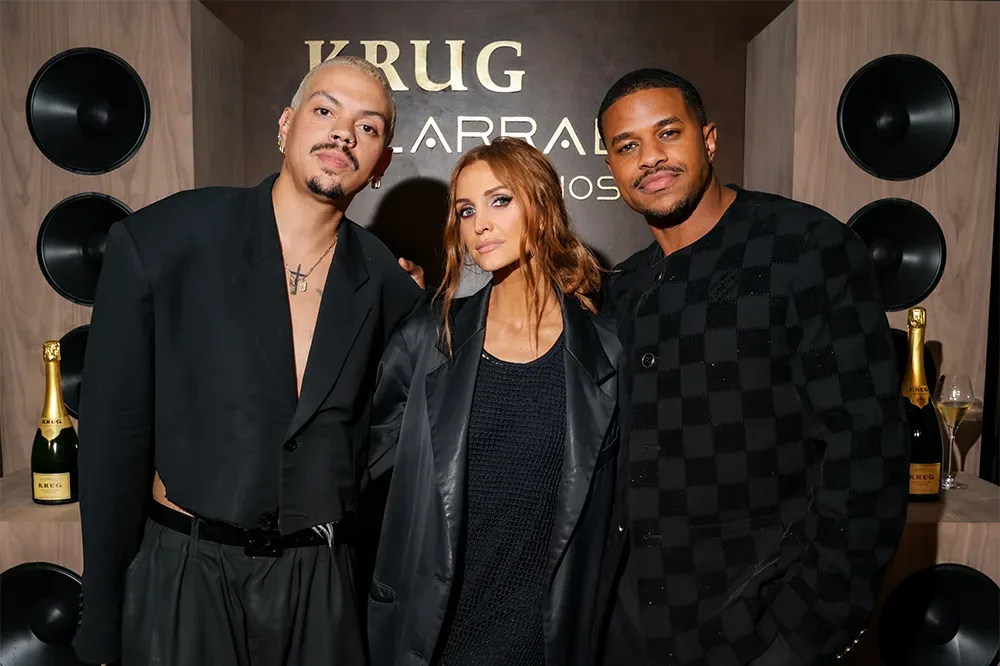
There are plenty of ways to pair a drink with music: put on a favorite record, build a dinner playlist, argue gently over who gets control of the speakers. Krug’s upcoming Los Angeles experiment takes the idea several steps further. “The Art of Blending Krug & Sound”, held at Larrabee Studios from September 28 through 30, is designed to turn the responses provoked by Champagne into an original piece of music made in the room.
The setting is Larrabee’s Studio 6, and the premise is more participatory than a conventional listening party. Guests are asked to describe their reactions to each pour—not merely flavor impressions, but the memories, moods, colors and sensations they connect with it. Those written and spoken responses then become prompts for a live composition. The goal is not to prove that every glass has one correct soundtrack. It is to show how personal associations can become creative material when a group of musicians and producers interprets them together.
That makes the event an unusual collision of tasting, studio craft and audience involvement. Champagne is typically discussed through aroma, texture, acidity and finish. Here, the vocabulary is intentionally wider. A participant might reach for a color, a feeling of nostalgia, a burst of energy or an image that has little to do with formal wine language. The music is built from that less technical, more emotional reaction.
How the Champagne-to-song concept works
Manny Marroquin, the 14-time Grammy-winning mixing engineer and owner of Larrabee Studios, is leading the sessions with producers Scott Tibbs, Nick Rosen and Mike Bennett. The event details for the preview also refer to a contributor named Costa during the live-composition process. What is clear is the central method: producers collect guests’ reaction words and translate them into musical decisions as the evening unfolds.
That distinction matters. This is not described as a playlist curated to match a bottle, nor as background music placed behind a formal dinner. It is a responsive composition process. In practical terms, guests supply the prompts; the production team turns those prompts into elements such as rhythm, melody, instrumental texture and energy. A word like “invigorating” might suggest momentum or a brisk beat, while “nostalgia” may encourage a more reflective tone. Those are interpretations rather than fixed rules, which is exactly why two sessions need not produce the same result.
At an advance gathering in Studio 6, words including red, invigorating and nostalgia informed two upbeat songs performed with cello, piano and drums. That demonstration puts some welcome limits around the concept: the tasting notes are not being converted into an abstract data visualization or a pre-programmed audio trick. They are prompts for human musicians and producers working in real time.
What “live composition” means here
Live composition does not necessarily mean beginning with a completely blank page and finishing a polished, radio-ready recording before dessert. In this context, it means assembling and performing music during the evening in response to the room. The producers’ expertise is crucial because an open-ended pile of adjectives needs to become an intelligible musical direction. The guests create the spark; the studio team makes that spark playable.
It is also a social exercise. Individual tasting notes can be solitary and private, but this format makes them communal. One person’s association may reinforce another’s, while a contrasting response may steer the resulting piece somewhere unexpected. Marroquin has framed Larrabee as a place where creative work emerges through exchange, and the event turns that idea into the structure of the night.
Related coverage includes Krug Brings a Live Champagne-to-Sound Experience to Larrabee Studios.
The approach offers an intriguing reminder that a listening environment is not passive. Music affects attention and mood; food and drink can do the same. Put the two together, invite people to articulate what they feel, and the room itself becomes part of the arrangement. The resulting track is therefore tied to a particular audience, sequence of pours and conversation. It is less a definitive musical portrait of a Champagne than a record of one evening’s collective response.
The bottles and the dinner
Krug 2013 and Krug Grande Cuvée 169ème Édition sit at the center of the Studio 6 experience. Chef Oscar Torres of VERSE is preparing a multi-course dinner, with further pours including Krug Grande Cuvée 173ème Édition and Krug Rosé 29ème Édition.
The terminology is worth unpacking. A cuvée is a wine blend or bottling; in this program, the word appears as part of the products’ names. “Grande Cuvée” is paired with an edition number, while Krug 2013 identifies a specific year. The event does not position those labels as a test guests must study before entering. Instead, each pour supplies a new occasion for reaction and a possible pivot in the music.
That is a smart structural use of a dinner format. Multiple courses and pours naturally create chapters, rather than one uninterrupted block of sensory information. The event can move from first impressions to changing conversations, and then from those conversations into different pieces of music. The components remain distinct: Torres’s food pairing is one part of the evening, while the producers’ live work is another. Yet both are built around the act of paying attention.
For people accustomed to treating tasting notes as intimidating shorthand, the experiment also opens the door to a more accessible response. No supplied detail suggests guests need expertise in Champagne or music production. The preview’s own examples—color, energy and nostalgia—are ordinary words, not a recitation of specialist descriptors. The invitation is to notice an association and share it.
A studio with its own listening history
There is a reason a recording studio changes the tone of the occasion. Studio 6 is normally a working creative space rather than a standard dining room, and the limited sessions offer public access to it. During the preview, the room played songs associated with Larrabee’s history, including John Mayer’s “Gravity” and Portugal. The Man’s “Feel It Still.” Pianist Chloe Flower later performed live, while a jeroboam of Krug Grande Cuvée 163ème Édition arrived for a final pour.
A jeroboam is a large-format bottle. Here, the point is primarily theatrical: the presentation gave the preview an obvious finale. But it also underlines the event’s basic preference for scale and shared ritual over a quiet, individual tasting. Everything about the plan—Studio 6, the handwritten prompts, the live instrumentation and the closing performance—pushes toward a memorable group encounter.
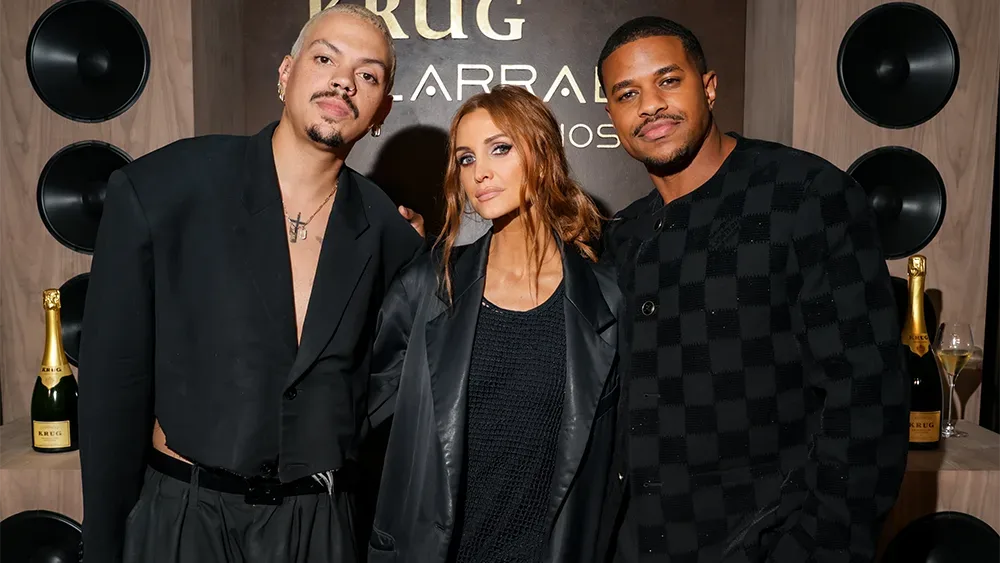
The preview audience included Nas, Ashlee Simpson Ross, Evan Ross, Jeremy Pope, Sabrina Claudio, producer Dahi and Flower, among others. Their presence reflects the event’s overlap with Los Angeles music culture, but the public sessions are not presented as celebrity appearances. The core offering is access to the format: a chance to participate in the prompt-to-performance process inside the studio.
For another angle on how playback hardware can shape the experience of recorded music, Joking Joystick has explored why a turntable stylus upgrade can matter more than Bluetooth for vinyl sound. Krug and Larrabee are taking a different route, focusing not on playback fidelity but on the environment and emotions surrounding a live piece of music.
Why this is more than a branding playlist
Krug has previously explored the relationship between sound, taste and emotion with musicians and composers, including Max Richter. The Larrabee collaboration extends that interest by making guests part of the creative input rather than simply the recipients of a finished pairing.
That is the project’s most interesting practical implication. A standard music-and-drink pairing can suggest that a particular track objectively belongs with a particular bottle. This model accepts that reaction is variable. One group might produce words associated with brightness, intensity or celebration; another might dwell on memory, calm or contrast. The producers’ work is to make a coherent response to the people actually in the room, not to enforce one permanent answer.
There is a modest lesson for any music fan in that framework. Describing a reaction—even with imprecise language—can sharpen listening. It asks participants to move beyond “I like this” or “I don’t like this” and identify what an experience evokes. A musical preference might become a color, a physical sensation, an image or a memory. In Studio 6, those fragments then have the rare chance to become the beginning of a song.
Following the three-night run, Torres will carry the idea to Larrabee’s neighboring restaurants, VERSE and Mensano, with a month-long Krug Grande Cuvée pairing inspired by the collaboration. The restaurant extension is a continuation of the food-and-Champagne side of the project; the limited Studio 6 sessions remain the portion built around live, guest-informed composition.
Reservations for the intimate public events are available through Tock. For anyone who has wondered whether “nostalgia” has a tempo, or whether “red” belongs on cello, piano and drums, this is a particularly lavish way to find out.