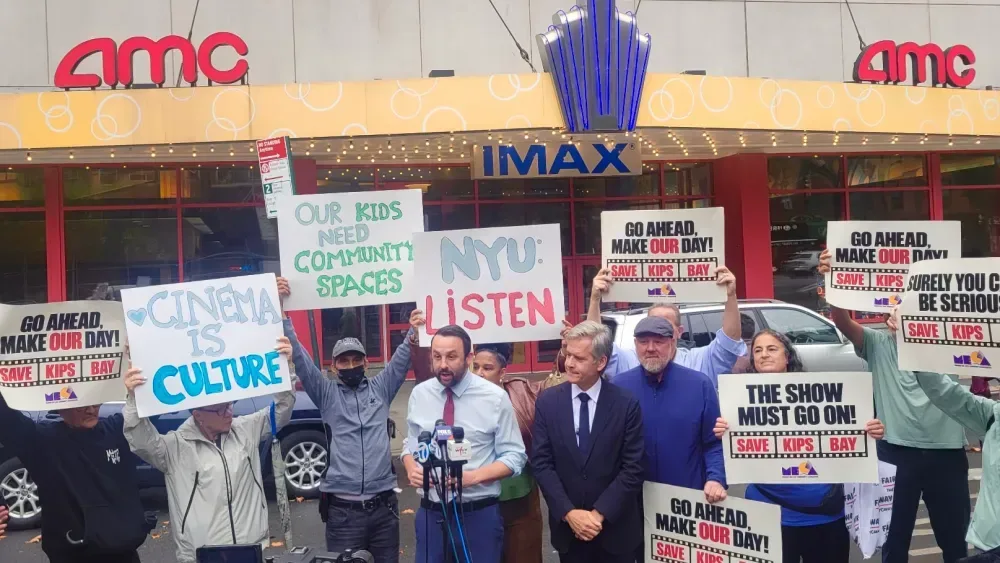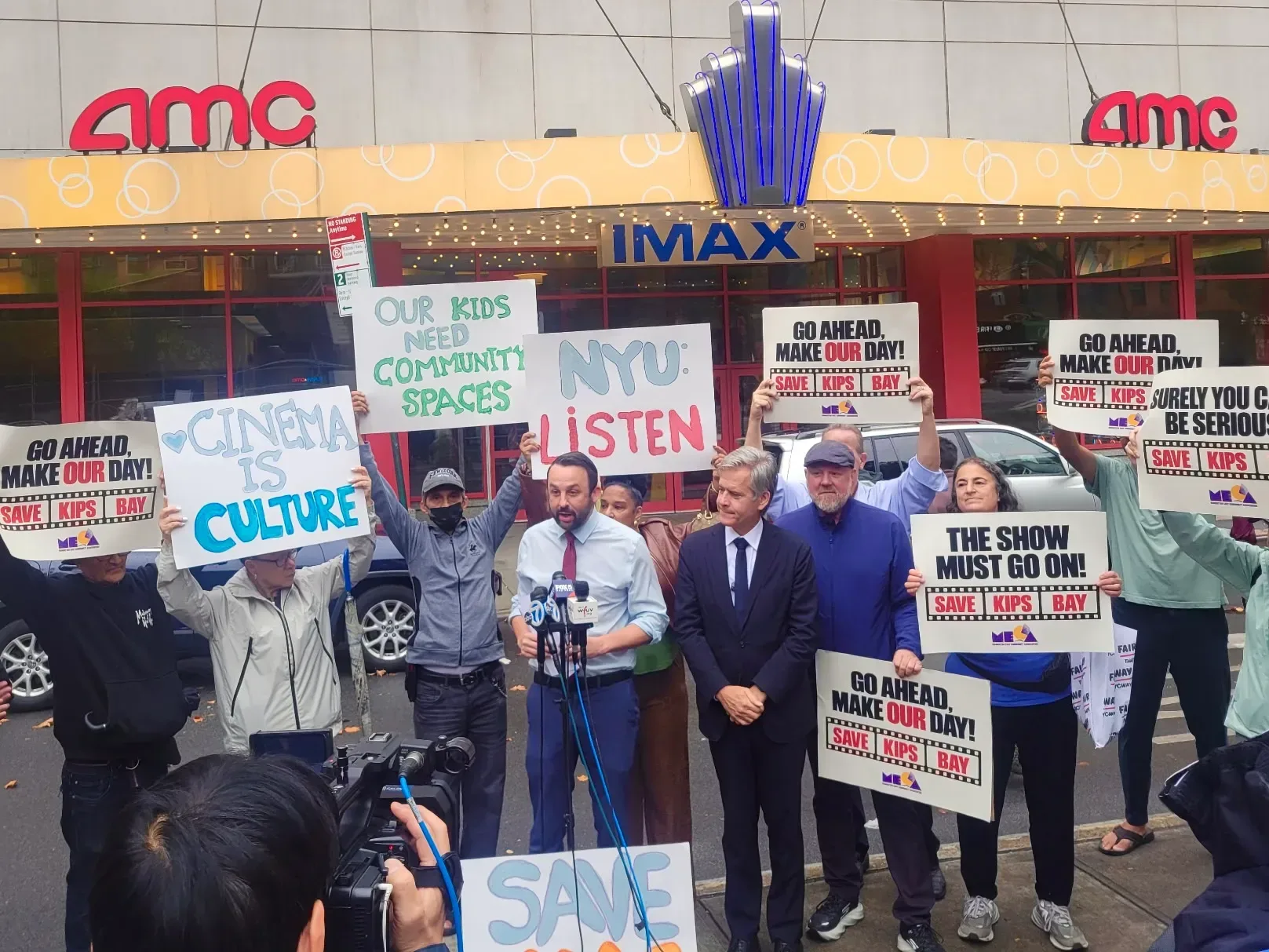
For a neighborhood movie theater, the pitch was suitably cinematic: more than 100 New Yorkers gathered outside AMC Kips Bay 15 on a rainy Sunday, with Manhattan Borough President Brad Hoylman-Sigal reciting the familiar AMC pre-show line, “We came to this place for magic,” in an Australian accent. The occasion, however, was far less playful. The Kips Bay multiplex is expected to close at the end of the year, prompting residents, local businesses and elected officials to make a public case for keeping it alive.
The rally, titled the “Save the Kips Bay AMC Theater Rally,” centered on a simple concern: a neighborhood that loses a cinema loses more than screens and showtimes. It loses a reliable public place for meeting friends, discussing movies after the credits, taking children or relatives out, and participating in entertainment as a shared activity rather than an individual stream at home.
That distinction helps explain why the demonstration drew attendees across generations. Lucy Di Lorenzo, a lifelong Kips Bay resident, said she had been going to the theater since childhood. Local patrons also described a theater having existed at the site since 1973. AMC Kips Bay 15 is the chain’s second-largest multiplex in Manhattan, making its potential departure especially consequential for people who want a nearby theatrical option.
A closure expected before a sale is finalized
The property’s status requires some care. NYU Langone says its purchase of the Second Avenue site is under contract, not yet complete, and is not expected to close until early next year. The health system said it is considering the location because of its proximity to its Manhattan hospital campus and a need to expand clinical services as demand grows.
NYU Langone also said that AMC and the landlord had previously agreed to a lease provision allowing either party to terminate at any time. In practical terms, the cinema’s uncertain future is not presented as a straightforward eviction following a finalized acquisition. The theater is nevertheless expected to close at the end of the year, while the larger real-estate transaction remains pending.
That timeline is central to the campaign. Organizers and residents see an opening to ask both AMC and NYU Langone for engagement before the theater is gone. Their argument is not that healthcare access is unimportant; NYU Langone has framed its interest in the parcel around community healthcare needs. Rather, the protesters are asking whether growth in one essential neighborhood function must come at the expense of one of the area’s remaining cultural gathering places.
Why a multiplex can be a community space
A multiplex is, of course, a commercial business. It sells admissions, concessions and premium experiences, and its programming changes from week to week. But its civic role can be broader than its business model. Movie theaters create one of the few routine settings where large numbers of strangers choose the same cultural event, at the same time, in the same room.
That shared experience is particularly meaningful in dense neighborhoods. A nearby cinema makes spontaneous plans easier: see a movie after work, meet before a showing, continue the conversation afterward at a bar or restaurant. When a theater disappears, none of those individual activities necessarily vanishes, but the convenient anchor connecting them can.
The local response around Kips Bay reflects that effect. Paddy Reilly’s Music Bar, an Irish pub around the corner from the theater, promoted the rally and offered a free drink to people who showed a selfie from it. Owner Desi Murray described the cinema as important to the area’s many young moviegoers and called its potential loss significant for the community. The bar is celebrating its 40th year in business, illustrating how the theater’s impact reaches neighboring establishments as well as ticket buyers.
Those spillover effects do not automatically settle the underlying property question. NYU Langone has cited growing clinical demand, and healthcare facilities also serve local residents. But they do make the debate larger than nostalgia. The disagreement is about what mix of spaces a neighborhood needs, how decisions affecting that mix are communicated, and whether residents get meaningful opportunities to respond before a major change is effectively irreversible.
Officials seek earlier community engagement
The rally was organized by the Eleanor Roosevelt Independent Democrats, a local political club that represents communities in the Lower East Side, East Village and Midtown East. Its president, Judith Gross, said members were devastated by the news but hoped the turnout would persuade AMC and NYU Langone to listen.
New York State Sen. Kristen Gonzalez raised a related concern about communication. She said officials had to contact NYU Langone to learn it was pursuing the land, despite the health system already being an established neighbor. Her position was that it is reasonable to expect proactive outreach when a project could remove a widely used local amenity.
“Community engagement” can sound abstract in a development dispute, so it is worth defining plainly. It means informing affected people early enough that their feedback can still influence planning, rather than presenting a completed decision and calling the later reaction consultation. It does not guarantee that residents receive their preferred outcome. It does mean they can understand the proposal, identify concerns, and ask decision-makers to consider alternatives or mitigations while options still exist.
For the Kips Bay campaign, the key uncertainty is whether there is a workable route to preserve the theater or retain some kind of cinema presence as plans evolve. No replacement plan, preservation agreement or new theater commitment was described. NYU Langone said it would provide updates on clinical plans after the transaction is finalized. AMC’s expected year-end closure therefore remains the immediate issue for moviegoers.
The practical stakes for local moviegoers
The rally arrived despite what was described as a record-breaking summer at the box office. That juxtaposition matters: a strong box-office period does not, by itself, secure every individual location. A theater’s future can also depend on its lease terms, property ownership, landlord decisions and potential alternative uses for the site.
For regular patrons, the practical impact of a closure would be fewer nearby screening choices. That can mean more travel for a specific film, fewer easy last-minute outings, and less ability to choose a theatrical showing based on a convenient local schedule. The change may be felt most sharply by people who have incorporated the venue into a longstanding weekly or family routine.
It also affects the texture of movie conversation. At Paddy Reilly’s, locals were already talking about the humor in Resident Evil and Robert Pattinson’s performance as Batman. That is the low-stakes but valuable social life surrounding a cinema: films become prompts for debate, recommendations and memories. For more entertainment context, readers can also explore Ke Huy Quan’s reflections on the lasting impact of his early film work.
What happens next remains unsettled
There are several facts worth keeping separate. AMC Kips Bay 15 is expected to close at year’s end. NYU Langone says its purchase is still under contract and is expected to close early next year. The health system says it is exploring clinical expansion near its Manhattan campus and will share clinical plans once the deal is finalized. The cinema lease, NYU Langone says, contained a mutual termination right that predated its involvement with the property.
Beyond those points, the future remains unresolved. Organizers want AMC and NYU Langone to recognize the theater’s role in neighborhood life and engage directly with the people who use it. The health system has articulated a healthcare rationale for its potential acquisition, while residents have articulated a cultural and social rationale for preserving the multiplex.
For now, the protest has made the disagreement visible: Kips Bay residents are not treating the possible closure as a quiet change in retail tenancy. They are treating it as a decision about the kind of neighborhood they want to inhabit—and about whether “magic” at the movies can remain within walking distance.