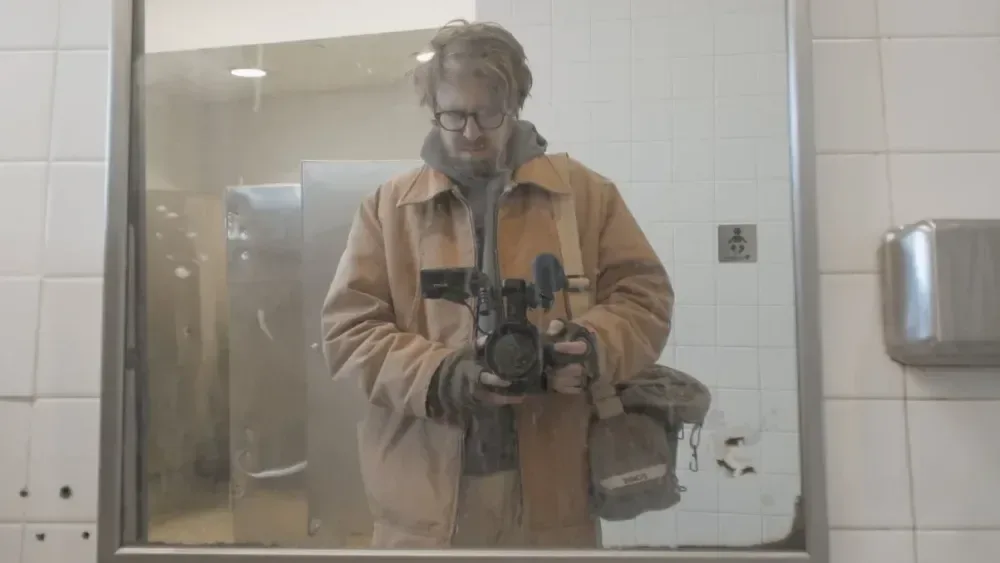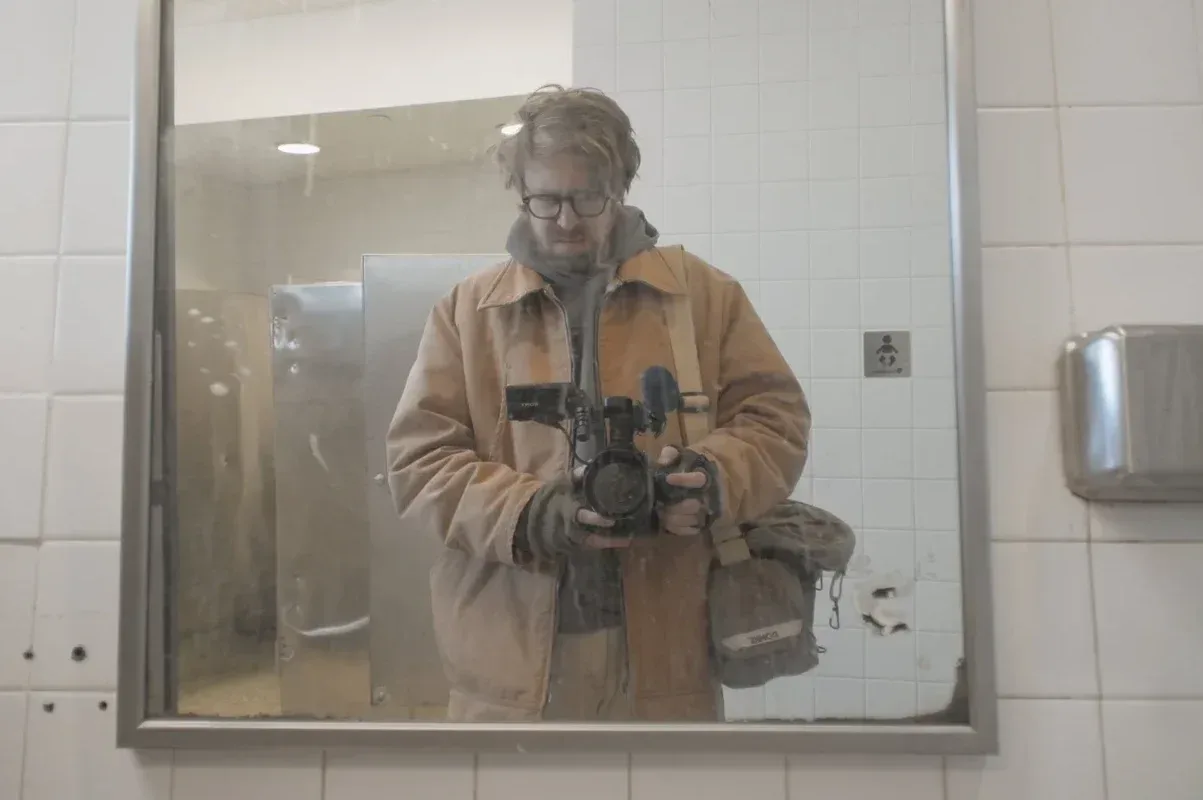
Minor spoilers for The History of Concrete follow.
A film named The History of Concrete sounds like a dare: either it will be exactly what the label promises, or it will use that most literal of topics as a route toward something stranger. John Wilson’s new documentary does both. It follows concrete through conventions in Las Vegas and New Orleans, ancient buildings in Italy and graves whose locations are not disclosed. But Wilson ultimately finds a second, more awkward material to excavate: the process of convincing the entertainment business that a movie with that title deserves to exist.
That dual purpose is the key to the film’s appeal. Wilson began with a sincere ambition to make a definitive film about concrete. About a year into the process, however, the repeated effort to fund and sell the project became compelling enough to enter the movie itself. Zoom pitches to executives sit alongside travel, observation and encounters with people whose lives connect only loosely, if at all, to the subject at hand. The result is not simply a documentary about a building material. It is also a documentary about the ideas that become legible to gatekeepers, and the ones that have to fight for a hearing.
The title is part of the experiment
Wilson is best known for How To, and the feature shares that work’s interest in following a plain premise until it opens into something expansive, uncomfortable or unexpectedly tender. Here, the phrase “history of concrete” functions as both a subject and a test. Once the finished movie exists, the title can sound amusingly dry because viewers know there is an actual film behind it. Before that point, when someone is being asked to put up money, it carries a different weight.
Wilson has described the funding ask as being in line with the scale of a streaming documentary and comparable to what his earlier series cost. Yet the difficulty was greater than he expected. The film reportedly shows only a portion of that struggle; Wilson did not want the feature to be overloaded by the setbacks. That restraint matters. A movie about a difficult pitch can easily turn into a record of professional grievance. Instead, the production problem appears to be a structural pressure that explains why the title, the footage and the people encountered all feel unusual.
The broader criticism Wilson raises is not that documentaries need familiar subjects to survive, but that decision-makers may find it easier to approve stories whose dramatic value has already been publicly validated. He points to repeated accounts of sensational crimes or musicians whose careers have already passed through recognizable stages. Those are not inherently lesser subjects. The issue is what happens when predictability becomes the main evidence that a nonfiction story is worth making.
In that sense, the film’s self-awareness is more than a behind-the-scenes bonus. It makes the conditions of production visible. “Meta” storytelling can be an imprecise term, but here it means the work includes the circumstances of its own creation. The documentary does not pretend that a filmmaker simply arrives at a subject with a camera and emerges with a finished feature. It includes the layers of approval, presentation and uncertainty that stand between an idea and a release.
A feature gives the observations time to change shape
Wilson sees the longer format as an opportunity for what he calls more durational subjects. “Durational” in this context means stories that unfold across a substantial stretch of real time rather than being compressed into a quick encounter. The documentary includes a 3,100-mile race that lasts for months, and Wilson says he spent a year and a half with one of the film’s central people near its end.
That distinction helps explain why a feature-length version of this approach can feel different from episodic television even when the surface style is related. A shorter episode has to find a shape fast. A feature can let the original topic drift, return and acquire new emotional associations. Concrete may remain the anchor, but a lengthy project allows chance meetings, repeated contact and a filmmaker’s own changing understanding of the project to become part of the architecture.
Wilson has framed the film as broader in scope and, in some respects, like a foundation for the rest of his work. The concrete metaphor is almost too convenient, which is presumably why it works: the documentary’s literal material is also the base from which its other stories spread. The film starts with hard surfaces but keeps arriving at people, including a professional gum buster and a local musician named Jack who is dealing with grief.
That contrast is not merely decorative. Concrete is a physical foundation, while Wilson’s interest lies in what ordinary environments reveal about the people moving across them. He describes Jack as having an especially soft interior in a world of hard surfaces. The phrase describes the film’s underlying method: follow an impersonal object, workplace or location patiently enough and a personal story may emerge.
Closeness, responsibility and a little distance
Long-term documentary work raises an unavoidable question: what does a filmmaker owe a participant when the camera is off? Wilson’s account of working with Jack suggests a practical balance rather than a grand rule. They met at a liquor store close to Wilson’s home, making their paths likely to cross outside the project. At the same time, producer Francis Carr generally handled communication about Jack’s performances and other logistics.
Wilson argues that some journalistic distance has value when a filmmaker is working with many people. That does not mean indifference. Rather, it recognizes that proximity can complicate the act of representing someone. A documentarian may build rapport, return over months or years and remain accountable for choices in the edit, but does not have to turn every subject relationship into a friendship or a one-to-one support system.
The account is also a useful reminder that documentary intimacy is not a single thing. It can be created through duration, through recurring neighborhood encounters, through attention during filming or through the space given to somebody’s story. The film’s emotional charge seems to come from letting those forms of connection stay somewhat unresolved instead of reducing them to a neat inspirational arc.
The celebrity scene is designed to be uncomfortable
One likely flashpoint is footage from a GQ dinner in which Dwyane Wade gives a toast to Kim Kardashian. Wilson films Kardashian looking directly toward his camera. He says he did not interact with her, and that his discomfort began the moment he entered the room; operating the camera actually made the situation easier to navigate.
The scene’s intent, as Wilson explains it, was not to chase a celebrity encounter but to preserve the oddness of sitting across from someone so famously photographed and watching the moment without the usual editorial cushioning. He deliberately left out musical score. A score is music placed beneath a scene to steer mood, build suspense or signal how an audience should interpret an image. Its absence can make silence, room tone and eye contact feel more exposed. Here, that choice seems designed to hold viewers inside the social tension rather than quickly telling them whether to laugh, admire or recoil.
Wilson regarded the event as a rare environment worth documenting and noted that an internal film-and-photo crew was also recording it. He has been cautious about how such material becomes possible to use, saying only that the film’s release in its present form feels remarkable. The important point for the viewer is that the sequence is presented as an observation of celebrity-event awkwardness, not as an interview or a claimed interaction with Kardashian.
Tim Robinson appears at the end of the shot, providing the release valve. Wilson says the original cut did not include Robinson; it held on the unsettling eye-contact moment. After showing the film to viewers, he found that the reveal worked as a comedic way to break the tension. It is a small editing decision with a large effect. The scene can sustain discomfort, but the later reveal gives the audience permission to exhale.
That laugh also carries a limitation Wilson recognizes. In some international screenings, it reportedly drew little response because Robinson and other cultural reference points did not have the same recognition value. Comedy built on a face, brand or public persona can travel unevenly. The basic rhythm of a reveal may remain, but the precise punchline depends on shared familiarity.
Accident, editing and the last image
Wilson’s favorite images point to the blend of accident and construction that defines this kind of filmmaking. One involves filming a sidewalk: his shadow is visible as the camera zooms in, then a sharp change in light makes the shadow appear to vanish into the pavement. It was unplanned, but Wilson found it poetic. The image fits the film’s larger interest in surfaces, observation and the way a person behind a camera can become momentarily absorbed by the world being recorded.
Another favored moment is more overtly comic: a tattoo-preservation specialist casually asks his father where Chef Boyardee is buried. Wilson calls the timing remarkable. What began as a seemingly offhand question became important enough to help determine the movie’s ending.
Wilson was still filming after the documentary had been accepted into Sundance. With only four days before the film needed to be ready, he was considering a visit to Chef Boyardee’s grave as the final shot. Producers Josh Safdie, Ronnie Bronstein and Eli Bush urged him to get it. Wilson filmed the sequence alone on Christmas Eve, one day before the picture was locked.
“Picture lock” is the stage at which the edit is treated as final: the order and duration of shots are no longer supposed to change before finishing work proceeds. That makes the timing especially striking. The ending was not a detail settled years in advance; it was captured under a near-final deadline and then built into the completed structure. Wilson also notes that the Christmas Eve shoot connects with a Christmas theme, although that production fact would not be obvious to an audience.
The last-minute decision is not proof that every film should be assembled in a sprint. It does, however, reveal something central about Wilson’s method. His documentaries make room for what cannot be scheduled: an odd question, a shift in light, a person who changes the scale of the story, or a final image that becomes clear only once most of the movie is already there.
Why the concrete pitch matters beyond one film
The History of Concrete has a deliberately unglamorous premise, and that is precisely why its production story has force. The title exposes a common reflex: a demand that a documentary announce its stakes in advance through celebrity, scandal, a pre-sold concept or a known cultural event. Wilson’s answer is not that subjects must be strange for strangeness’ sake. It is that the value of an original project may lie in the connections a creator discovers after the first, apparently narrow question has been asked.
There is a practical implication for viewers, too. A documentary’s topic is not always its final destination. The words on the poster can describe the entry point rather than the full experience. In Wilson’s case, concrete leads to labor, death, celebrity observation, grief, visual accidents, an endurance race, industry meetings and a grave-side coda involving a canned-food icon.
That sprawling route is an argument for curiosity as a production value. It is also a useful counterpoint to an entertainment economy increasingly eager to demonstrate familiarity and predictability before audiences get a chance to see the work. For another look at how the industry’s push toward technical novelty can expose deeper creative questions, see this examination of AI entertainment’s problems.
Wilson’s film is now in theaters through Magnolia Pictures. Its biggest joke may be that a title people initially dismiss as impossible to sell turns out to contain an entire worldview: look long enough at the least promising object in the room, and it may show you how much human life has been built around it.