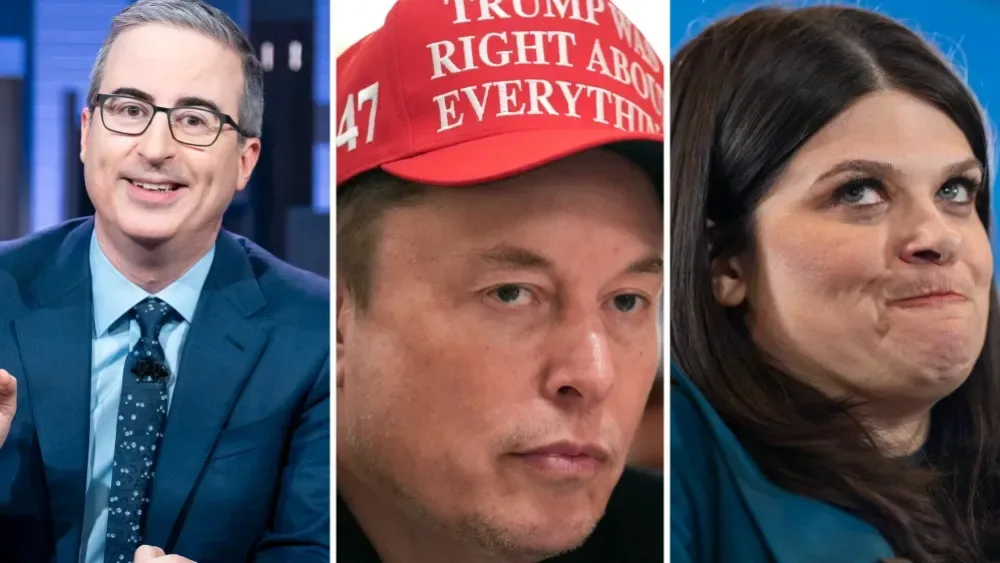
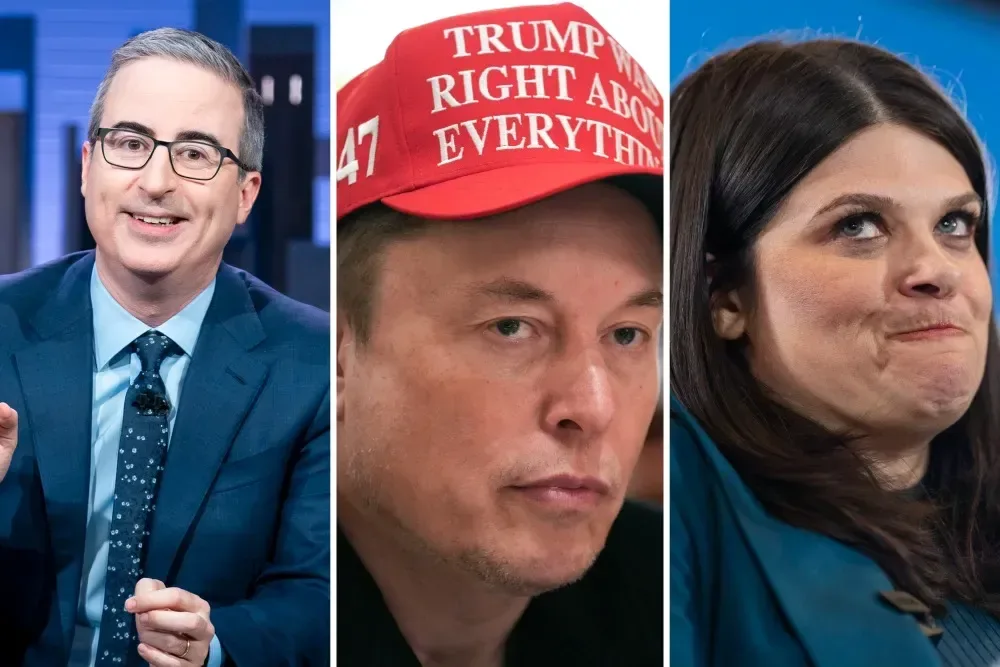
John Oliver’s latest Last Week Tonight opening turned postelection processing into a rapid-fire victory lap. Following midterm results described as a decisive Democratic resurgence, Oliver focused on the scale of the reported wins before narrowing his attention to two targets: Elon Musk and Michigan politician Haley Stevens.
The comic’s point was not subtle. He framed the election as a moment when several outcomes that had seemed unlikely or hard-fought arrived at once, creating the kind of results list that can feel almost unreal in the immediate aftermath. Texas turning blue was central to that sense of disbelief, as were reported wins and milestones in congressional, gubernatorial and state-government races.
A crowded results board became the joke’s engine
Oliver opened by calling it a busy week and a good one, then leaned into the difficulty of taking in so many favorable outcomes at once. That structure matters: instead of treating one result as the entire story, the monologue built momentum by stacking results.
Among the outcomes highlighted were Democrats securing 22 state trifectas, Chris Pappas becoming the first openly gay man elected to the U.S. Senate, Deb Haaland becoming the first Native American woman elected governor of a U.S. state, and Keisha Lance Bottoms becoming the first Black woman elected governor of a U.S. state in Georgia.
A state trifecta generally means one party controls a state’s governorship and both chambers of its legislature. It is political shorthand with practical importance: unified control can make it easier for a party to advance its legislative agenda, while divided government can require negotiation or lead to stalemate. Oliver used the figure less as a policy lesson than as another entry in an accumulating list of results he found striking.
His delivery also relied on the emotional whiplash of election night: a viewer processes one surprising result, then another arrives, then another. In that format, the comedy comes from an overflow of good news for the speaker’s preferred side rather than from a detailed assessment of every contest.
Michigan’s Abdul El-Sayed race put Haley Stevens in Oliver’s crosshairs
Oliver singled out Abdul El-Sayed’s Michigan win, saying that hostile attacks directed at El-Sayed had failed. He paired that outcome with sharp criticism of Haley Stevens, arguing that her political decision had backfired.
The supplied account says Stevens, characterized there as a Democrat, backed Republican candidate Mike Rogers rather than El-Sayed during the primary contest. El-Sayed ultimately won. Oliver’s argument was therefore about the political consequence of that choice: a candidate he viewed as having abandoned the eventual winner’s campaign did not get the outcome she had supported.
Related coverage includes John Oliver Takes Aim at Musk and Haley Stevens After Midterm Results.
The segment’s language was intentionally caustic, and it is worth separating the rhetoric from the underlying fact pattern. Oliver’s declaration that Stevens had damaged her own career is commentary, not an established measurable result in the material available here. The supported event is the endorsement choice and El-Sayed’s eventual victory; the prediction about Stevens’ future is Oliver’s punchline and political judgment.
He similarly celebrated Susan Collins’ loss with a critique built around a long-running public image: expressing reservations before ultimately supporting a contested action. That is a familiar late-night technique—compressing a politician’s perceived pattern into a single, repeatable comic premise—though the monologue’s aim was plainly celebratory rather than neutral.
Musk’s spending drew the night’s biggest comparison
Elon Musk received perhaps the cleanest joke of the segment. Oliver said Musk had spent roughly half a billion dollars trying to influence the midterm cycle, only for that effort to fail. The account specifies that the total was nearly $500 million, including $200 million spent unsuccessfully in an effort to defeat Texas Senator-elect James Talarico.
Campaign spending is often treated as evidence of power, reach or commitment. Oliver flipped that assumption. In his telling, the more consequential number was not the amount spent but the fact that it did not produce the desired electoral result. That reframing made the spending figure useful as both political criticism and setup for a consumer-product gag.
Oliver compared the money spent on the election effort to a parked Cybertruck going up in flames.
The joke then folded in separate news that production of the Cybertruck was ending. Oliver acknowledged that the production development was not itself an election result, but suggested it carried a similar emotional charge for people enjoying Musk’s political defeat. The connection is comedic, not causal: the available material does not establish any relationship between election spending and Cybertruck production plans.
That distinction is important because the bit works by deliberately merging unrelated disappointments into one broader image of setback. Late-night satire frequently operates this way, using a recognizable product or company as a cultural shorthand for a public figure. It can communicate an attitude efficiently, even when it is not making a technical claim about the business.
For readers interested in the broader technology-business context around high-profile executives and their companies, Apple’s ecosystem-focused growth under Tim Cook offers a contrasting lens on how corporate identity, product strategy and public-facing leadership can become tightly linked.
Why the monologue lands as entertainment rather than election analysis
Oliver’s segment was structured for television satire, not for an exhaustive results breakdown. The opening assembled milestones, upsets and high-profile losses into a single emotional narrative: a huge political win followed by a chance to mock people he regarded as having backed the wrong side.
That approach gives the piece its pace. A comprehensive political analysis would need to examine individual race conditions, turnout, campaign messaging, local issues, spending channels and the limits of post-election interpretations. None of that is the point of a cold open. Oliver instead uses the news cycle’s broad contours to make a compact argument about consequences.
The consequences he emphasized were symbolic as much as electoral. Texas changing political color carried obvious national significance in the monologue. Historic firsts in Senate and gubernatorial races made the outcome feel larger than a routine shift in congressional control. Musk’s spending became a test case for whether extraordinary financial influence guarantees an outcome. And Stevens’ support for Rogers became an example of a political gamble that, in Oliver’s view, ended badly.
What the segment does—and does not—claim
- It does claim: Democrats achieved a sweeping set of reported midterm wins, including control of Congress.
- It does claim: Musk spent nearly $500 million during the cycle, with $200 million aimed at defeating Talarico in Texas, unsuccessfully.
- It does claim: Stevens backed Mike Rogers over El-Sayed, who went on to win.
- It does not establish: that Musk’s spending alone determined—or failed to determine—every relevant race outcome.
- It does not establish: that Cybertruck production news had any causal connection to the election.
- It does not establish: that Stevens’ political career is permanently damaged; that was Oliver’s opinion expressed through comedy.
In other words, the segment’s factual hooks are substantial, but its main purpose is tonal. Oliver is savoring a political outcome, calling out people he believes misread the electorate, and turning an enormous spending total into a punchline about the limits of money and celebrity.
The recurring late-night formula: facts first, catharsis second
The strength of this kind of monologue is that it begins with recognizable events before escalating into editorial comedy. Viewers do not need a deep procedural explanation of every contest to understand the central contrast: large investments and prominent endorsements did not prevent a slate of outcomes Oliver celebrated.
That does not make the jokes objective, nor are they intended to be. The show’s perspective is explicit. The most useful way to read the segment is as a sharply partisan cultural response to an election, one that uses reported results as the foundation for an argument about public rejection, failed influence and political miscalculation.
For Oliver, the week’s satisfaction was cumulative. One win was good; a long run of wins, historic firsts, expensive failures and the collapse of an opponent’s preferred narrative was better. By the time the monologue arrived at Musk and the Cybertruck, it had already established the premise: the jokes were the celebration.