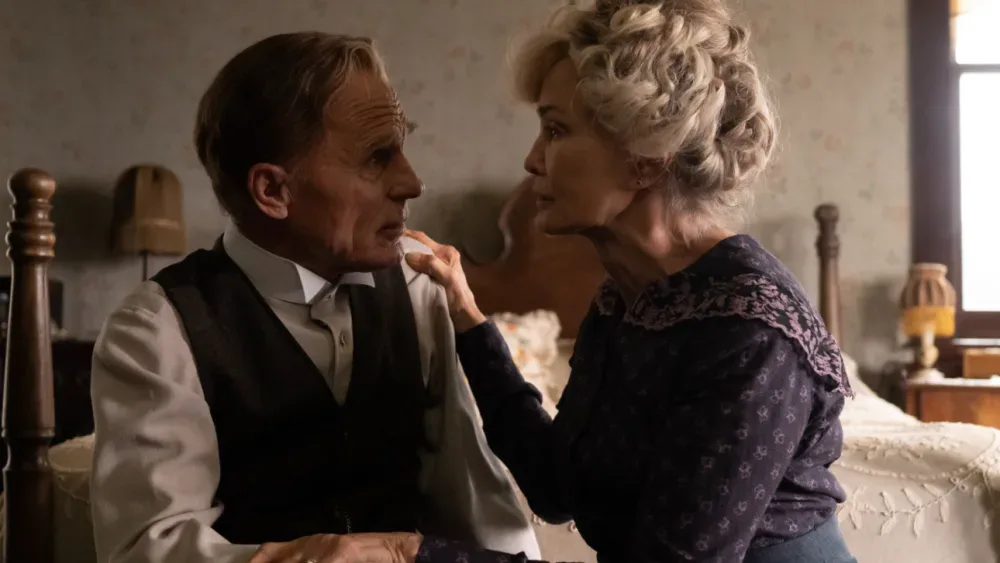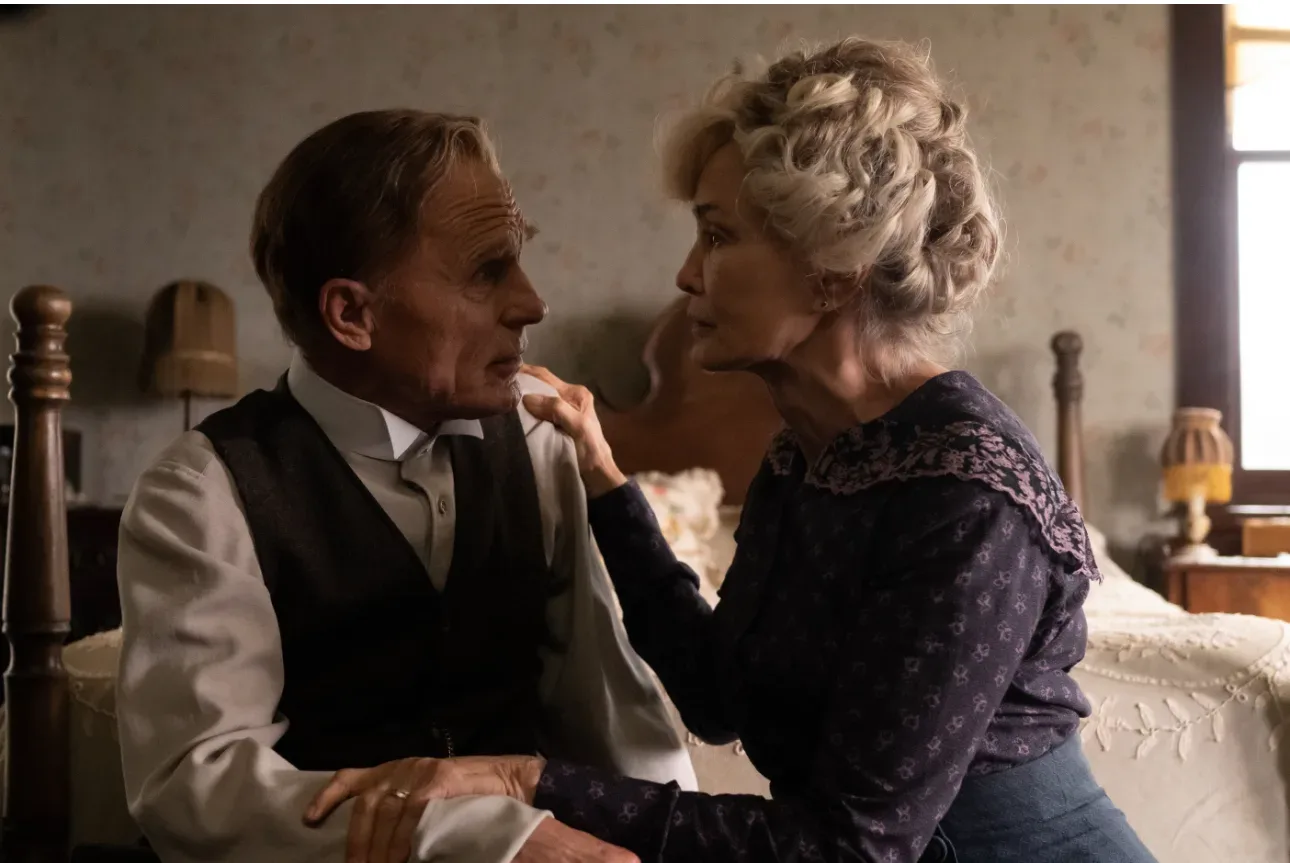
Quiver Distribution has acquired the U.S. rights to Long Day’s Journey Into Night, a feature-film adaptation of Eugene O’Neill’s Pulitzer-winning drama. The film places a formidable quartet at the center of the Tyrone family: Jessica Lange as Mary, Ed Harris as James, Ben Foster as Jamie and Colin Morgan as Edmund.
The release is scheduled for select theaters on September 25. It is also set for a Monday screening at Film at Lincoln Center. Those details establish a deliberately theatrical introduction for a project built around one of American drama’s most demanding family stories, with its pressure-cooker setting, old grievances and painful intimacy.
Jessica Lange Returns as Mary Tyrone
Lange’s role carries a particular connection to the play’s stage legacy. She is reprising Mary Tyrone, the part for which she won a Tony Award. Jonathan Kent, making his feature-directing debut with this film, previously directed Lange in the same role on Broadway.
That continuity matters because Mary is not a character who can be reduced to a single trait. In the Tyrone household, every gesture and exchange exists beside a larger history of disappointment, dependence, affection and denial. A screen version has the opportunity to bring the audience physically closer to those shifting emotions, while the performance still has to retain the scale and precision that the material requires.
Kent has emphasized that a screen translation of a play of this stature depends first on its actors. His comments pointed to the central importance of the four performers depicting the family, and to the challenge of keeping the film’s emotional focus on their relationships rather than treating the source merely as a prestigious literary property.
Ed Harris, Ben Foster and Colin Morgan Complete the Tyrone Family
Harris plays James Tyrone, Mary’s husband. The casting places Lange and Harris at the head of a household whose members are tied together by love but continually wounded by the ways they express it—or fail to. The dramatic engine is not an outside spectacle arriving to disrupt a calm home. The crisis is already embedded in the family’s past and in the ways each person copes with it.
Foster plays Jamie, the Tyrones’ elder son, who is described as alcoholic. Morgan plays Edmund, the younger son, an optimistic and poetic figure based on O’Neill himself. The contrast between the brothers is essential to the story’s architecture: one has been battered into destructive habits, while the other still carries hope and sensitivity even as the family’s circumstances close in.
That four-person concentration is one reason the adaptation’s cast is so central. A film can expand the visual language around a play, but Long Day’s Journey Into Night remains fundamentally a drama of people unable to cleanly escape one another. Every performer has to hold a distinct perspective while also making the family’s collective history feel present.
- Jessica Lange plays Mary Tyrone.
- Ed Harris plays James Tyrone.
- Ben Foster plays Jamie Tyrone, the eldest son.
- Colin Morgan plays Edmund Tyrone, the younger son.
An Autobiographical Family Drama Moves to Film
O’Neill’s play is autobiographical in inspiration, and Edmund is based on the author. The Tyrone family narrative follows its members as they confront personal trauma and attempt to live inside a volatile mixture of tenderness, resentment and memory. That is a useful reminder of what the title promises: this is a story shaped by duration. The day does not simply pass; it presses down on the people living through it.
For audiences who know the play, the film’s appeal will include seeing how a new medium approaches material famous for the intensity of its language and performances. For those meeting the Tyrone family for the first time, the setup is direct but far from simple: a family gathers, old patterns emerge, and everyone is forced to reckon with the distance between what they feel and what they can say.
The project was adapted for the screen by David Lindsay-Abaire. Screen adaptation is especially consequential with a work so closely associated with theatrical performance. The task is not only to preserve the narrative and its characters, but to find a film rhythm for a story whose power comes from accumulation. The emotional damage is not delivered as a one-note revelation; it is disclosed through conflict, defensiveness, longing and the repeated effort to rewrite the past.
Jonathan Kent Makes His Feature Debut
Long Day’s Journey Into Night is Kent’s first feature as a director. His prior work with Lange in the role of Mary supplies a clear creative bridge between stage and screen, though the film is its own production rather than simply a recorded stage version. Kent’s stated emphasis on the cast suggests that the adaptation will be anchored in the Tyrone family’s performances above all else.
That approach fits the property. The film’s most important question is not whether the story can be made larger through scenery or external action. It is whether the camera can capture the complicated, frequently contradictory ways that family members see each other. James, Mary, Jamie and Edmund are not interchangeable pieces in a domestic tragedy; they each represent a different form of regret, expectation and survival.
The arrival of another serious stage-to-screen production also lands during a period when viewers are reassessing entertainment’s changing costs and formats. Streaming price hikes are forcing viewers to reconsider what entertainment is worth, while a select-theater run foregrounds the continuing value of seeing actor-driven drama in a cinema setting.
Release Details and Production Team
Quiver Distribution will release the film in select theaters on September 25, following its acquisition. A Film at Lincoln Center screening is planned for Monday. No broader release plan is specified here, so audiences should treat the confirmed information as limited to the select-theater date and the listed screening.
The producers are Gabrielle Tana, Bill Kenwright, Gleb Fetisov and Redmond Morris. Together with Lindsay-Abaire’s screenplay and Kent’s direction, the production brings O’Neill’s family drama to film with a cast led by Lange and Harris.
There is a certain built-in risk whenever a canonical play reaches the screen: familiarity can become a burden if the adaptation treats reputation as a substitute for urgency. But the announced creative team is centered on a specific answer to that problem. Lange brings back a Tony-winning role; Kent returns to a character-performer collaboration he has directed before; and Harris, Foster and Morgan form the rest of a family whose fractures are the story’s real subject.
At its core, Long Day’s Journey Into Night is not being positioned as a history lesson about a celebrated playwright. It is a tragic portrait of the Tyrones, played by four actors asked to make a family’s love and resentment coexist in the same room. Its September 25 select-theater release will be the next stage of that journey.