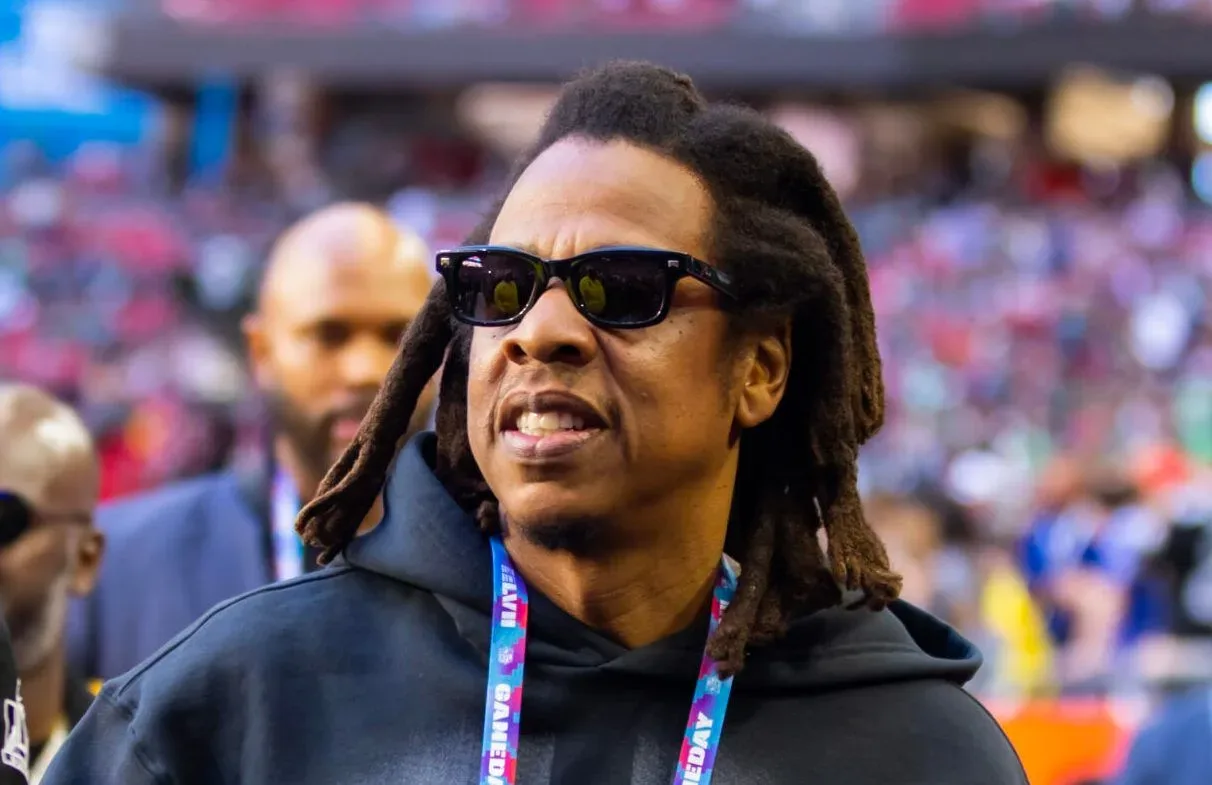
Jay-Z is reportedly in line to headline the Super Bowl LXI halftime show, but the prospect has already turned into a debate about what audiences expect from one of music’s most visible stages. The immediate point of friction is not whether he has enough recognizable songs for the assignment. It is whether discussion of a potential Jay-Z set is leaning too hard on the stars who could join him.
DJ Akademiks made that argument in a post on X after reports said Jay-Z had been selected for the 2027 performance. The NFL and Roc Nation have not officially confirmed that a booking has been made, so the reported halftime appearance should still be treated as unannounced. Still, the conversation illustrates the unusual position Jay-Z occupies: he is both a possible performer and the founder of a company that has helped the league shape halftime entertainment since 2019.
“U know you shouldn’t be performing at the superbowl that year when the only positive conversation about you possible headlining is ‘WHO ELSE CAN U BRING OUT’,” Akademiks wrote. “Sounds like some dj Khaled sh*t ngl.”
The post was a pointed comparison. DJ Khaled is strongly associated with collaboration-heavy records and all-star lineups, so Akademiks’ criticism was aimed at the idea that a Jay-Z halftime show could be more exciting for its hypothetical visitors than for its central artist. That is a subjective judgment, but it captures a real feature of the current speculation: names such as Beyoncé, Rihanna, Alicia Keys and Kanye West are quickly raised whenever Jay-Z’s possible booking is discussed.
No additional performers have been confirmed. Until there is an official announcement, a guest list is simply a fan and media exercise—not a lineup.
The report remains unconfirmed
The report surfaced on October 20, with an industry insider said to have confirmed Jay-Z as the Super Bowl LXI headliner. It followed an earlier report claiming he selected himself after other possible choices, including Miley Cyrus and Justin Bieber, had been considered. Those details have generated substantial discussion, particularly because Roc Nation’s partnership with the NFL gives Jay-Z’s company a role in producing and choosing halftime talent.
That relationship makes a reported Jay-Z booking distinct from a typical performer reveal. Since 2019, Roc Nation’s NFL arrangement has been associated with halftime appearances by Dr. Dre, Rihanna, Usher, Kendrick Lamar and Bad Bunny. If the report proves accurate, Jay-Z would be stepping from an entertainment decision-making role into the headlining spotlight himself.
That overlap does not establish anything improper on its own, and there is no official confirmation to evaluate. But it explains why the question of how the selection was made has become part of the reaction. A halftime show is not merely a concert slot. It is a highly public showcase with a brief runtime, broad audience and unusually intense scrutiny, which makes the identity of its lead performer a major cultural talking point before the music even begins.
Related coverage includes Jay-Z’s Reported Super Bowl LXI Slot Spurs Akademiks Debate.
For readers tracking the business side rather than just the rumor cycle, Jay-Z’s reported placement is also a reminder that artists can occupy several roles at once: recording act, catalog owner, executive and production partner. That broader music-business ecosystem is worth keeping in view alongside other industry developments, including a recent leadership transition at BMI.
A guest conversation is not evidence of a thin catalog
Akademiks’ argument is ultimately about perception. In the era of social media speculation, an anticipated guest can become an event in itself. A surprise appearance carries a built-in reveal, and a short halftime production can use a second artist to introduce a new song, a contrasting vocal, or a recognizable collaborative moment with very little setup.
But that does not mean the headliner lacks material. Jay-Z’s own catalog includes “99 Problems,” “Hard Knock Life,” “Big Pimpin’” and “Dirt Off Your Shoulder,” among many other records from a commercial run spanning three decades. Whether any particular mix of songs would feel right for a Super Bowl audience is a matter of taste. The more limited claim—that he would need guests simply to construct a setlist—is difficult to square with the number of established solo hits named in the discussion.
A headliner is the principal billed act, not necessarily the only person who will be onstage. In live-event terms, guests can be a creative choice rather than a substitute for the main performer. They may help represent different periods of a career, make a collaboration instantly recognizable, or create a moment designed for a television audience. None of those uses automatically undermine the person whose name is at the top of the bill.
That distinction matters here because Jay-Z’s collaborative history is extensive. A show built entirely around solo material would communicate one kind of career summary. A show with guests would communicate another, emphasizing the network of artists linked to his records and professional history. Both approaches could be plausible in theory; neither has been announced.
Why the guest list has become the loudest question
The answer is partly structural. Halftime performances are compressed productions, not full-length tours. That format encourages efficient, high-recognition choices: a familiar hook, a sharp transition, a visual reveal or a collaborator walking out at the right moment. The audience is also far broader than a normal arena crowd, which raises the value of songs and performers recognizable across several generations.
Jay-Z has the catalog to invite debate over song selection, but he also has relationships that make speculation easy. That combination turns every possible cameo into a separate storyline. Beyoncé and Rihanna, in particular, are names that invite immediate attention because of their individual status as performers as well as their connections to Jay-Z. Alicia Keys and Kanye West also belong to the list of artists frequently associated with his work.
There is a difference, however, between a compelling hypothetical and a confirmed plan. Treating fan casting as a promised production can set an unrealistic standard for an event that has not been formally announced. It can also obscure the basic question Akademiks raised: what does a Jay-Z-led show look like when judged first as a Jay-Z show?
What a reported Jay-Z halftime show would represent
If confirmed, the booking would put particular focus on Jay-Z’s long-running relationship with the NFL’s entertainment strategy. Roc Nation has helped produce and select halftime acts since the partnership began in 2019, and the company’s association with several recent performers has made it an important part of the event’s modern music identity.
That context may make the response more complicated than it would be for an artist with no organizational connection to the production process. Some people will view a Jay-Z appearance as a natural culmination of a partnership that has already elevated major hip-hop and pop artists. Others may be more interested in the optics of an executive-connected figure taking the marquee slot. Neither interpretation changes the current central fact: there is no official confirmation from the NFL or Roc Nation.
It is also worth separating two different claims often bundled together in online reaction. One is that Jay-Z is capable of leading the show on his own. The other is that people personally want him to do so. The first can be considered through the depth and recognition of his catalog. The second is preference, and it will vary widely. Akademiks’ post speaks to the latter debate, using the volume of guest speculation as evidence that the public’s excitement may be directed elsewhere.
Supporters can reasonably counter that major-event audiences discuss guests for nearly every potential headliner because surprise appearances are part of the format’s appeal. Critics can reasonably say that the conversation itself reveals where attention is concentrating. At this early stage, both positions rely on anticipation rather than a disclosed creative plan.
February 2027 is the date to watch—if the booking is made official
Super Bowl LXI is scheduled for February 14, 2027, at SoFi Stadium in Inglewood, California. Jay-Z is also scheduled to perform at that venue on October 23 and 24. Those concerts may draw extra attention in light of the halftime reports, but they are not a confirmed preview of any Super Bowl production.
They could, at most, give observers a current look at how Jay-Z structures a large-venue performance and which portions of his catalog receive emphasis. It would be a mistake to assume that songs, staging or any collaborators involved there would carry directly into a halftime program. The two events serve different purposes, and no Super Bowl creative details have been released.
For now, the responsible read is straightforward: Jay-Z has been reported as the potential Super Bowl LXI headliner; the NFL and Roc Nation have not confirmed it; and the debate over guests has arrived well before any official lineup. Akademiks has framed that anticipation as a criticism of the booking. Whether it becomes a fair description of the eventual show depends on an announcement that has yet to come—and on a performance that, at present, remains only reported.