Doug Aitken’s Lightscape has closed its run in the Darla Moore Gallery at the Shed, but the seven-screen installation received a particularly fitting after-hours variation at the venue’s annual gala: Jamie xx performed a live score while its images moved across the room.
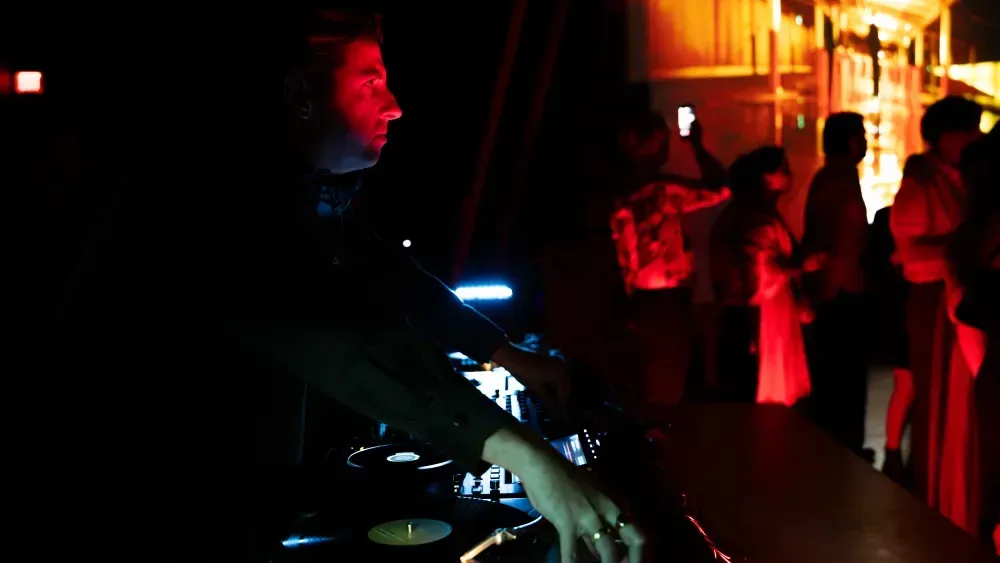
The result placed an electronic musician’s equipment console inside a work already built around scale, movement and separation. Rather than treating music as a fixed backing track, the presentation made the act of creating and manipulating sound part of the environment. Audience members could stand close to the console and watch Jamie xx work as the imagery unfolded, turning a film installation into a one-night meeting point between gallery art, live electronic performance and cinematic composition.
What ‘Lightscape’ puts on screen
Lightscape runs for 65 minutes and spreads its film across seven screens. Its cast includes Natasha Lyonne, Beck and members of the Los Angeles Dance Project. The people on screen travel through varied American settings: deserts, remote mountains, factories and highways.
Those locations matter because they create a visual language of distance. They are expanses, transit routes and workplaces rather than a single enclosed room where characters are forced into direct contact. Even when more than one person appears in a sequence, the characters rarely interact. Aitken has described the broad concern of the project as the isolation and disconnection people can experience in modern life.
That premise makes the seven-screen format more than a matter of spectacle. A multi-screen installation asks viewers to divide their attention, choosing where to look while accepting that something is always happening outside their field of view. In a conventional single-screen film, editing controls the viewer’s eye with much greater precision. Here, the physical placement of screens and the viewer’s own position create part of the experience. The format can make separation palpable: figures may coexist in the same room without necessarily sharing the same moment.
The film’s landscapes have been compared to the work of Wim Wenders, a useful shorthand for an approach interested in people moving through immense environments. But Lightscape is not presented as a traditional narrative feature. Its characters and locations instead function as recurring visual presences inside an installation, with the audience free to read patterns of travel, solitude and stalled connection across the screens.
A live score rather than a concert set
Jamie xx’s contribution was more atmospheric and less song-driven than In Waves, his 2024 album. That distinction is essential. A song-centered set generally gives individual tracks clear beginnings, hooks, rhythmic payoffs and endings. An atmospheric score can privilege texture, transitions, tone and duration, supporting an image without repeatedly demanding that the listener shift attention toward a chorus or a drop.
That does not mean the music abandoned the traits associated with Jamie xx’s solo work. The live performance retained unusual combinations of voices and beats, alongside audible sound manipulation. In practical terms, sound manipulation means taking recorded or generated audio and changing elements such as its timing, pitch, density, repetition or spatial feel. A vocal fragment can become a rhythmic figure; a beat can be blurred, interrupted or transformed; a familiar sound can be made to feel detached from its original source.
For a work concerned with isolation and dissociation, those techniques have an obvious expressive role. A voice does not have to operate as a lyric delivering a complete message. It can be fragmented, layered or pushed into the background, suggesting communication that is present but unstable. Likewise, beats can provide momentum without resolving into the kind of full song structure that would make the images feel like a music video.
The important point is not that a visual installation needs music to explain it. Lightscape had already been shown with other live contributors on select summer nights, including the Los Angeles Master Chorale, William Basinski, Suzanne Ciani and the Sun Ra Arkestra. Instead, the changing roster demonstrates how a film-based installation can remain visually consistent while its emotional temperature changes with a different musical response.
A choir, an ambient composer, an electronic-music pioneer, a jazz ensemble and Jamie xx do not bring the same relationship to pulse, silence, melody or collective performance. The images remain Aitken’s, but the live music changes how an audience inhabits their pace. That flexibility is a defining strength of a work designed for a gallery rather than locked permanently to one soundtrack.
Why the visible console changes the experience
In most cinema settings, viewers hear a soundtrack but do not see the labor behind it. The score arrives as an apparently seamless finished object. At the gala performance, the console was accessible enough for the audience to watch Jamie xx and his equipment in real time. That visibility changes the meaning of “live.” It is not merely that the sound was occurring in the same building as the images; the audience could observe an artist shaping the audio in response to the event.
There is a useful parallel with the installation’s seven screens. Both the visual arrangement and the performer’s visible process resist a single, perfectly sealed focal point. Viewers could look at a desert, a factory, a performer on screen, an electronic console or the person operating it. The room therefore made attention itself a moving part of the piece.
Analysis: This setup also offers a compelling model for game and interactive-media audiences accustomed to thinking about audiovisual work as fixed content. Games frequently use adaptive music, where the soundtrack changes as a player explores, enters danger or moves between locations. The Lightscape performance was not described as interactive in that sense, and there is no indication that the images were controlled by the music. Still, it shows the appeal of a related idea: sound can be experienced as an active layer, not merely an invisible file attached to pictures.
That distinction matters for anyone curious about how electronic artists can approach scoring. A composer working with moving images must consider timing, atmosphere and the amount of space an image needs. A strong standalone song can be memorable because it insists on its own shape. A strong score may need to do something harder: establish a distinctive identity while leaving room for viewers to notice what they are seeing.
From months of collaboration to an uncertain release
Jamie xx and Aitken had been collaborating on the project for months before this gala performance. The music prepared for the event had been recorded, although whether it will receive a release remains uncertain. That is a meaningful caveat for listeners hoping to hear the score outside the gallery: recorded music exists, but there is no confirmed plan for a public release.
The live set ended with “Doot Doot,” Freur’s understated 1983 dance track. Freur included two future members of Underworld, and “Doot Doot” had been a fixture with new-wave DJs during its era. Its placement at the end is striking because it brings a defined pop-era song into a performance otherwise described as atmospheric and image-responsive. Rather than prove the score was secretly a conventional DJ set, the choice highlights the contrast between open-ended sonic environment and a compact, recognizable closing track.
What is confirmed:
- Lightscape is a 65-minute, seven-screen film installation.
- It presented characters moving through American deserts, mountains, factories and highways.
- Jamie xx delivered a live accompaniment at the gala presentation.
- The performance involved recorded material and real-time sound manipulation.
- A release for the music has not been confirmed.
What remains interpretation: The live score’s precise relationship to each image, and how closely any potential release could reproduce the experience of standing among seven screens and watching the music being shaped, cannot be determined from a recording alone. Site-specific work often depends on scale, sightlines and the listener’s freedom to wander. Those conditions are part of the composition of the event, even when the sounds have been recorded.
The presentation also lands in a wider moment where musicians move freely between albums, clubs, galleries and screen work. For a related look at a performer framing a new stylistic direction as a fresh chapter, see Chanel West Coast’s move toward country music. Jamie xx’s Lightscape work does not amount to a declared career pivot, but it does underline how his melodic electronic instincts can be redirected toward image, atmosphere and duration.
Most significantly, the gala set preserved the central tension of Aitken’s installation. Lightscape studies people who are near one another but not fully connected, moving through large and impersonal spaces. A live score introduced a shared, temporary event around those images: one room, one audience and a musician visibly altering the sound. That communal setting does not erase the film’s feeling of distance. It gives that feeling a new counterpoint.