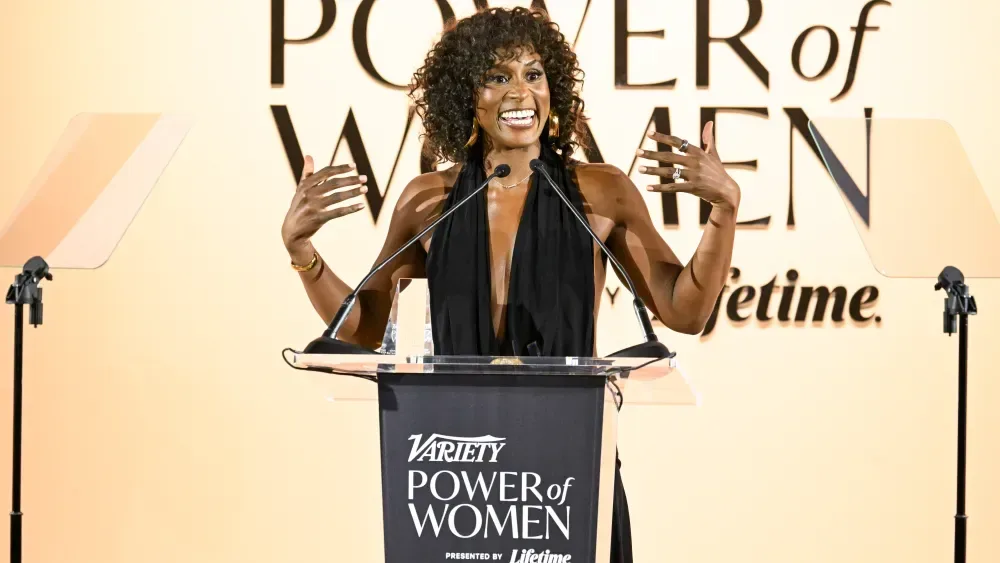
Issa Rae has received an Entertainment Entrepreneur of the Year award at a Beverly Hills Power of Women event, an honor that recognizes a career spanning performance, writing, producing and business-building. The Emmy-nominated creator used her acceptance speech to make the case that influence is less about an abstract title than the choices a person makes about collaborators, projects and the people they elevate.
The speech began with Rae’s characteristically sharp humor. She said she had not prepared a conventionally inspirational address because she was preoccupied by national events, climate disasters, politics, artificial intelligence and an entertainment business she described as consuming itself. She then drew laughs by laying blame at the feet of “rich, white men,” before delivering the more pointed line: “It is hard to feel like a powerful woman when men keep fucking everything up.”
But the heart of Rae’s remarks was neither a punchline nor an awards-show victory lap. It was an acknowledgement that discouragement can make ambition feel hollow—and a statement that power still exists in the practical decisions a creator, producer or employer is able to make.
From feeling helpless to identifying agency
Rae said it can be difficult to feel inspired when someone feels helpless or useless, a feeling she described as familiar in her work as a writer. Her response is to focus on the boundaries of her own agency: who she spends time with, who she works alongside, who she champions and invests in, which stories she chooses to tell, and whose work she gives a platform.
“I can use the power I do have to pour into my little community to make sure whatever success I’m lucky enough to have doesn’t stop with me.”
That distinction matters. “Agency” means the ability to make choices and act on them; it does not mean an individual can solve every structural problem in an industry or in public life. Rae’s framing is notably concrete. Rather than presenting influence as an all-purpose solution, she identified a chain of decisions that are actually available to a working creative: staffing, collaboration, investment, attention and storytelling.
In entertainment, those decisions can carry particular weight. A producer can help determine which concepts get developed and who receives an opportunity to make them. An executive producer can shape a project’s creative direction and may help assemble talent behind the camera as well as on screen. A performer with an established profile can bring visibility to a smaller project or colleague. None of those actions erase wider instability, but each can redistribute opportunity within a person’s reach.
Rae’s speech treated that work as ongoing rather than glamorous. She said that even when she is tired, angry or deeply uninspired by events around her, she keeps trying to work out where she can be useful. Her closing request was blunt: find the power available to you and use it “for good.”
Related coverage includes Issa Rae Honored as Entertainment Entrepreneur of the Year in Beverly Hills.
Why “entrepreneur” fits Rae’s body of work
The entrepreneur label is supported by the breadth of Rae’s credits, not simply by her visibility as an actor. She created, executive produced and starred in HBO’s Insecure, which concluded in 2021. That combination of jobs is important: creating a series means originating its premise and creative foundation; starring places the creator in the work itself; and executive producing signals a senior role in guiding the production.
Insecure also provides a useful lens for the community-focused language in Rae’s speech. The award presenter praised Rae for putting her Los Angeles community at the center of her ventures. Rae’s own comments explain the operating principle behind that praise: success becomes more meaningful, in her view, when it creates room for other people rather than ending with the person who initially receives it.
Her credits show that her work has not stayed in a single lane. On screen, Rae has appeared in Greta Gerwig’s Barbie, Cord Jefferson’s American Fiction, the Black Mirror episode “Hotel Reverie” and A Black Lady Sketch Show, where she also served as an executive producer. She voices Jessica Drew in Spider-Man: Across the Spider-Verse and Angela in the HBO Max series Young Love.
Behind the scenes, Rae produced the 2023 film Gray Matter, executive produced the HBO Max series Rap Sh!t, and produced One of Them Days, starring Keke Palmer and SZA. The supplied slate also says she is set to write and executive produce an untitled HBO comedy pilot described as a male-friendship show.
Taken together, those credits illustrate a model of entrepreneurship based on working across forms and responsibilities. Acting, voice performance, writing and producing are distinct disciplines; combining them gives a creator multiple ways to participate in the life of a project. It can also give that person more opportunities to make the kinds of choices Rae highlighted in her speech—especially around who gets hired, supported and heard.
Community is not a vague add-on
“Community” is frequently used as awards-season shorthand, but Rae gave it a much more practical definition. Her list of controllable choices makes community an active network of relationships and commitments, rather than a brand-friendly slogan. The people someone works with, invests in and platforms are not interchangeable categories. Each describes a different way of sharing access.
- Working with people means creating professional opportunities and building a creative environment.
- Championing people means publicly supporting work or talent that might need greater recognition.
- Investing in people means dedicating resources or confidence to their potential.
- Telling stories and providing a platform means deciding which perspectives reach an audience.
That approach is particularly relevant in an industry where a small number of greenlights, casting decisions and partnerships can set careers in motion—or halt them. Rae did not claim that creators control the whole system. In fact, her references to political, environmental and industry pressures argued the opposite. Her proposal was to resist paralysis by locating the points at which an individual does have leverage.
For audiences, there is a practical implication as well. A screen credit is often read as a simple sign of who appears in a movie or show. Rae’s career is a reminder to look at creative credits more broadly. A performer may also be a producer; a familiar name attached to a project may indicate an effort to create opportunities beyond a single role. That does not tell viewers everything about how a production was made, but it helps explain why creative ownership and senior producing roles matter.
AI, instability and the limits of an acceptance speech
Rae included the rise of AI among the issues occupying her attention. She did not offer a policy prescription or make a specific claim about a particular tool, so her remark should not be stretched into one. The significance lies in the grouping: AI was presented alongside politics, climate disasters and broader instability in entertainment as part of the atmosphere making inspiration harder to access.
In this context, AI refers broadly to computer systems that can generate, analyze or transform material. Its presence in conversations about film, television and other creative work raises questions that extend beyond any one production: who gets credited, whose labor is valued, who has the authority to make decisions and which human perspectives remain central. Rae’s address did not attempt to settle those questions. Instead, it returned to a more immediate standard—how people wield the influence they already possess.
That emphasis also sits comfortably beside wider debate about technology’s role in media work. For a gaming-adjacent example, concerns about how platforms and tools shape trust are already part of the conversation, as explored in the discussion of YouTube’s video-cut A/B tests and viewer trust. Rae’s comments were about entertainment more broadly, but the common thread is that new tools do not remove the importance of human judgment. They make questions about responsibility, visibility and power more urgent.
A speech built on responsibility, not optimism theater
There is a useful difference between optimism and the stance Rae expressed. Optimism can suggest confidence that circumstances will improve. Rae did not offer that assurance. She openly described frustration and exhaustion, and she did not minimize the scale of problems outside any one person’s control.
What she offered instead was responsibility: the refusal to let discouragement fully determine one’s behavior. Her commitment to keep finding ways to be useful is a more demanding proposition than a generic call to stay positive. It asks successful people to examine the practical effects of their choices, particularly when they have access to resources, audiences or decision-making power.
The Entertainment Entrepreneur of the Year honor therefore recognizes more than a list of screen credits. Rae’s remarks positioned entrepreneurship as a sustained practice of building: building projects, yes, but also building relationships, creating openings and ensuring that the benefits of success travel beyond one person. In an address that made room for anger and uncertainty, that was the clearest measure of power she put forward.