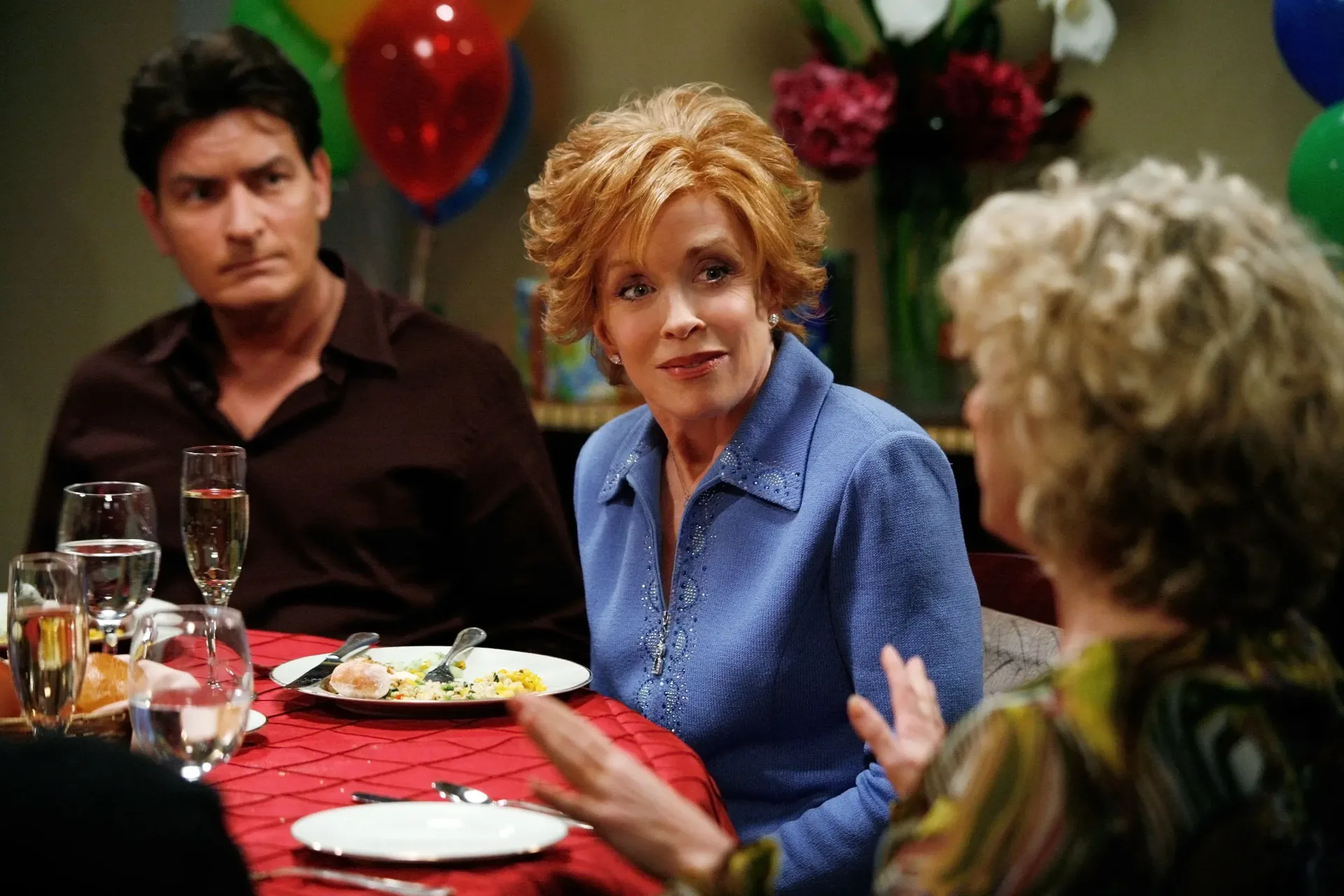
Holland Taylor has explained why her role on Two and a Half Men changed after the sitcom’s sixth season: she did not want to remain under contract. The actor, who played Harper family matriarch Evelyn Harper, says the decision involved both compensation and the freedom to decide when she worked.
Taylor appeared on the series for its first six seasons as the mother of Charlie Harper, played by Charlie Sheen, and Alan Harper, played by Jon Cryer. She says she was paid at a level comparable to what she had earned on a series years earlier, even as her work on the sitcom brought four Emmy nominations in the supporting-actress category.
“They never paid me very well on that show,” Taylor said on the Alchemy with Anthony Mason podcast. “I was paid on that show what I had made on a series like eight years before or something. And I got four Emmy nominations, and they never gave me a raise. They usually do.”
A contract decision rather than a simple exit
The important distinction in Taylor’s account is that she did not necessarily choose to sever her relationship with the comedy altogether. Instead, after six years, she declined a new contract and made herself available for selected guest appearances.
That changed the arrangement in a practical way. A regular television contract generally means an actor is committed to work when the production requires them during the applicable period. A guest role, as Taylor describes it, allowed her to assess an individual request and accept or refuse it.
“I stopped being under contract,” Taylor said. “So, in other words, they would say, ‘Can you do a guest appearance at the end of March?’ And I would say, ‘No, I cannot.’ I only did it if I wanted to do it.”
That flexibility, rather than a revised pay offer, was the result Taylor wanted. She says the show’s producers were astonished by her choice. In her telling, they interpreted the conversation as a negotiation and said they could not pay her more. Taylor’s response was that a higher offer was not the point: she simply did not wish to continue as a contracted regular.
“You could actually pay me the cost of this building, but don’t bother because I don’t want to continue on under contract,” Taylor recalled saying. She proposed an arrangement in which she could return from time to time, and did so as a guest.
Related coverage includes Holland Taylor Explains Why She Left Her ‘Two and a Half Men’ Contract.
Why the Emmy nominations matter in Taylor’s account
Taylor’s four nominations are central to how she views the pay issue. An Emmy nomination is recognition from the Television Academy, not a guarantee of a pay increase. But Taylor says she expected that level of repeated recognition to be followed by a raise, and felt it was notable that one never came.
Her comments do not turn the story into a claim that awards attention automatically determines an actor’s rate. Rather, they show how Taylor evaluated her own standing after years on a hit network sitcom: she had a continuing character, four nominations during her run and, in her view, no salary movement to reflect that record.
She also said she loved many elements of working on the series, while adding that the production was “not full of courtesies.” Taken together with her explanation of the contract decision, that comment suggests a broader workplace calculation. Taylor was not presenting guest work as a consolation prize; she saw it as a more suitable structure for her time and professional autonomy.
Evelyn Harper’s place in the show
As Evelyn, Taylor played the mother at the center of the Harper family dynamic. Charlie and Alan were core characters, and Taylor acknowledged the obvious narrative reason for keeping a channel open for returns: “I did play the boys’ mother.”
That is what made an occasional guest arrangement viable. The character’s family connection could naturally support appearances without requiring Taylor to be locked into a regular schedule. It was a middle ground that preserved a relationship with the show while giving the performer control over specific bookings.
For viewers, a cast member shifting from contract status to recurring guest appearances can look like a departure, but it is not always an all-or-nothing break. Taylor’s experience illustrates that the same character can remain part of a series’ world under a different working agreement. The difference may be mostly behind the scenes—who controls the calendar, what obligations are ongoing and whether each appearance needs its own agreement—but it can substantially change an actor’s day-to-day life.
The larger context of a long-running sitcom
Two and a Half Men ran for 12 seasons, from 2003 through 2015. Taylor’s original six-season contract period therefore covered a significant portion of the show’s overall run, but not its full lifespan. Sheen left the series in 2011 following public struggles with substance abuse.
Long-running television comedies can undergo major changes while still retaining familiar relationships and supporting characters. Taylor’s comments are a reminder that those shifts are not only storytelling decisions. They can also follow personal choices by performers who weigh compensation, recognition, scheduling and the amount of commitment they want to make to one job.
In Taylor’s case, the priority became clear after six seasons. She says she was content to return when she wanted to, rather than commit to another contract cycle. That framing matters because it avoids reducing her choice to a single disputed number. Pay was a stated reason for dissatisfaction, but independence was the outcome she actively pursued.
What Taylor’s account says about creative work and control
There is a temptation to treat a successful television role as an unqualified career win: a durable character, an established audience and awards recognition should, on paper, make staying straightforward. Taylor’s comments point to a more complicated reality. Professional satisfaction may depend on whether a role offers respect, financial progression and room for the rest of a person’s work and life.
A contract can provide stability, but it can also limit an actor’s ability to say yes to another project—or simply say no to a particular date. Taylor says that, once she was working as a guest instead, she could decline an invitation to appear at the end of March. The example is mundane, but it captures the value she placed on having a choice.
That same question of how veteran performers fit into continuing television franchises remains relevant in current conversations about returning casts and reworked series. For another example of a legacy-show discussion focused on changing circumstances, see Jessica Biel’s comments on the family pressures shaping a proposed 7th Heaven reboot.
Taylor’s recollection is ultimately direct: she felt underpaid, did not receive the raise she believed her work merited, and chose flexibility over a renewed commitment. She kept the door open to Evelyn Harper appearances, but on terms that gave her final say over when she returned.