Guillermo del Toro has offered another sharply defined view on artificial intelligence in art: speed is not the same thing as creation. During a September 9 fan Q&A on Reddit’s movie community, the filmmaker returned to a subject he has addressed before, arguing that AI may rush a person toward an acceptable-looking result, but it cannot replicate the wandering, tactile, error-prone human process that produces a truly original one.
For del Toro, that process is where the meaningful work happens. His point is not merely that an artist uses a hand while a computer does not. It is that an artist spends time in conversation with a half-formed idea: sculpting it, reconsidering it, finding a surprising reference, responding to a material, and changing direction. The final image matters, of course, but so does the long route that allowed its maker to discover what the image needed to become.
That position extends a comment del Toro made at the British Film Institute in 2024, when he characterized AI’s artistic output as potentially attractive but fundamentally limited. He also framed art’s worth as something beyond inexpensive, effortless production. The important question, in his formulation, is what people would be willing to risk or commit in order to encounter a work.
The missing stretch between prompt and breakthrough
Asked what is lost when software produces an image rather than a person, del Toro focused on the large, unglamorous portion of creativity that happens before an artist reaches a finished answer. AI, he said, can move someone quickly to the middle of a process. But the last, most distinctive fraction of the journey depends on a back-and-forth between the maker and the work.
It is an especially useful way to describe the dispute without treating it as a simple battle between old tools and new ones. Plenty of artists use technology, and filmmaking itself is a collaboration of physical craft, visual effects, editing, sound, design, performance, and more. Del Toro’s concern is about replacing the exploratory relationship with an instant output. A rapid result can appear to solve a creative problem before the artist has learned what the problem actually is.
His language for that discovery is “alchemy.” It is not a claim that creativity is magical in a way that defies all explanation. Rather, it recognizes that good work often emerges from connections that cannot be mapped in advance: a memory meets a texture, an old poster collides with an animal photograph, or a practical constraint forces an unexpected choice. Those associations grow through time, attention, and a creator’s accumulated experiences.
That is also why a generated image that resembles a finished concept does not necessarily contain the journey that made the concept resonant. Del Toro sees AI as operating through extraordinarily quick recombinations of existing material, while creation involves bringing forth something that did not previously exist in that form. The distinction is a philosophical one, but it has very practical implications for directors, concept artists, designers, writers, and performers navigating tools that promise immediate solutions.
The Pale Man as a case for creative detours
Del Toro illustrated the idea with one of his most indelible creations: the Pale Man from Pan’s Labyrinth. The creature did not arrive fully assembled as the result of a clean, linear plan. Del Toro described an evolving design process shaped by a manta ray image and art from a poster for Don Coscarelli’s Phantasm. The creature was initially sculpted as an elderly man with a face; then the face was removed. Eventually, the concept arrived at its famously unsettling visual feature: eyes placed in its hands.
What matters in the anecdote is the duration between those decisions. Del Toro said he had lived with the creature’s idea for a month or two. Separate inspirations came together at separate moments, and the design changed as he and his collaborators engaged with it. The Pale Man is not simply a checklist of components—old man, ray, faceless head, hand-eyes—but the result of prolonged experimentation and intuition.
For audiences, this is a reminder that the creations most likely to stay in the mind are frequently stranger than the first sensible idea. They contain choices that seem inevitable once seen, even though they were not inevitable at all. A tool can help arrange familiar ingredients; del Toro’s argument is that the essential creative labor is recognizing when a bizarre combination has become the right one.
That kind of productive strangeness appears across games as well as movies. An unsettling hybrid concept can carry a project farther than technical polish alone. It is part of why a premise as absurdly aggressive as a falling-block puzzle fused with Doom-style shooting and an unnerving infant can immediately communicate a human being’s willingness to follow an odd impulse somewhere unexpected. Whether every experiment works is beside the point; experimentation is the mechanism that gives creators a chance to find an idea they could not have efficiently planned.
Apprenticeship is not a stage that ends
Del Toro also raised a concern that reaches beyond any single image: the loss of apprenticeship. In his view, artists never fully graduate from learning. A veteran director, illustrator, or craftsperson remains an apprentice because every new project demands fresh problem-solving. The labor of building, revising, failing, and trying again teaches judgment that cannot be separated from the work itself.
This is a major reason debates about AI cannot be measured only in minutes saved. If an emerging creator regularly delegates early sketches, drafts, reference gathering, compositional choices, or revision to a system, the individual may receive a competent result without developing the underlying instincts. The danger del Toro identifies is not merely an uninspiring final image. It is a weaker pipeline of future artists who have spent less time confronting the awkward stages where skills and taste are built.
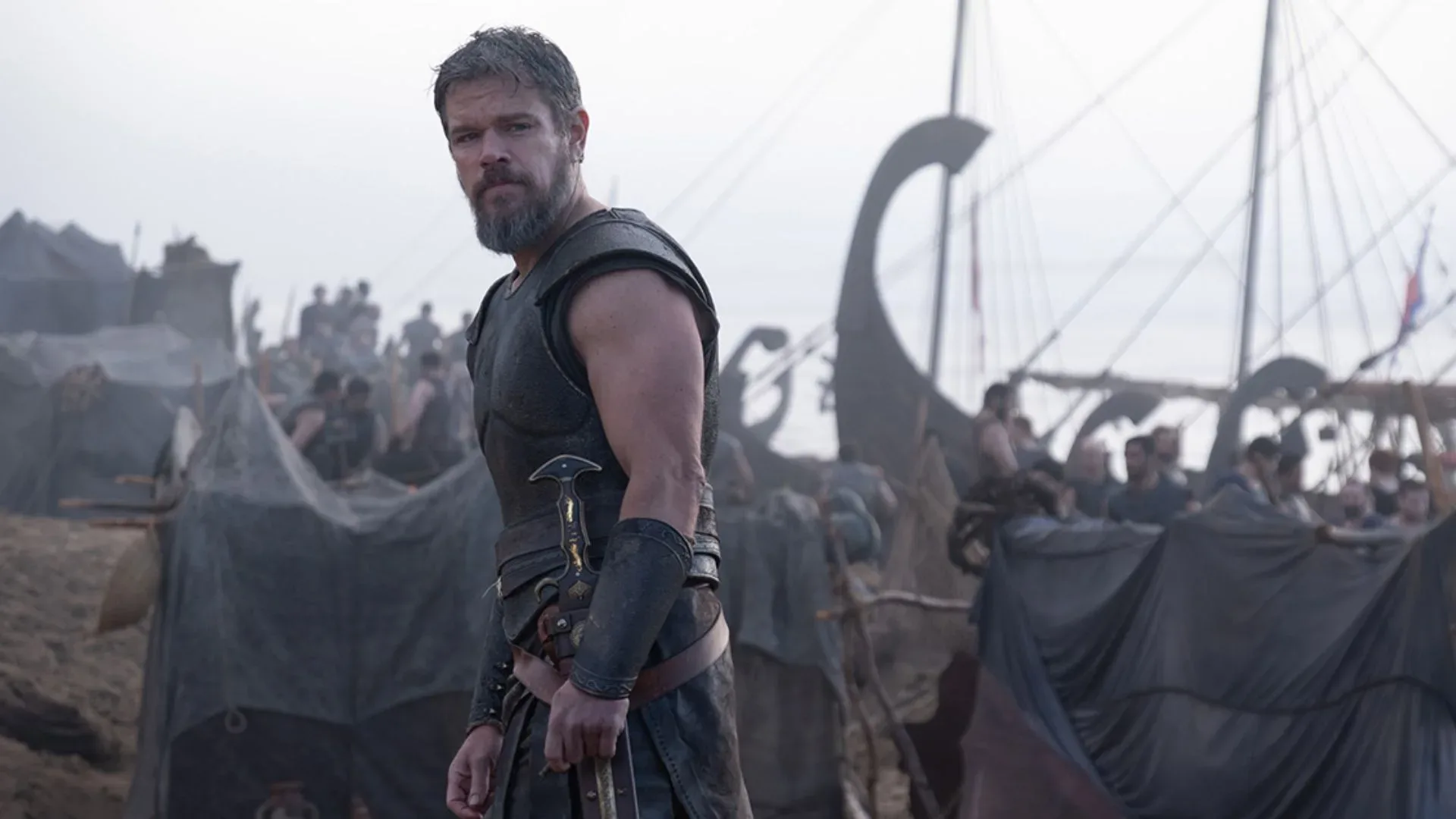
His anecdote about Christopher Nolan reinforced that kinship between filmmakers who value practical problem-solving. Del Toro recalled discussing a sequence in Nolan’s The Odyssey in which Matt Damon’s Odysseus is adrift in a violent ocean storm. Del Toro asked how it had been accomplished. Nolan’s answer, as recalled by del Toro, was direct: they put Damon in a storm at sea.
The story is memorable because it is both simple and demanding. It does not mean every film must avoid effects work or that physical production is inherently superior in every instance. It does reveal a shared preference for engaging with material reality—water, weather, miniatures, performers, camera placement—and allowing that reality to push back. Del Toro mentioned that both directors make use of a maquette or model, another hands-on stage in which an idea becomes something a team can observe, alter, and learn from.
Why the accident matters
Perhaps del Toro’s clearest point came through a recollection involving James Cameron and Terminator 2. Looking at the scene in which Robert Patrick’s character breaks a car window with his arm, Cameron drew attention to lens flares that had been added because apparent imperfections can persuade viewers that an image is real. Del Toro agreed with the underlying insight: accidents are vital, and the best ones are not forced. They happen through interaction with reality.
He estimated that roughly 30 percent of a great image can arise accidentally. A raindrop on a lens, an unplanned camera shake, or a flare at the edge of the shot may introduce a sense of immediacy that a perfectly controlled image lacks. More importantly, the incident can lead the artist somewhere new. A mistake becomes a detail; a detail changes the mood; the mood changes the entire sequence.
This is the part of del Toro’s argument that may be most difficult to reduce to a technical checklist. An AI system can imitate the appearance of imperfection. It can be asked for grain, blur, flare, asymmetry, or a weathered surface. But del Toro is talking about something different from a preselected “accident” filter. He is talking about the surprise of working with a world that refuses to behave exactly as intended, then having the experience and curiosity to recognize value in the deviation.
His position does not depend on claiming that every accident is useful, or that every painstaking production produces art. Instead, it asks creators and audiences to value the conditions in which surprises can occur. Human art is not valuable because it is slow for its own sake. It is valuable because time, risk, material resistance, collaboration, and imperfect choices can produce discoveries that no one knew to request at the beginning.
A defense of the weird route
Del Toro’s comments land as a defense of the circuitous route: the sketch that goes wrong, the model that reveals a flaw, the reference that suddenly rearranges an idea, and the physical shot that acquires an unplanned detail. In a moment when generative tools are marketed largely around acceleration, he is asking what acceleration leaves behind.
The answer, for him, is not just the human hand. It is the mind that keeps changing while it works, the student’s habit of learning through practice, and the accidents that enter a piece of art because artists are dealing with actual people, objects, weather, cameras, and time. That is the alchemy del Toro believes remains beyond a fast machine’s reach.