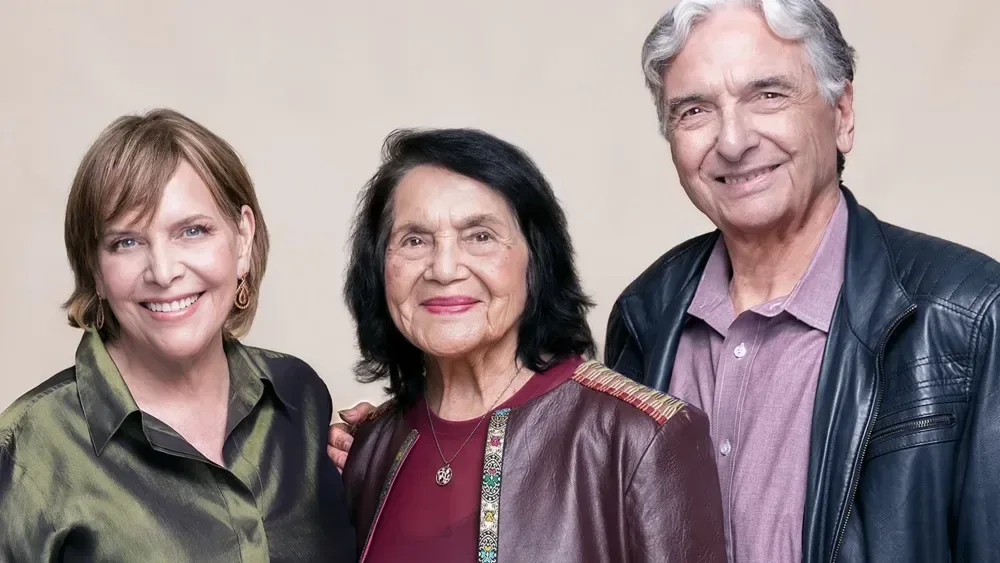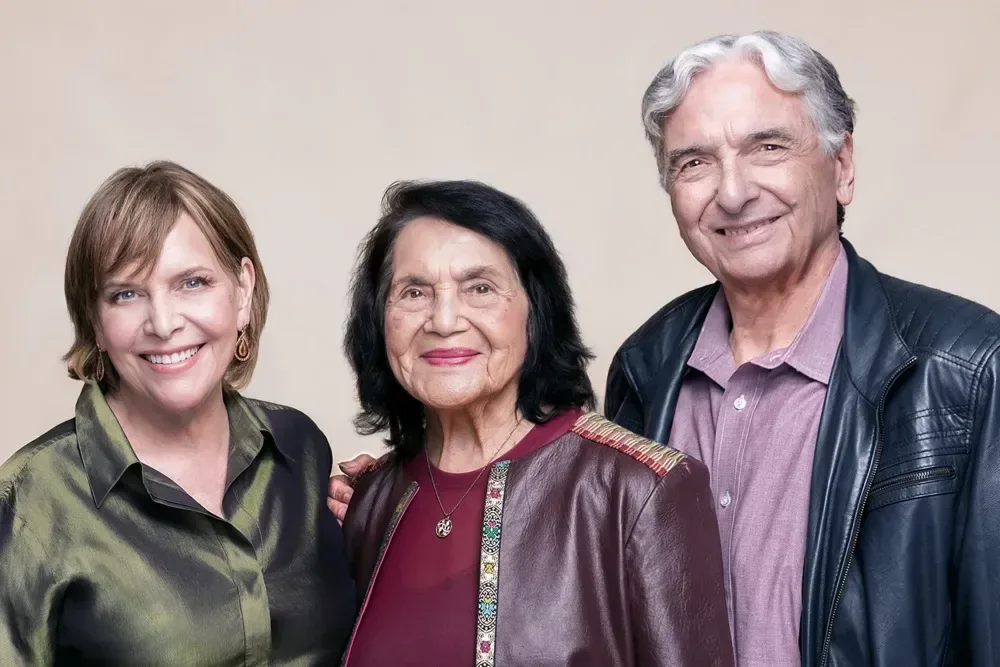
Director Gregory Nava and producer-writer Barbara Martinez Jitner have remembered Dolores Huerta as a fearless advocate whose life and work changed the country, while reaffirming their intention to bring her story to the screen with care.
Huerta, the labor organizer and civil-rights leader who co-founded what became the United Farm Workers, died Wednesday at age 96. A family spokesperson said cancer was the cause. She died at home surrounded by family.
For Nava and Martinez Jitner, the loss is also deeply personal. Huerta introduced the pair, served as a witness at their wedding, and remained close to them for decades. The filmmakers traveled to Bakersfield on Tuesday night to say goodbye and be with her family.
“Dolores was a great light and a fearless warrior for justice,” Nava and Martinez Jitner said in a joint statement. “She set the world ablaze with her passion for equality and inspired generations to discover their own power.”
Their connection has become central to a dramatic feature in development about Huerta’s life. Nava is set to write and direct; Martinez Jitner is co-writing and producing. The project is described as the first dramatic feature centered on Huerta, who had received approaches from filmmakers over the years but chose collaborators she had known for decades.
That distinction matters. A biographical feature, or biopic, is not simply a timeline converted into scenes. It asks filmmakers to decide which moments best explain a life, how private experiences connect to public achievements, and how to depict people whose significance reaches far beyond the frame. In Huerta’s case, those choices carry particular weight: her legacy includes labor organizing, women’s political participation, racial justice, family life, physical danger and a lifetime spent insisting that farmworkers be treated with dignity.
A personal trust behind the planned film
Nava and Martinez Jitner said Huerta and her family had entrusted them with the story’s “courage,” “struggles and joys,” and “deepest pain.” Huerta spent more than 70 hours in conversation with the couple during her final years, sharing material she had not previously discussed with others.
The filmmakers said they will honor that responsibility “with tenderness and care,” carrying Huerta’s voice to future generations. Their statement does not provide a production schedule, casting information or a release plan. What it does establish is that the project remains rooted in direct access to Huerta’s recollections and in a relationship that long predates its development.
Related coverage includes Gregory Nava and Barbara Martinez Jitner Honor Dolores Huerta After Her Death at 96.
That background also gives the planned film an unusual degree of continuity with Nava’s body of work. His 1983 drama El Norte, about Guatemalan siblings crossing into the United States, earned him an Academy Award nomination for original screenplay. He later directed Mi Familia and the 1997 biographical drama Selena. All three films are in the Library of Congress’ National Film Registry.
Martinez Jitner has been Nava’s collaborator since Selena. She also made history in 2002 as the first Latina to executive produce a primetime network drama with PBS’ American Family, a series created by Nava. Their shared history makes the Huerta project an extension of a long creative partnership rather than a newly assembled prestige package. For a glimpse at the present-day television business that has continued to make casting and representation part of the entertainment conversation, see the latest series-regular casting news for Ascension.
Why Dolores Huerta’s life demands more than a slogan
Huerta is widely associated with “Sí, se puede,” the phrase that became a rallying cry for collective action. Its plain-language meaning—“Yes, it can be done”—captures a core idea of organizing: difficult conditions can be changed when people act together. Yet her history is far larger than one phrase.
Born Dolores Clara Fernández on April 10, 1930, in Dawson, New Mexico, Huerta was the daughter of a coal miner and a mother who operated a hotel in Stockton, California, that served farmworkers. She taught elementary school for one year, then left after seeing children come to class hungry and barefoot. She concluded that organizing their parents could make a more fundamental difference than remaining in the classroom.
In 1962, Huerta and Cesar Chavez founded the National Farm Workers Association, which later became the United Farm Workers. A union is an organization through which workers act collectively to negotiate over conditions, pay and protections. In field labor, where workers can be geographically dispersed and vulnerable to employer pressure, building that collective voice is especially demanding.
Huerta helped lead the 1965 Delano grape strike alongside Filipino labor leader Larry Itliong. The strike became a pivotal fight for farmworkers, and Huerta helped negotiate the first field contracts. Her role is an essential corrective to simplified accounts of the movement that reduce its achievements to a single personality. The organizing involved workers, families, communities and leaders across backgrounds, including the Filipino farmworkers represented by Itliong.
Public achievement, personal cost
Huerta’s activism exposed her to direct violence. In 1988, while protesting outside a George H.W. Bush fundraiser in San Francisco, she was beaten by a police officer wielding a baton. The assault broke four of her ribs and ruptured her spleen. She recovered, then devoted the following decade to encouraging Latinas to run for office.
Her public honors included the Presidential Medal of Freedom, awarded by President Barack Obama in 2012. California designated April 10 as Dolores Huerta Day in 2018. She was also the mother of 11 children—an important part of a life too often described only through its organizing milestones.
In March, Huerta publicly disclosed that Chavez had raped her in 1966 in a secluded grape field. She said she had held the secret for 60 years because she feared it could damage what the union had accomplished. Her decision to speak added a profoundly difficult dimension to the history of a movement often presented through heroic shorthand.
Any screen portrait committed to Huerta’s own account will have to hold these truths together without treating trauma as mere dramatic texture. Her disclosure concerns an alleged assault that she described publicly; it should not be flattened into a plot twist or used to eclipse her agency. At the same time, omitting it would risk ignoring a consequential part of the story Huerta chose to tell late in life.
This is where Nava and Martinez Jitner’s emphasis on trust and care has practical meaning, not just commemorative language. The materials shared during their conversations may offer a fuller perspective on how Huerta understood the choices, risks, losses and victories that shaped her. But the filmmakers will still face the difficult task of shaping a coherent drama without substituting easy uplift for the contradictions of a real life.
What the tribute says about the film’s responsibility
Nava once characterized Huerta as a force comparable to an earthquake that shook the country. The image fits the scale of her impact, but a feature about her must also make room for the work behind seismic change: meeting with workers, building coalitions, sustaining strikes, negotiating contracts and recruiting people to participate in public life.
That is the practical implication of putting Huerta at the center rather than treating her as a supporting player in another person’s legend. A film about her can foreground the strategic labor of organization, the contributions of women and the multiracial character of the farmworkers’ movement. It can also recognize that a legacy is not static. Huerta continued urging younger people toward action well into her nineties.
For Nava and Martinez Jitner, the immediate moment is one of grief. Their statement closes with love and gratitude for Huerta’s family, along with a pledge to take up the baton she leaves behind. It ends, fittingly, with the words Huerta spent decades embodying: Sí, se puede.
The planned feature now carries an added obligation: not only to commemorate a revered organizer, but to tell the story of a woman who understood change as work people do together—and who spent her life persuading others that they had the power to begin.