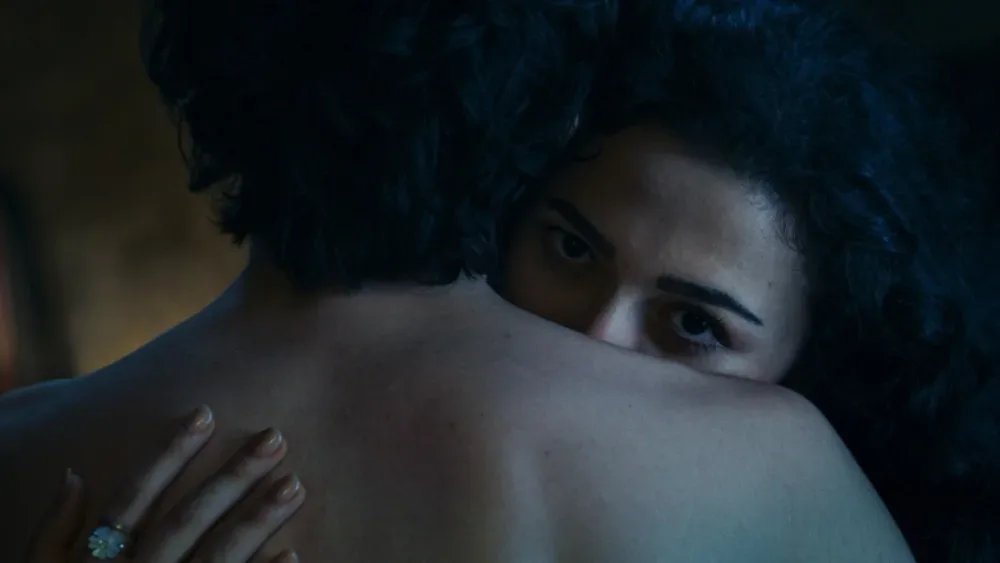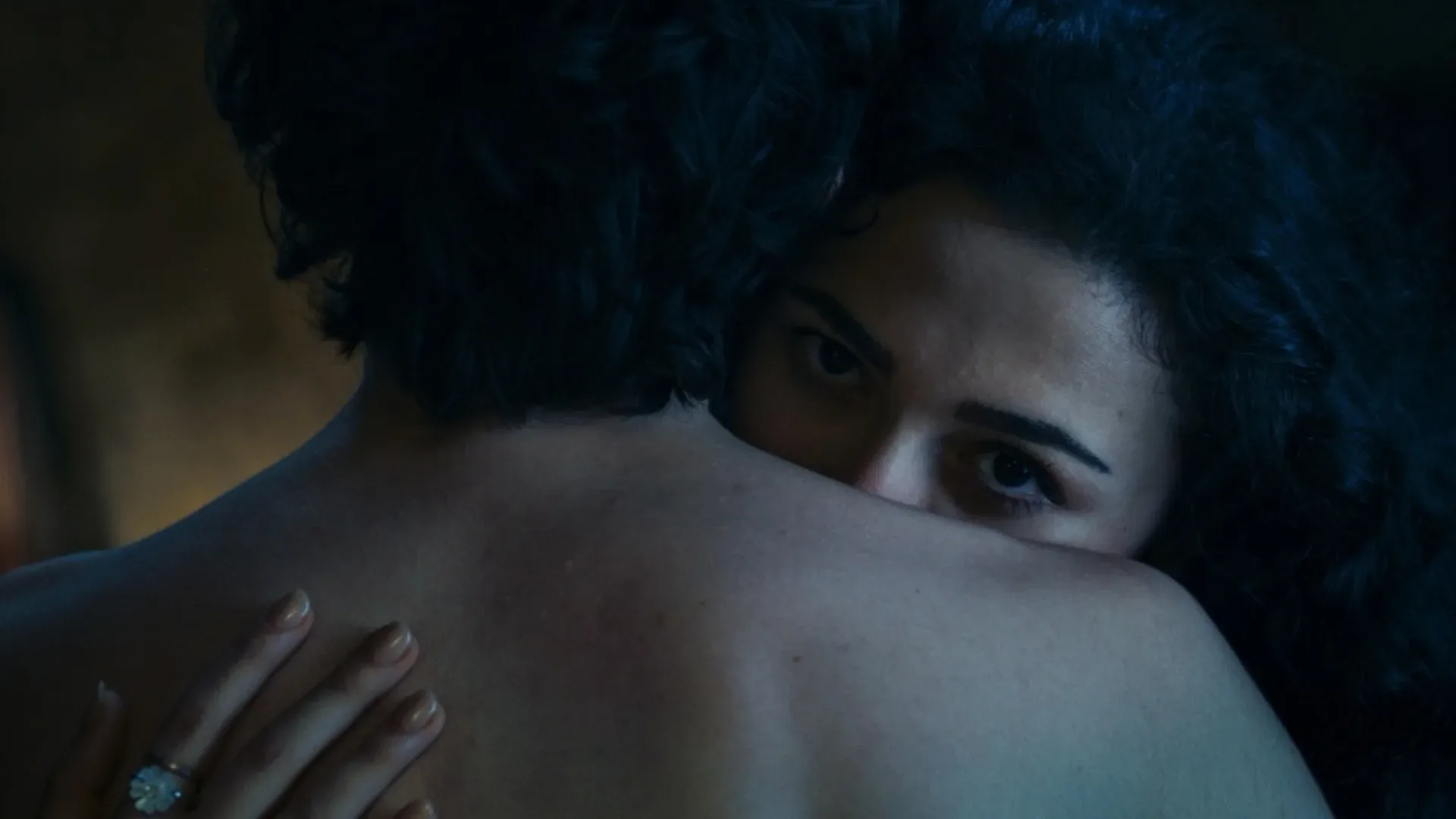
Ghost Song arrives as a supernatural romance with an immediately legible premise and an unusually tactile visual identity: a young couple’s brief attraction is interrupted by a fatal car accident, yet death does not entirely end their connection. Set in Hamburg and photographed in stark black-and-white, Fatih Akin’s new film uses ghosts less as a vehicle for shocks than as a way to stage grief, longing and the painful refusal to let somebody go.
It is an attractive foundation for a 105-minute drama. The complication is that the film asks viewers to accept a love powerful enough to overcome the mortal divide after its central pair have known one another for only one evening. That is deliberately grand romantic material, but it places a heavy burden on the writing and on the early scenes between Farasha and Faris. The emotional claim is enormous; the character work has to make it feel inevitable rather than merely announced.
Ghost Song appears strongest when it stops trying to explain the universe and lets image, place and ritual carry the feeling. Its account of a young woman observing the aftermath of her own death has the potential to be far more unsettling—and more moving—than its conventional star-crossed-romance framework.
A chance meeting turns into an afterlife courtship
Farasha, played by Mariam Dawoud in her first film role, is a Syrian refugee living with her family in Hamburg after a period in Turkey. She is a physics student, wears a headscarf by choice, and has a private butterfly tattoo that she knows would trouble her mother. Those details establish her not as a symbol but as someone negotiating family expectations, belief, personal agency and a future shaped partly by her late father’s example.
At a graduation party in Hamburg’s Telemichel tower, Farasha meets Faris, played by Eren M. Güvercin. Faris is German-born and of Turkish descent. Joined by Farasha’s friend Una, played by Carlotta von Falkenhayn, the group leaves in Faris’s car. The journey ends with the vehicle going into the Elbe river.
Faris survives and wakes in hospital facing police questions. Farasha drowns, though the film does not simply leave her story with the living. She awakens in a ghostly state: able to move through the city but unseen and unheard by almost everyone. Her late father is the exception, and he tells her she has 40 days in which she can visit living people in their dreams. The number corresponds to a mourning period observed in some Muslim traditions, giving the story’s supernatural rule a connection to the film’s particular cultural and religious setting.
That rule creates Ghost Song’s central dramatic opportunity. Farasha can continue seeing Faris, but only under conditions that deny them a normal relationship and postpone the full recognition of her death. The romance becomes increasingly perilous as the story turns on a question familiar to tragic love stories: which person will sacrifice most for the other?
Faith is part of the story’s framework, not a decorative aside
Ghost Song distinguishes itself from a more generic paranormal romance by placing Muslim faith and multicultural Hamburg at the heart of its characters’ lives. Farasha and Faris are both Muslim, but their backgrounds, families and ways of navigating modern life are not presented as identical. Farasha’s choices—including her headscarf, academic path and hidden tattoo—make the tension between private identity and familial responsibility tangible before the supernatural premise takes over.
Related coverage includes Ghost Song Opens With Striking Images, but Its Romance Stays Thin.
The 40-day period gives grief a structure. In narrative terms, a rule like this is a countdown device: it establishes a limited window in which the protagonist can act, which brings pressure to each encounter. In emotional terms, it reflects the fact that mourning is not a single moment of realization. Farasha is physically separated from the people she loves but still emotionally attached to them, and the ability to visit dreams gives that attachment a form.
The film’s most powerful reported sequence is not built around the couple’s declarations of devotion. It finds Farasha watching her family prepare her body for burial. The scene is literally out-of-body, but its dramatic weight comes from its intimacy: Farasha is present for an act of communal care and farewell while being unable to participate in it. That situation makes death feel both metaphysical and painfully practical. A body must be mourned, cleaned and buried; relatives have to live through the rites even as the dead person remains unable to comfort them.
This is where the film’s themes of faith, family and loss seem most layered. The ghost premise does not erase bereavement; it creates a distance from which Farasha can witness it. That perspective can be haunting precisely because it is not focused on proving the romance’s cosmic magnitude.
Hamburg’s monochrome becomes a character
Whatever reservations one may have about the film’s emotional compression, Ghost Song has a clear visual proposition. Cinematographer Frank Griebe, working with Akin for the first time, shoots Hamburg in inky monochrome and widescreen compositions. The approach treats city landmarks, dark bedrooms and imposing concrete architecture as parts of the same dreamlike terrain.
Chiaroscuro is the technical term often used for visual design built on pronounced contrast between brightness and darkness. In Ghost Song, that contrast fits the material naturally. The lovers exist between states: life and death, presence and absence, memory and experience. Black-and-white photography can turn even familiar urban locations into places that feel suspended outside ordinary time.
The monochrome also gives the film a visual kinship with Wim Wenders’ Wings of Desire, another German romantic fantasy concerned with the boundary between earthly life and an ethereal realm. Ghost Song is not set in Berlin, however; it draws from Hamburg, and it filters its ghost story through younger characters and the cultural specificity of its Muslim protagonists. The comparison helps describe the atmosphere and the formal ambition, but it also sets a daunting standard for lyricism and philosophical depth.
Ghost Song reportedly interrupts its black-and-white world with iridescent illustrated title cards, while color enters around the closing stretch as the characters face a decisive life-or-death choice. The contrast is a purposeful visual signal rather than a random flourish. If monochrome represents a world of mourning, memory and in-between states, color can suggest a disruption: a return of immediacy at the moment a choice can no longer be deferred.
The central weakness: devotion arrives before the audience can fully believe it
The movie’s key challenge is not whether supernatural love can work. Cinema has long made room for heightened, irrational and impossible attachment. The issue is whether Farasha and Faris have enough time, specificity and dramatic exchange before the accident for their later devotion to carry the intended force.
Ghost Song asks its audience to see their immediate spark as a soul-level connection. Dawoud and Güvercin bring individual charisma to the roles, but the characters’ relationship has been described as thinly drawn, and the screenplay by Akin and Ruth Toma returns repeatedly to the intensity of their bond without always giving it greater spiritual or philosophical substance. Repetition can communicate obsession, especially in a ghost story about someone unable to move on. It can also expose a gap if the audience is still waiting for the relationship itself to become more distinct.
That does not make the film’s romantic idea unserious. There is something emotionally direct about a story in which death arrives before a relationship has had the chance to become ordinary. Farasha and Faris are not losing a long shared past; they are losing the possibility of one. The idea of a future that never happens can be devastating. But the screenplay’s elevated sentiment and occasionally clunky handling of metaphysical questions may leave the film’s biggest claims less persuasive than its images.
A graphic-novel companion points to a wider life for the story
Akin has also adapted Ghost Song into a graphic novel with artist Bea Davies. That companion work is notable because the film already thinks in bold visual contrasts: glistening black-and-white cityscapes, illustrated titles and an afterlife that has graphic rules. A comics format could be especially suited to the material’s suspended moments, dream visits and stark shifts between the visible world and the invisible one.
The parallel graphic novel also suggests an attempt to meet younger audiences through more than one medium. It is not evidence that the film’s story will necessarily gain depth on the page, but the move makes sense for a project whose appeal rests strongly on mood, iconography and a heightened romance. Readers interested in the broader conversation around novels and screen adaptation can also see how another creator is approaching that territory in this look at Chloe Gong’s adaptation hopes.
What Ghost Song ultimately offers
Ghost Song seems poised between two versions of itself. One is a straightforward, youth-facing supernatural romance about a couple trying to keep love alive beyond death. The other is a more resonant grief story about Farasha’s family, religious mourning practices and the unbearable experience of watching people mourn you while being unable to answer them.
Akin’s film does not always give those versions equal weight. Its romance can feel overly asserted, and its metaphysical ideas do not always receive the rigor that the premise invites. Yet the film’s best qualities are substantial: a sharply realized Hamburg, expressive monochrome photography, a memorable visual approach to ghosts, and a culturally specific framework for death and mourning.
For viewers drawn to atmospheric romance, Ghost Song’s imagery may be enough to make its unevenness easier to forgive. It does not need to solve every question about the afterlife to make absence visible. When it concentrates on a daughter separated from her family at the exact moment they need one another most, the film finds a sadness more immediate than any declaration that love can conquer death.
Ghost Song at a glance
- Director: Fatih Akin
- Screenplay: Fatih Akin and Ruth Toma
- Cast: Mariam Dawoud, Eren M. Güvercin, Carlotta von Falkenhayn and Gabriel-Winner Amorim
- Cinematography: Frank Griebe
- Editor: Andrew Bird
- Music: Malakoff Kowalski
- Running time: 105 minutes
- Languages: Arabic, German and Turkish