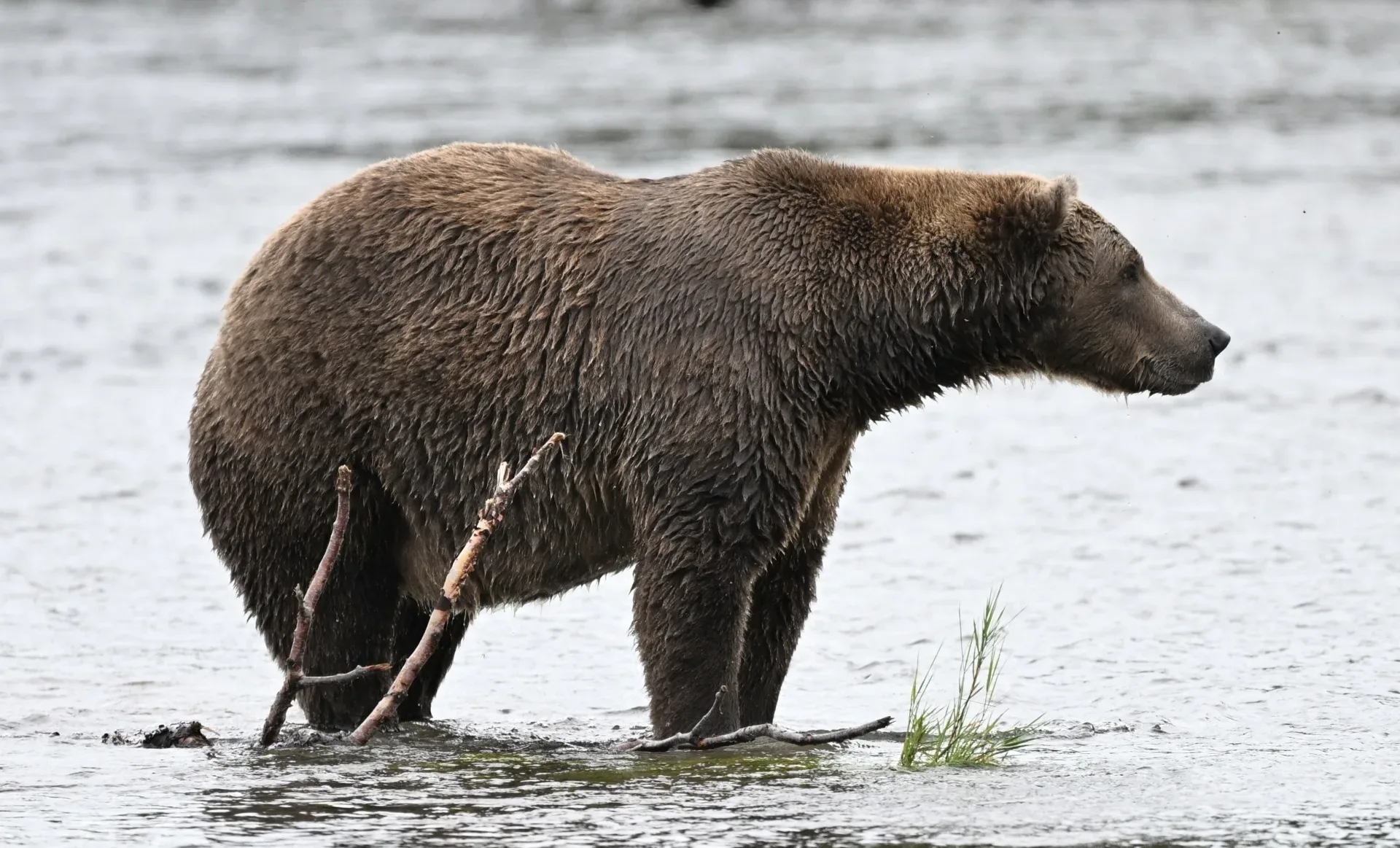
Autumn’s arrival has a lot of unofficial markers: cooler mornings, wet sidewalks, the first desperate search for a jacket that was definitely put somewhere sensible. But there is a far more important seasonal signal in Alaska: the bears of Katmai National Park have spent the summer eating with purpose, and it is time for the public to admire the results.
Fat Bear Week, the annual online tournament organized by Katmai Conservancy, is set to open voting on September 22. Its premise is wonderfully straightforward. Bears at Katmai National Park are placed into a single-elimination bracket, and voters choose the animal they believe has done the strongest job of becoming magnificently, winter-readily large.
That wording matters. Fat Bear Week is playful, but the size on display is not merely a gag or a beauty contest in the human sense. The bears are preparing for the long period ahead when they will not be out pursuing salmon or berries. Their late-summer bulk is a visible sign of successful feeding and energy storage before winter hibernation.
So yes, pick the bear that looks like it could cast a shadow over a picnic table. But also appreciate what that shape represents: fishing skill, access to food, persistence, and a successful season in the wild.
This is a bracket, not a weigh-in
The central Fat Bear Week question is not “which bear weighs the most?” Wild bears are not conveniently queued up for routine weigh-ins, and the contest does not pretend otherwise. Instead, the event asks voters to look at each animal’s transformation across the season.
Contest materials pair early-summer “before” images with late-summer “after” images. The comparison gives voters a practical way to judge condition without inventing precise measurements that have not been taken. A bear that began the season relatively lean and ends it round, sturdy and visibly well prepared can make a stronger case than one whose sheer size is impressive but whose seasonal change is less obvious.
That makes Fat Bear Week a little different from the tournament language surrounding it. The bracket supplies the drama: head-to-head matchups, advancing contenders and inevitable voter arguments. The actual subject is animal preparation. A successful bear is one that has made the most of the feeding season before entering a period in which it will not be eating fish or foraging for berries.
Hibernation, in this context, is the winter period the bears are preparing to endure. The relevant takeaway for voters is simple: the extra body fat is stored energy, not a frivolous achievement. The contest’s gleeful language works because it points toward something real and consequential in these animals’ annual cycle.
How the public vote works
The event uses a single-elimination tournament. That means a bear faces one opponent in a given matchup, the public selects its preferred contender, and the loser is eliminated while the winner moves on. It is a familiar structure to anyone who has filled out a sports playoff bracket or waited nervously for a favorite game to survive a knockout round.
There is room for different kinds of competitors. The field can include males and females, older animals and younger bears beginning their first winter preparations. A family category also recognizes an especially delightful competitive unit: a mother and her cubs.
Those wanting to follow beyond the vote can find bear-focused videos, live chats and bear cams through the event’s official channels. The cams offer a more immediate view of the bears’ world than a bracket image can provide, while the educational material helps put each contender’s seasonal success in context.
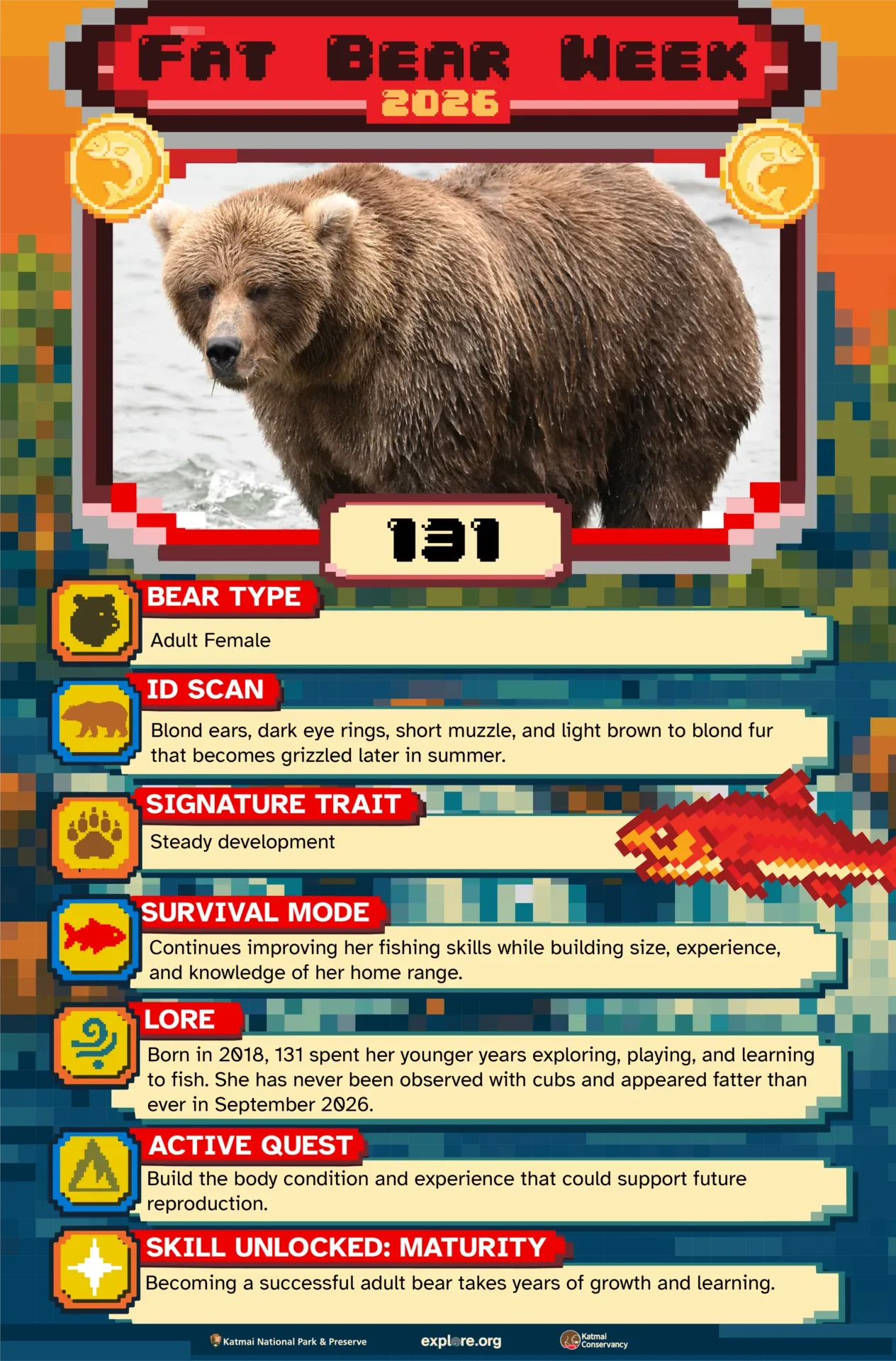
There is also an unusually tempting press kit for people who enjoy turning a fun internet poll into a full household occasion. It includes a printable bracket, bear trading cards and an “I Voted” sticker. Anyone who finds themselves suddenly having opinions about card presentation can at least take comfort in knowing competitive cards are a serious business elsewhere too, as shown by these recent grade-specific sports-card auction records. The bear cards, thankfully, ask no one to assess corners, centering or population reports—only the undeniable majesty of a very successful salmon season.
Contender watch: 132 and her three cubs
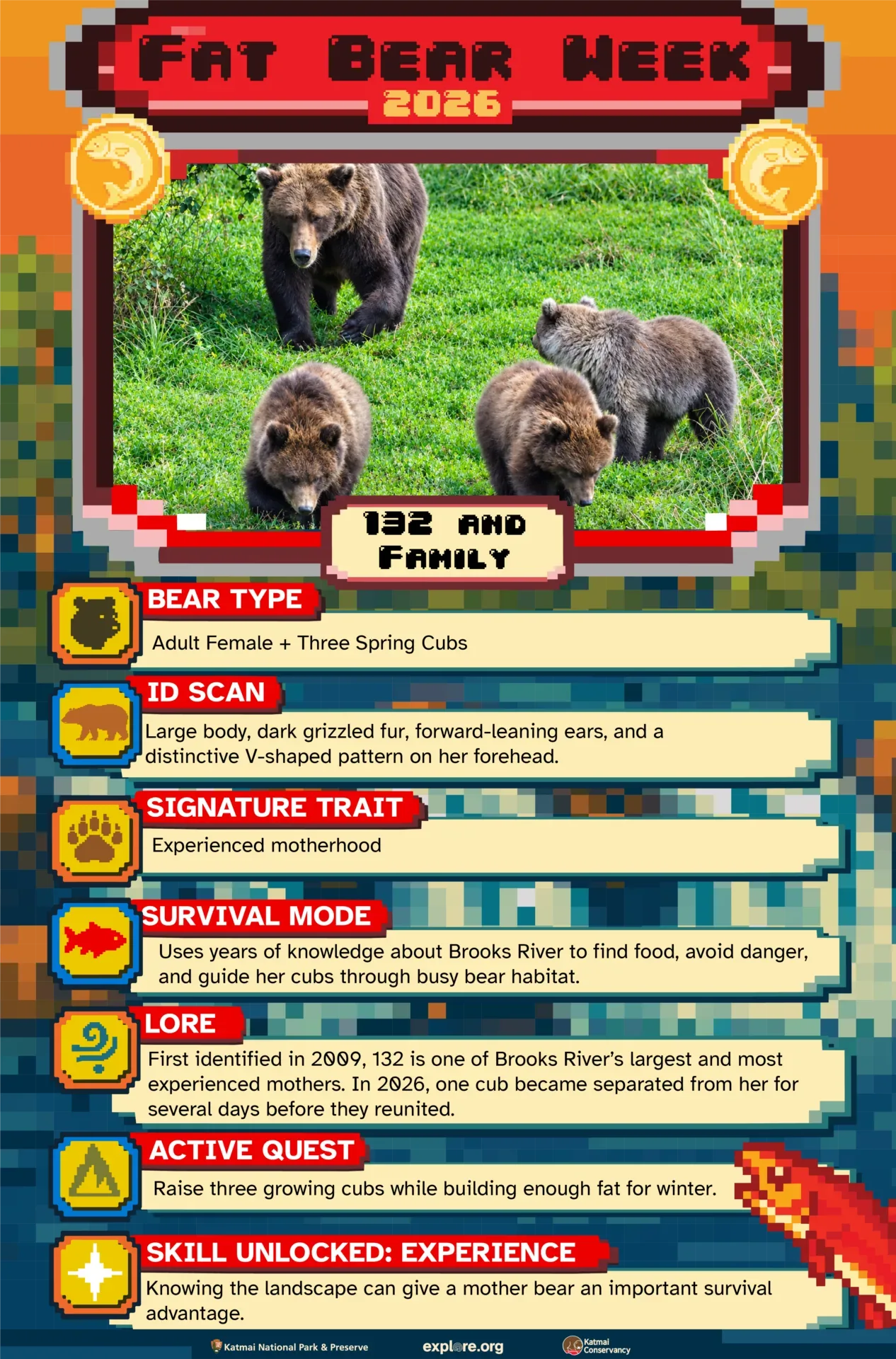
One of the most compelling entries is bear 132, competing alongside three cubs in the family division. The group’s before-and-after images show cubs that have become strikingly rounder over the summer, which is precisely the kind of seasonal development the event celebrates.
The family entry carries an extra layer of interest because 132 is raising three cubs, the largest number of cubs among the family-division competitors. The contest should not be read as a scientific ranking of parenting or a measurement of how much food any one bear has supplied. Still, the visual story is easy to understand: a mother bear and three young animals have reached late summer looking robust ahead of winter.
It is also a reminder that “fat bear” is not exclusively shorthand for a giant solitary adult looming over a river. The event allows viewers to notice different life stages and situations. A cub’s first winter is not the same proposition as an established adult’s winter, and a mother traveling with cubs presents a different image from a mature bear fishing alone. The family division gives that distinction a place in the celebration.
Marshmallow’s strongest season yet
Another name likely to catch voters’ attention is Marshmallow. Nicknames are never a disadvantage in a public bracket, particularly when the name is so perfectly aligned with the required visual brief. But Marshmallow’s case is not only branding.
She is described as a young adult who has spent recent years playing with other bears and improving her fishing. Now approaching an age at which she may have cubs, Marshmallow has reached the fattest condition documented for her so far. That makes her entry especially satisfying when viewed through the contest’s intended lens: compare the seasons, consider the bear’s circumstances, and recognize a meaningful improvement.
Her candidacy also illustrates why Fat Bear Week works better as a celebration of individual animal stories than as a generic vote for “largest silhouette.” A before-and-after set can reveal a bear’s development over time. Voters are not simply choosing an abstract shape; they are responding to recognizable animals with names or identifying numbers, habits and changing fortunes across the summer.
There is no need to turn that into a fictionalized tale of heroic self-improvement. Marshmallow is still a wild bear, and the critical fact is that she has been successful at feeding. Yet knowing she has become larger than she has been in prior seasons gives a matchup more narrative texture than a number on a scale ever could.
Bucky’s clever fishing pays off
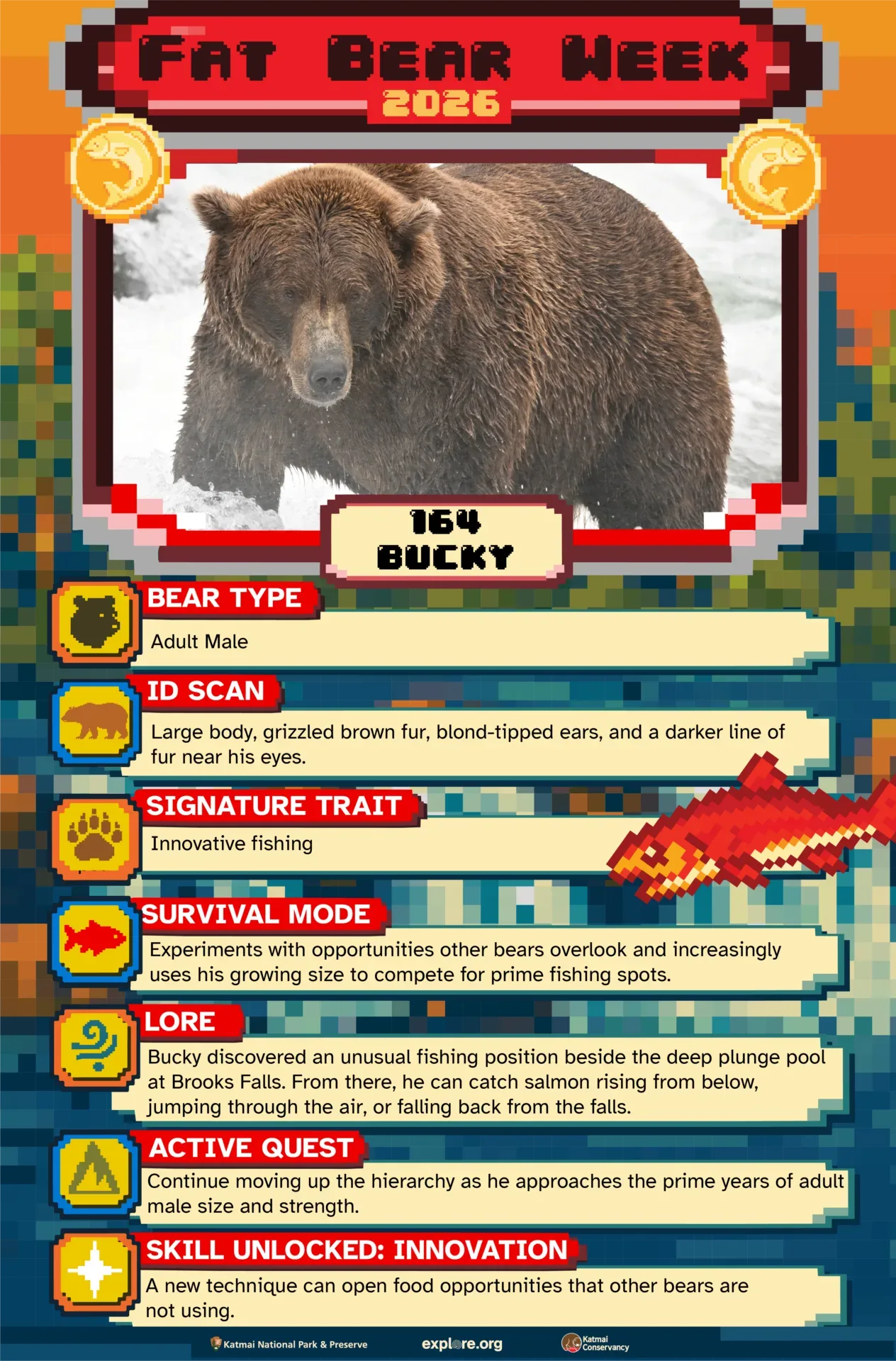
Then there is Bucky, a nine-year-old male whose seasonal change is hard to overlook. Bucky is described as unusually aggressive, even by bear standards, but his most relevant competitive advantage appears to be practical intelligence around fishing.
He has found ways to catch salmon in a pool near Brooks Falls where other bears have not managed to catch fish. That detail matters because it connects the visible result—Bucky’s remarkable late-season condition—to behavior. A bear’s ability to access food efficiently during salmon season can have obvious consequences for its pre-winter reserves.
At nine, Bucky is also not presented as a finished product in Fat Bear Week terms. If he continues to thrive, future contests could show further changes. That uncertainty is part of the fun of following named or numbered bears over multiple years: no bracket result can guarantee what another season will bring.
For this year, though, Bucky has a clear campaign platform. He found a fishing approach that worked, and he has the substantial frame to show for it.
Vote with joy, but keep the point in view
Fat Bear Week invites absurdly enthusiastic civic participation. Make a bracket. Declare a favorite. Insist that a bear’s excellent profile has been unfairly undervalued. The cheerful excess is the point, and a tournament centered on spectacularly round grizzlies does not need much assistance generating drama.
But the event’s better trick is that its humor directs attention toward wild animals and the conditions they need to navigate. The images ask viewers to observe. The cams and educational material offer a chance to learn. The before-and-after format gives a tangible view of why a bear’s late-summer condition is meaningful rather than incidental.
For voters, the soundest strategy is not complicated: look at the seasonal comparison, consider how convincingly each bear appears to have prepared for winter, then embrace whatever level of bracket-induced partisanship feels appropriate. Root for 132’s formidable family, Marshmallow’s standout year, Bucky’s ingenious fishing, or another contender entirely.
The winners may move forward one matchup at a time. The real victory is that, for a few days, the internet gets to focus its competitive energy on the profoundly correct idea that a well-fed bear is worth celebrating.