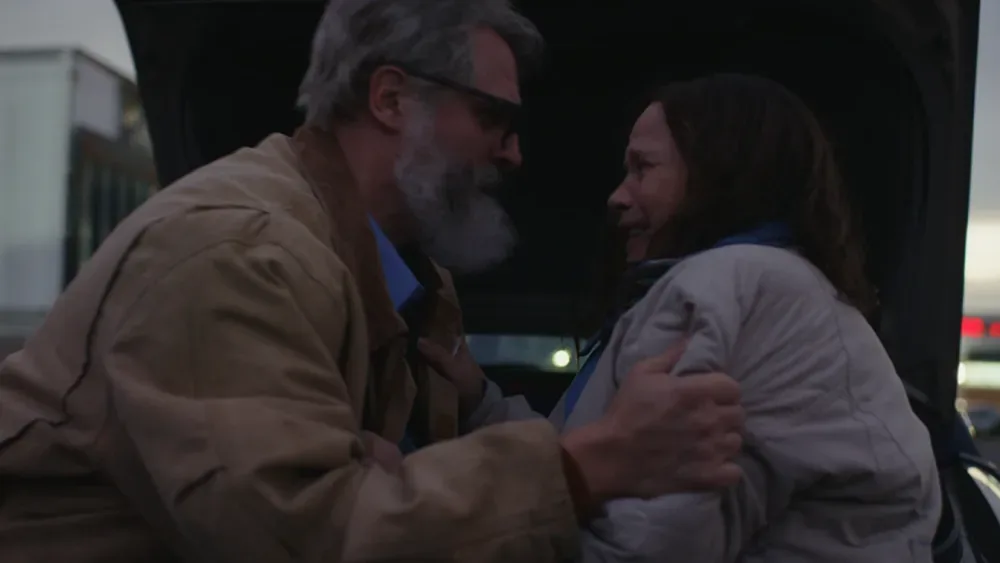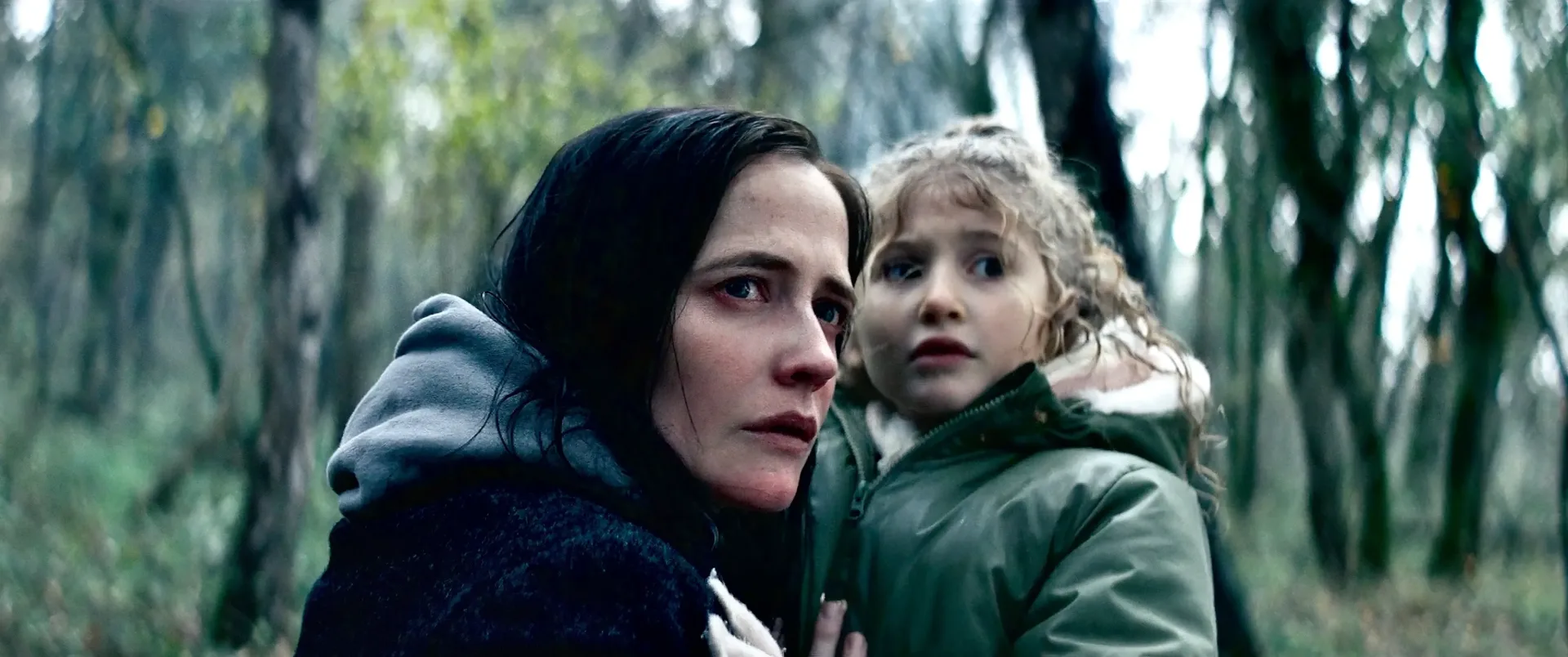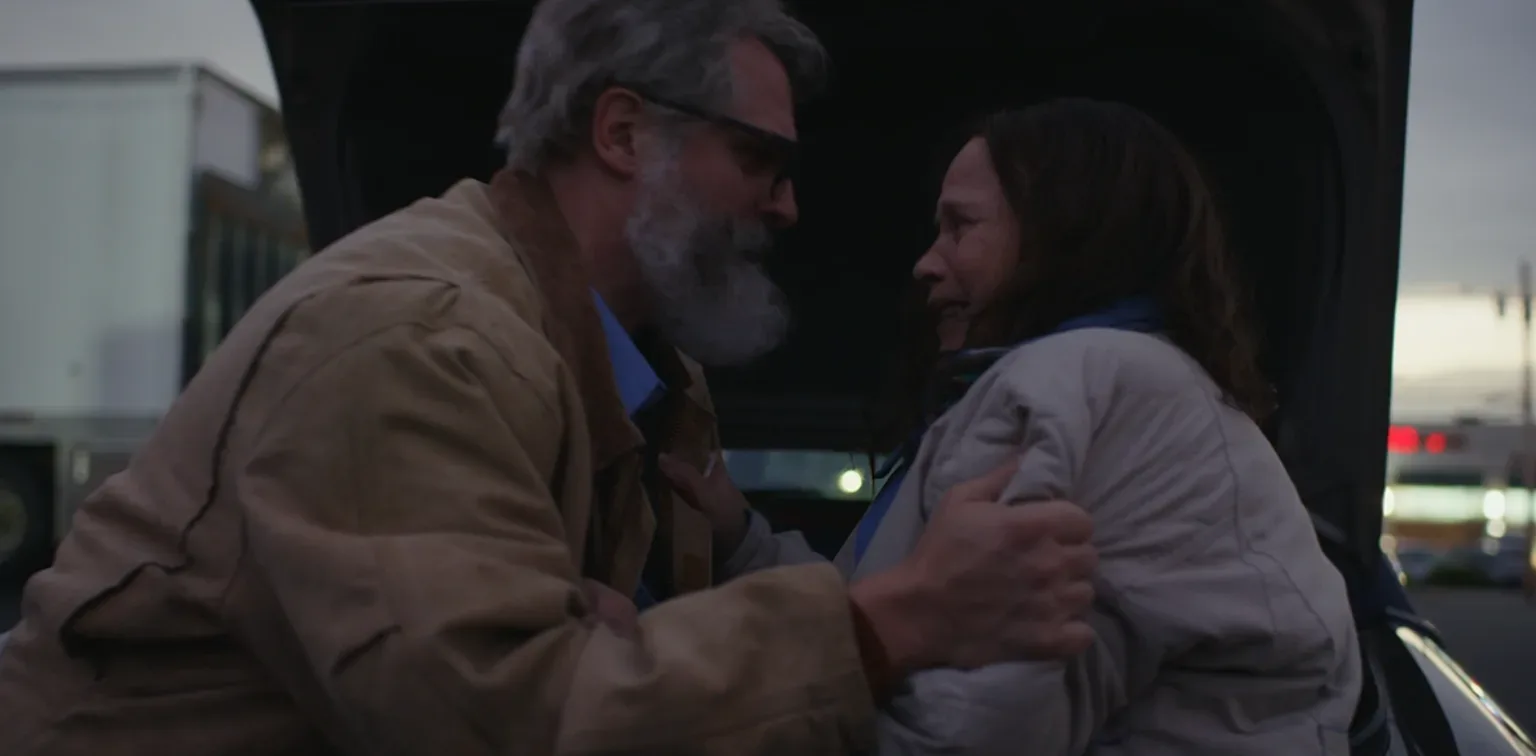
Courteney Cox’s Evil Genius approaches an already infamous real-life case with the volume turned high and the humanity turned low. The 97-minute feature dramatizes the 2003 killing connected to the “pizza bomber” case, building its story around failed criminal plotting, combative relationships and a sequence of increasingly disastrous decisions. It has a formidable group of actors, led by Patricia Arquette and David Harbour, and a premise with enough bizarre turns to support a frantic crime film. Yet the film’s choice to play much of that material as a broad, hostile comedy of errors makes for an uneasy and often abrasive experience.
The central issue is not that a dramatization exists. The underlying events have been the subject of a 2018 documentary series and extensive public attention for more than two decades. A new version could find a different route into the story: the people caught in it, the mechanics of a collapsing plan, or the emotional damage created by an exploitative and volatile relationship. Cox and screenwriter Courtenay Miles instead frame the story primarily as a cruelly ironic spectacle, making the title’s “genius” a running insult aimed at people whose criminal scheme repeatedly proves incompetent.
What the film covers
Evil Genius stars Tom McCarthy as Brian Wells, a middle-aged pizza delivery worker who robbed a PNC Bank branch outside Erie, Pennsylvania, on August 28, 2003. Wells claimed he was a hostage and wore an explosive collar around his neck. He said the device would detonate if demands were not met.
The plan called for $250,000, though Wells left with only a four-figure amount. Police apprehended him soon afterward, and the bomb exploded, killing him. The aftermath led to a lengthy FBI investigation.
Rather than treating that robbery and killing as its opening mystery, the film uses it as a structural destination. It begins with Bill Rothstein, played by Harbour, calling police to report the body of Marjorie Diehl-Armstrong’s boyfriend in a freezer. The narrative then connects that earlier killing to the later bank robbery plot.
That is a meaningful difference in construction. The documentary series moved backward from the bombing to unravel the plan. Cox’s film begins within the surrounding mess and accelerates toward the better-known event. In principle, that lets the movie concentrate on the dysfunctional connection between its two key conspirators rather than merely reproduce an investigation.
Arquette and Harbour occupy very different registers
Arquette plays Diehl-Armstrong at maximum intensity. Her performance is conspicuously large, sharp-edged and rarely softened. The characterization presents Diehl-Armstrong as angry, suspicious and convinced she deserves a better outcome than the world has given her. That approach certainly makes her impossible to ignore, but it provides limited variation over the film’s runtime.
Harbour offers a more subdued counterweight as Rothstein, Diehl-Armstrong’s co-conspirator and intermittent lover. He is portrayed as shambling and pliable, caught in her orbit without bringing much authority to the partnership. Their on-and-off romance is the film’s major point of emphasis, replacing some of the procedural attention a longer treatment might give to the case’s wider web of events.
The film includes flashbacks to Diehl-Armstrong’s younger years, with Arquette’s daughter Harlow Jane playing the younger version of the character. These scenes suggest an intelligent young woman with potential who needs an opportunity. But the dramatic bridge from that person to the older figure at the center of the conspiracy remains underdeveloped. The film signals a transformation without doing enough to make viewers understand it.
That missing connective tissue matters because a character study needs more than a chain of outrageous acts. It needs an account of cause, contradiction or interiority. Evil Genius instead repeatedly returns to shouting, humiliation and dysfunction. The result is a film that can describe the toxicity of this relationship while struggling to illuminate why it endured or what the people involved believed they could gain from it.
A true-crime dramatization needs a tonal point of view
“Tone” means the emotional attitude a film takes toward its material. It is shaped by performances, dialogue, music, camera work, editing and the way consequences are presented. Here, the tonal choice is heightened farce: a mode in which bad planning and bad behavior are emphasized for their escalating absurdity.
Farce can be an effective tool. It is often built on misunderstandings, desperate improvisation and plans that deteriorate faster than their architects can control. The facts here clearly contain elements that could support that construction. But farce also needs calibration, especially when the story includes a real death and people treated as pawns. If every failure is greeted with the same smirking distance, the film risks turning its lack of compassion into the main event.
That is the uncomfortable imbalance in Evil Genius. It is eager to underline the conspirators’ foolishness and unpleasantness, while giving limited attention to the emotional weight of the harm around them. The movie makes its subjects look awful; it does not always make them dramatically legible. The distinction is important. Understanding is not excusing. A more character-focused film could have examined these people without absolving them, and could have made the case’s absurdity land harder by treating its stakes with more care.
The supporting players, including Garret Dillahunt and Danielle Macdonald, are largely used to extend the gallery of inept accomplices. They register more as pieces of a chaotic mechanism than fully developed people with clear motivations. With so much incident compressed into 97 minutes, that economy is understandable, but it limits the film’s ability to create a rounded picture of the conspiracy.
The compression problem
There is a lot of story to fit into the film’s running time: the freezer discovery, the volatile Diehl-Armstrong and Rothstein relationship, additional accomplices, the planning of the robbery, the robbery itself and the investigation that followed. The prior documentary had more than twice as long to cover the saga. A feature does not need to mimic a series, but it needs to make decisive choices about what it can deepen.
Cox’s version makes its choice: the romance and its rot are the organizing principle. The trouble is that its relentless mode flattens the very relationship it prioritizes. The characters argue, manipulate and fail, but their repetitions begin to feel like noise rather than revelation. A shorter format can create momentum through selectivity; here, the pace feels more like a pinball machine, bouncing through incident before the implications of one scene have settled.
For viewers already familiar with the case, that also reduces the sense of discovery. The film has little new factual terrain to reveal, so its value depends on interpretation. A dramatic retelling must show why the story needs to be told this way now, beyond the basic appeal of revisiting stranger-than-fiction details. Evil Genius has an angle—the toxic partnership at its center—but the presentation is too shrill to make that angle especially penetrating.
Harsh images and louder music reinforce the approach
Cinematographer Eigil Bryld gives the movie a deliberately severe look. The imagery is gray, rough and tightly framed, with an intentionally unflattering quality that matches the film’s bleak view of its characters. That visual strategy is consistent, but it can feel like another layer of punishment in a movie already committed to showing an ugly situation in aggressively ugly terms.
The sound design makes a similarly blunt impression. Rock tracks ranging from Blue Öyster Cult to Radiohead are used prominently, at times overwhelming dialogue. A needle drop is the placement of a pre-existing song within a film scene. Used with precision, it can establish time, mood or irony. Used too forcefully, it can announce the intended feeling rather than let the scene generate one. Here, the music often intensifies the sense that the film is pressing hard for an attitude instead of trusting the story’s inherent strangeness.
Those formal choices are not accidental: they support an aesthetic of disdain. Cox is not asking audiences to find beauty or grace in the case. Nor should a real-life killing be made decorative. Still, visual harshness and sonic aggression are not the same thing as seriousness. The film could have maintained a grim, unsentimental perspective while allowing quiet, confusion or grief to complicate the spectacle.
Why the streaming comparison makes sense
The film premiered in Toronto’s Gala Presentations section on September 12, 2026. Its scale and episodic concentration on scandalous turns may play more naturally for audiences encountering it at home, particularly those with prior interest in the case. Its most obvious draw is Arquette’s divisive, attention-commanding performance, while Harbour supplies a less flamboyant foil and McCarthy carries the role of Wells.
That does not establish any release plans or viewing platform. It simply reflects the kind of story this is: a familiar true-crime narrative reconfigured as a rapid, nasty dramatization. People interested in darker crime stories and deliberately unpleasant character portraits may find something to engage with. Those seeking an investigative account, a nuanced psychological drama or a respectful treatment of the people harmed by the events should set expectations accordingly.
The broader appetite for dark comedy remains visible across streaming projects, including Netflix’s recently greenlit All the Rage. But the category covers very different subjects and responsibilities. When the material is a real killing, a film’s comic distance requires unusual discipline. Evil Genius has the cast and the unnerving raw material to make a powerful case for itself. Its decision to turn so insistently toward mockery leaves it feeling more punishing than perceptive.
Cast and crew
- Director: Courteney Cox
- Screenplay: Courtenay Miles
- Cinematography: Eigil Bryld
- Editor: Kathleen McQuerrey
- Music: Charlie Seaborn
- Cast: Patricia Arquette, David Harbour, Michael Chernus, Garret Dillahunt, Ryan Eggold, Gregory Alan Williams, Tom McCarthy, Owen Teague, Harlow Jane, David Rasche, Dascha Polanco, Danielle Macdonald and Thomas Michael Allen