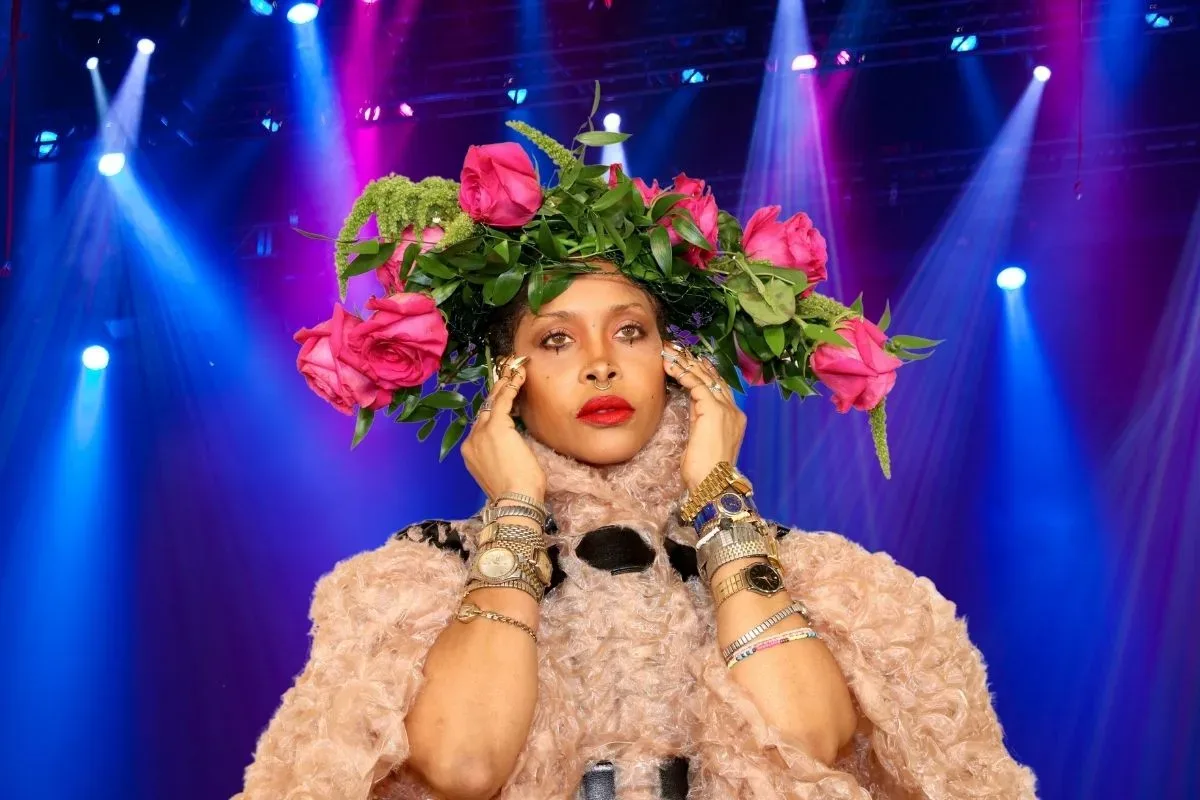
Erykah Badu and Rapsody are set to share the microphone again at the Soul Train Awards, where they will join CeeLo Green, Dave Hollister and Avery Wilson for the newly named Badu Cypher. Badu is producing and directing the segment, with Spotify presenting it.
The performance is scheduled for an awards broadcast that returns to Chicago, the city where Don Cornelius started Soul Train. It will air November 27 at 8 p.m. ET/PT on BET and CBS, marking the awards’ CBS debut. Anthony Anderson will host, and the wider program also includes a tribute to Freddie Jackson.
This is not simply a familiar set of artists assembled for a one-off ensemble number. The format has a direct connection to Badu’s history with the awards, while the lineup puts singers and a rapper from notably different lanes into the same performance space. The result, at least in concept, is a musical relay rather than a conventional awards-show medley.
What the Badu Cypher means
A cypher is a performance format closely associated with hip-hop: artists trade verses or turns over a shared musical foundation. It can emphasize individual style, timing and the ability to respond to the energy created by the person who performed immediately before them. The Soul Train version applies that communal, pass-the-mic structure to voices rooted in R&B and soul as well as rap.
Badu helped establish that idea at the 2015 Soul Train Awards. While hosting that ceremony, she performed behind the turntables as DJ Lo Down Loretta Brown for the first Soul Cypher. K-Ci, Chrisette Michele, Lalah Hathaway and Eddie Levert each took turns singing, with Omar on keys.
That inaugural performance gave R&B vocalists a format built around exchange instead of a standard solo showcase. It subsequently became a recurring part of the awards. Badu later received the Soul Train Awards’ Legend Award in 2018, at the same ceremony.
Calling this year’s installment the Badu Cypher makes the connection explicit. It signals more than a celebrity-hosted segment: Badu has a foundational relationship to the format and is taking on both the production and directing roles for this edition. Those responsibilities matter because a cypher depends on curation. Who enters, the sequence of appearances, the musical bed and the visual presentation can all shape whether it feels like a true conversation among performers rather than a list of guest spots.
Badu and Rapsody return to a Grammy-winning partnership
Badu’s appearance with Rapsody follows their Grammy win for “3:AM.” The Recording Academy named the track Best Melodic Rap Performance at the 2025 Grammys, delivering Rapsody’s first career Grammy win.
Related coverage includes Erykah Badu, Rapsody Set for Soul Train Awards Badu Cypher.
The category is useful context for why this pairing fits a soul-focused cypher. Melodic rap broadly describes music in which rap performance and sung or melody-driven elements are central to the record’s identity. “3:AM” brought Badu’s and Rapsody’s approaches together in a way that earned recognition from the Recording Academy; the Badu Cypher gives them a new live setting in which to reconnect.
Rapsody arrives with fresh awards-season momentum, too. Her God Gotta Afro & Gold Hoops has been nominated for Best Rap Album at the 2027 Grammys. For readers tracking music’s overlap with game culture and entertainment, there is a related awards-season story in Lil Jon’s 2027 Grammy nomination.
Badu has also remained active outside the awards-show setting. In August, she joined The Alchemist for Before the World Blows: The Abi and Alan Experiment. Together, those recent projects underline why her role here extends beyond nostalgia for the original Soul Cypher: she enters the segment as an artist continuing to collaborate across musical approaches.
A lineup built around distinct musical routes
The remaining performers bring different career paths into the same compact format. CeeLo Green emerged from Atlanta’s Goodie Mob before forming Gnarls Barkley with Danger Mouse. That background links rap-group experience with a later partnership known for a different creative identity, making his presence an especially natural match for a segment designed to blur rigid genre boundaries.
Dave Hollister’s résumé runs through R&B group work and notable featured vocals. He sang with Blackstreet and contributed to Tupac Shakur’s “Brenda’s Got a Baby” and “Keep Ya Head Up.” In a cypher context, that history matters because the format rewards immediately recognizable vocal character. A singer does not need an extended set to establish a presence; a few well-placed lines, a tonal shift or a response to the prior performer can become the moment.
Avery Wilson adds another route into the performance: television competition and musical theater. He competed on The Voice before playing the Scarecrow in Broadway’s The Wiz. That combination suggests comfort with both high-visibility vocal performance and the storytelling demands of a staged production, though the details of the Badu Cypher’s arrangement have not been disclosed.
It is worth separating what is known from what is not. The announced facts establish the five performers, Badu’s production and directing role, Spotify’s presenting role, and the broadcast details. They do not reveal the songs, order of performance, backing musicians, duration or whether the artists will deliver original material, covers, freestyles or a mixture. A cypher title describes the intended format, not a confirmed set list.
Why Chicago is part of the occasion
The location brings additional weight to the broadcast. The Soul Train Awards are returning to Chicago, where Don Cornelius began Soul Train. BET and the city partnered to stage the ceremony at the Harris Theater.
That setting pairs a contemporary, artist-led cypher with the local origin point of a long-running platform for Black music and performance. The Badu Cypher is built on a format commonly tied to hip-hop, yet its lineage within this awards show began by centering R&B singers. This year’s lineup continues that exchange: Rapsody represents rap directly, while Badu, Green, Hollister and Wilson bring intersecting soul, R&B, group, theatrical and crossover histories.
The CBS debut is another practical reason the segment may draw attention. An awards show reaching audiences on BET and CBS can introduce the Soul Cypher tradition to viewers who have not encountered its earlier editions. The appeal is straightforward even for casual viewers: rather than asking an audience to follow a long narrative or know an album cycle in advance, the structure lets personalities emerge turn by turn.
What viewers can reasonably expect
The clearest expectation is a collaborative performance shaped around contrast. Badu and Rapsody have an established Grammy-winning connection. Green, Hollister and Wilson add voices with backgrounds that range from Goodie Mob and Gnarls Barkley to Blackstreet, Tupac collaborations, The Voice and Broadway’s The Wiz. That variety gives the segment the raw material for an exchange between rap cadences, sung passages and stylistically distinct vocal performances.
Just as important, this is Badu returning to a concept she helped put on the Soul Train Awards stage in 2015. By producing and directing the 2026 installment, she is positioned to guide both its musical identity and presentation. The announced Badu Cypher therefore functions as a reunion for Badu and Rapsody, a gathering of varied performers, and a continuation of an awards-show tradition that was designed to let artists trade the mic.
Viewers can watch the Soul Train Awards on November 27 at 8 p.m. ET/PT on BET and CBS.