Emma Chamberlain is not framing her reduced internet presence as a disappearance. Instead, the creator and entrepreneur is attempting something considerably harder in a culture built around relentless visibility: working out how to create publicly without making constant public output the price of participation.
That effort now runs alongside the continued development of Chamberlain Coffee, her first company. The direct-to-consumer coffee brand recently opened its first physical café in Los Angeles, a project that had been in development since the company began. Chamberlain also remains involved with the brand’s new Pinterest collaboration, built around the platform’s 2026 “Wilderkind” trend and its outdoorsy, whimsical sensibility.
The important detail is that neither project requires a return to the pace of uploading that made Chamberlain an online star. She has said she wants to create again, but on terms that support her mental health. It is a distinction worth taking seriously. A hiatus can look, from the outside, like an absence. For a creator whose name is attached to a consumer business, it can also be a test of whether the work, team and brand can stand on their own.
A break from the feed, not a rejection of creative work
Chamberlain has been largely offline for months, while making clear that she does not intend to remain there forever. Her stated goal is to find a healthier way to do her job rather than to abandon the creative impulse behind it.
“I want to create things,” Chamberlain said. “I want to figure out a way to do this job in a way that is mentally healthy.”
That makes the break more nuanced than the usual all-or-nothing social-media narrative. The internet is not being presented as solely harmful; Chamberlain has described it as an enormous blessing as well as a source of psychological challenges. Both can be true. Her early online work made a career possible, but the ongoing expectation to be visible, reactive and consistently productive can turn an opportunity into an exhausting obligation.
She announced an indefinite pause from her long-running Anything Goes podcast in April. Her YouTube vlogs—the format that helped propel her to prominence in 2017—have also been absent for years. Neither point offers a timetable for a comeback, and there is no announced replacement schedule. What Chamberlain is describing is a process of reassessment, not a prepackaged relaunch campaign.
That restraint matters. Online audiences are accustomed to interpreting any quiet period as either a dramatic exit or a carefully planned promotional beat. Chamberlain’s comments point to neither certainty. She believes she can find a healthier arrangement, but she has not claimed to have solved it already.
Why a café changes the equation for Chamberlain Coffee
For the past six years, Chamberlain’s entrepreneurial work has centered on Chamberlain Coffee. The company began as a DTC operation, shorthand for direct to consumer: a business model in which a company sells straight to customers, rather than relying entirely on conventional retail intermediaries. In this case, the brand’s mail-order foundation provided a way to connect a product business to an audience already familiar with its founder.
The Los Angeles café represents another step. A brick-and-mortar location is a physical retail space where the customer encounters the product, design, staff and atmosphere in person. For a coffee brand, that means the experience cannot depend only on packaging, social posts or a creator’s latest video. It has to function in the room.
Chamberlain has said the café had been in progress since the company’s founding and that taking time helped it become closer to the café she had imagined. She pointed not just to the interiors, but to the location, baristas and wider team. Those details indicate the difference between attaching a famous name to a venue and building an operation meant to deliver a consistent experience.
That does not mean the founder is irrelevant. Chamberlain recognizes that disappearing completely would not make much sense when the company bears her name. But she has also said she does not need to be at the front of every campaign. The café, in her view, should be capable of attracting people through its own quality.
It is a practical ambition for any creator-founded brand. Founder visibility can provide an enormous early advantage: a ready-made audience, immediate recognition and a recognizable point of view. Yet it can also make the company vulnerable if each launch, product or public moment requires the founder to be permanently online. A business that only works when its namesake is posting at maximum volume is asking that person to become both the product and the marketing department.
Building a brand without turning a person into the product
Chamberlain’s stated balance is to remain involved more casually while reducing the degree to which the company’s success depends on her personal prominence. That is a meaningful shift in emphasis, especially given her concerns about public life.
The goal is not invisibility; it is durability. In practice, durability means a café can be judged by its environment and service, a coffee blend can appeal on its own terms, and a team can carry the day-to-day work without needing a constant stream of founder appearances to validate every decision.
There is also a human consequence. If the company has a life beyond the founder’s feed, Chamberlain gains room to make choices based on what is creatively and personally sustainable rather than what best feeds the content cycle. Her phrase for the earlier stage of the company—“building the boat as I’m sailing it”—captures how public-facing entrepreneurial work often develops in real time. The café’s arrival gives that boat more structure.
The Pinterest collaboration and a different kind of platform use
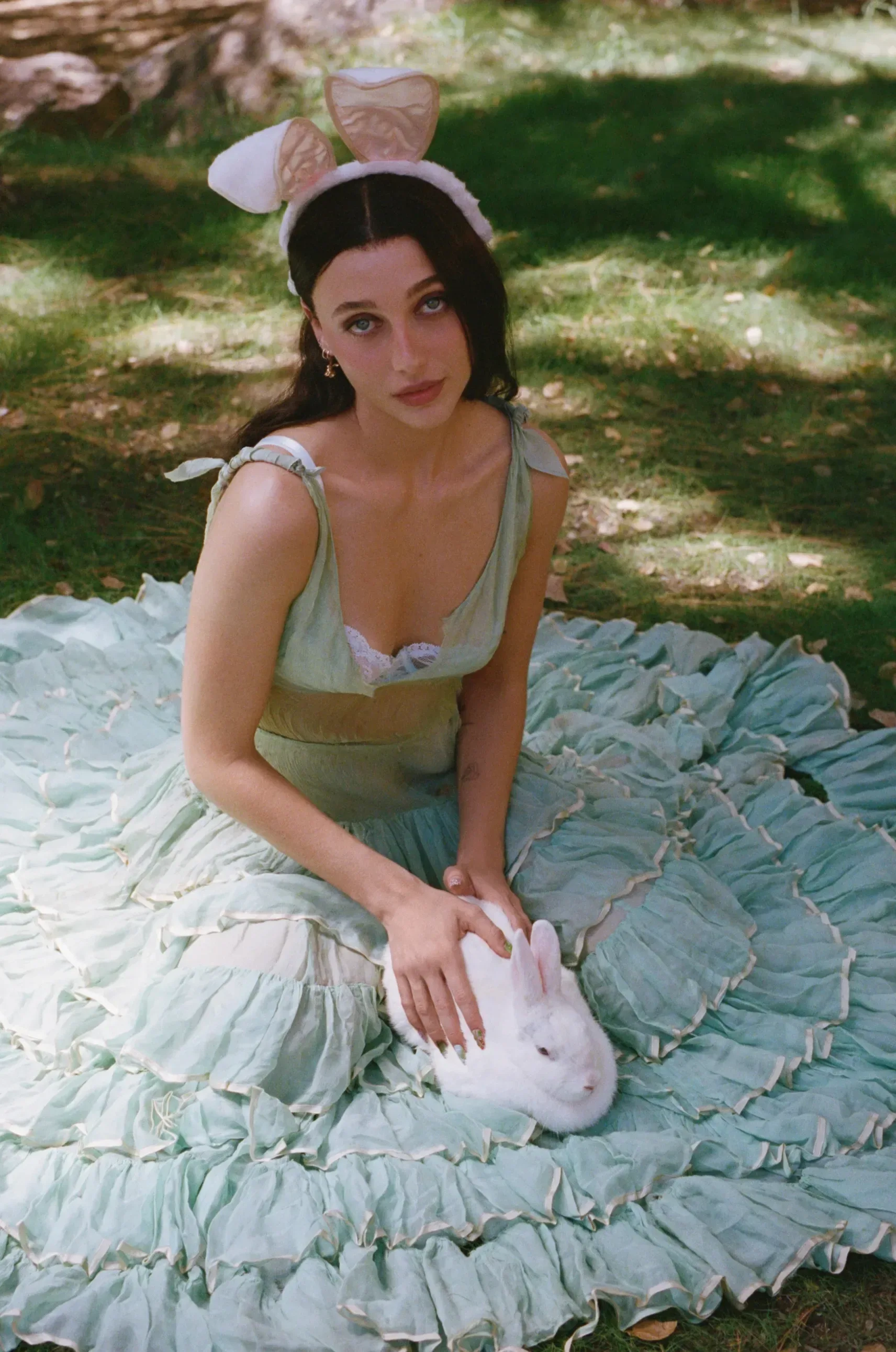
Chamberlain Coffee’s second collaboration with Pinterest is tied to “Wilderkind,” a Pinterest Predicts 2026 trend centered on nature, whimsy and spending time outdoors. The collection includes an almond-flavored coffee blend, blueberry syrup, a woodland-themed mug and a picnic blanket.
The products are straightforwardly aligned with the collection’s premise: coffee for a picnic-minded, woodland-inspired setting, with an object component that extends the theme beyond food and drink. But the more revealing aspect of the project is Chamberlain’s explanation of why Pinterest feels different from other corners of social media.
She describes Pinterest as a platform she can use as a consumer in a healthy way because it can encourage people to make things and go out into the real world. That is her perspective, not a universal prescription for platform use, but it identifies a sharp contrast in what she appears to want from digital spaces: inspiration that points outward rather than a system that demands unending self-display.
“Algorithmically built” is often used as a vague criticism or compliment, so it is useful to be specific. An algorithm is a set of computational rules used to sort, select or recommend material. In the social-media context, algorithmic feeds influence which posts people encounter and what kind of participation is rewarded. Chamberlain’s point is that she sees Pinterest’s recommendation structure as oriented toward ideas, projects and expression rather than the pressure to make her own life an always-on performance.
That does not erase the commercial element of a branded collaboration. It does explain why this particular partnership fits her current approach. The connection is less about demanding that she become a full-time broadcaster again and more about translating an aesthetic prompt into a limited product collection.
Content fatigue is not just a creator problem
Chamberlain’s comments extend beyond her own schedule. She sees a link between the pressure creators feel to produce constantly and the fatigue audiences experience from having too much to consume. In her telling, the crowded media environment is difficult for both sides: creators must ask how to add something meaningful to an already overflowing pile, while viewers and listeners can be worn down by the endless availability of new material.
Her observation is not that creative work has lost value. It is that more content is not automatically better content, especially when its production depends on a person operating beyond a healthy limit. The challenge becomes one of discernment: what deserves to be made, what can wait, and what need not be made at all.
That question reaches beyond the creator economy. Entertainment companies, platforms and individual artists all face versions of it, even as they navigate business pressure to remain visible. The broader industry conversation has recently included questions of identity, scale and consolidation; questions about how entertainment brands maintain a clear identity reflect a related concern. For Chamberlain, the issue is personal before it is corporate: how to have a public career without treating permanent output as the only proof of relevance.
There is no simple technical fix for that dilemma. A new platform feature cannot remove the psychological demands of being watched, and a temporary break cannot by itself redesign the expectations around online labor. Chamberlain has acknowledged the difficulty directly, saying she does not believe being a public figure is natural or inherently healthy.
Her confidence lies in the possibility of finding a better model and sharing it when she does. That is aspirational rather than settled. For now, the clearest evidence of the approach is structural: less reliance on a personal posting cadence, more attention to a company and café designed to exist beyond it, and carefully chosen collaborations that match the kind of online participation she finds constructive.
What audiences should and should not read into the quiet
Fans waiting for another vlog or podcast episode have a simple answer, even if it is not a definitive one: Chamberlain says she expects to return to creating eventually. They do not have an announced date, a promised format or a pledge that her eventual output will look like the work that first built her audience.
That uncertainty is the story. Chamberlain is resisting the idea that an internet personality must choose between total disappearance and total availability. Her current work with Chamberlain Coffee suggests a third route, one where creative identity can continue through business, design and selective projects while a person rethinks the terms of their own visibility.
For a figure who became famous through intimate-feeling online output, that may be an especially difficult transition. It is also a reasonable one. The café, the Wilderkind collection and the stated intent to return all point in the same direction: Chamberlain is still making things, but she is trying to ensure that making them does not require sacrificing the peace she says she is working to protect.