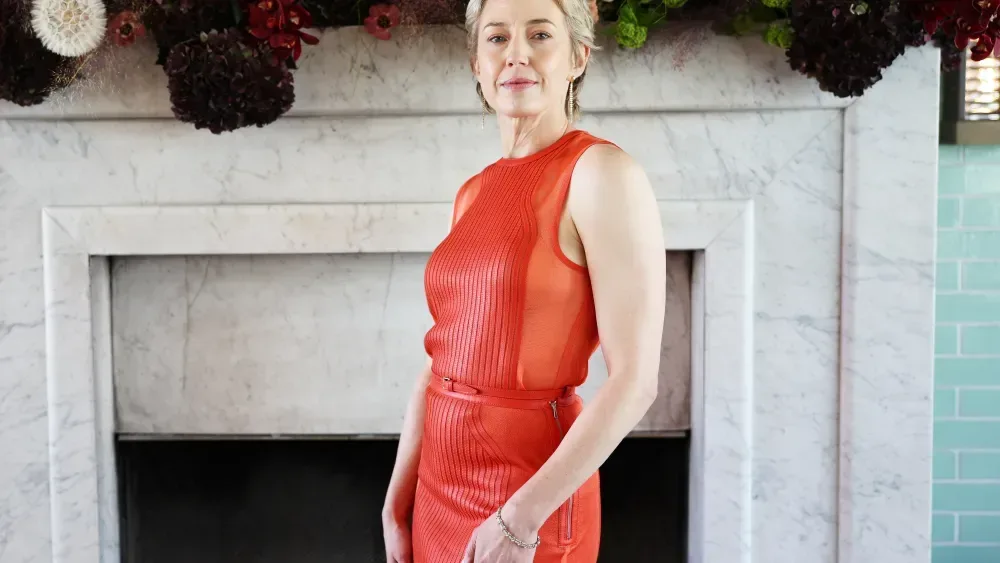

Elizabeth Meriwether will receive the 2027 Showrunner Award at the ATX Television Festival, recognizing a television career that stretches from the seven-season comedy New Girl to the limited-series drama The Dropout and the newer thriller Furious.
Meriwether is scheduled to take part in an onstage conversation at the Austin festival, running June 3–6, 2027. The appearance will be her first at the event.
The honor is built around the role of the showrunner: generally, the senior creative leader responsible for guiding a series’ writing, production priorities and overall voice. That job is not simply about originating a premise or writing an individual episode. It is the ongoing work of turning an idea into a coherent television series while coordinating a collaborative team. The festival’s award specifically recognizes showrunners who create an environment of creativity and collaboration while exerting a distinctive, wide-reaching creative influence on television.
Past recipients include David E. Kelley and Bill Lawrence. Meriwether’s selection places particular emphasis on range. Her cited work moves between a network single-camera sitcom, a fact-based streaming limited series and a serial-killer drama—formats with very different demands on tone, pacing and character construction.
A career across sharply different TV forms
New Girl, the Fox comedy created by Meriwether, ran for seven seasons. A single-camera comedy typically uses a more film-like visual approach than the traditional multi-camera sitcom format, and it does not depend on a live studio audience setup. The distinction matters because it gives writers and directors room for a different rhythm: scenes can be more intimate, edits can be more flexible and visual comedy can be integrated into the storytelling. Sustaining that sort of ensemble series across seven seasons also means maintaining its identity while allowing characters and relationships to evolve.
Her work on Hulu’s The Dropout represents a major tonal and structural change. The Emmy-winning limited series starred Amanda Seyfried and explored the life and career of Elizabeth Holmes. A limited series is designed around a contained story rather than an open-ended, multi-season structure. That containment can bring focus, but it also means that creators must make every episode serve a defined arc. There is less room to postpone essential turns or rely on the expectation of a later season to resolve the central story.
Meriwether’s more recent series, Furious, adds another register to that body of work. She created and served as showrunner on the Hulu series, which stars Emmy Rossum as an FBI agent pursuing a serial killer played by Lola Petticrew. The show was loosely inspired by the 1987 film Black Widow, and it was renewed for a second season in August.
The phrase “loosely inspired” is important. It signals a connection in creative starting point, rather than a claim that the series is a direct screen retelling of the earlier film. Furious also carries a different set of serial-storytelling responsibilities from The Dropout: its second-season renewal means its creative team can continue building the drama beyond the first season’s immediate framework.
Meriwether also has a credit on FX’s acclaimed Dying for Sex. Taken together, the projects cited in the award announcement make a case for a writer-producer whose work cannot be reduced to one genre or platform. Comedy, cultural drama and suspense place different pressures on a showrunner, yet the common thread recognized here is a willingness to take creative risks and build through collaboration.
Why the showrunner distinction matters
Television is inherently collective. Writers’ rooms develop episodes; performers give characters their shape; directors, editors, designers and production departments turn scripts into finished television. A showrunner’s influence is therefore not best understood as solitary authorship. The role involves establishing a clear creative direction while making room for many contributors to improve the work.
That is why the collaboration language in the Showrunner Award’s criteria is more than ceremonial. A series may have a recognizable point of view, but its durability depends on communication across departments and on decisions that keep the story, performances and production working toward the same goal. The award’s framing gives equal weight to creative voice and the environment in which that voice is executed.
Jenn Morgan, the festival’s head of programming, highlighted the shifts in Meriwether’s work: the “pure joy” of New Girl, the “righteous anger” of Furious, and the “sharp surreality and cultural relevance” of The Dropout. Morgan also pointed to Meriwether’s record of challenging audience expectations and argued that her work demonstrates the value of creative risk and collaboration.
Those descriptions do not suggest that every Meriwether project seeks the same emotional effect. Instead, they outline a career built on changing the frame. A long-running comedy needs a reliable engine that viewers want to return to. A limited series about a real public figure requires control over a finite narrative. A thriller centered on an FBI agent and a serial killer needs tension sturdy enough to support continuation. The genres differ, but each asks for deliberate control of what audiences feel and when they feel it.
What audiences can expect from the festival event
The confirmed program detail is an onstage conversation with Meriwether during ATX TV Festival’s June 3–6, 2027 run in Austin. No further panel subjects or session specifics were provided. Still, the format is well suited to a career that offers several useful avenues for discussion: moving among comic and dramatic modes, leading a series through production, and adapting a creative approach to a show’s intended length.
For viewers who know Meriwether primarily through one title, the award offers a reason to look at the contrast between the work. New Girl is the obvious starting point for fans of character-centered comedy. The Dropout demonstrates a different mode in a finite, Emmy-winning drama. Furious, meanwhile, is the current continuing series in the group, with its second season confirmed. This is not an argument that those shows are interchangeable; the point is that the span between them is exactly what the award is recognizing.
The festival is also honoring Meriwether at a moment when television conversations frequently turn to creative leadership: who determines a series’ voice, how writers’ rooms function, and how a program changes as it progresses. Those questions have practical consequences for the programs audiences ultimately watch, even when much of the process remains offscreen. A showrunner’s choices shape which stories gain focus, how tonal shifts are handled and whether a series feels consistent from episode to episode.
Meriwether responded to the honor by calling the festival a special gathering for people who love television and Texas barbecue, and said she was deeply grateful. The remark fits the event’s community-minded emphasis, but the substantive achievement being celebrated is substantial: a body of work spanning a major broadcast comedy, an Emmy-winning limited series, an acclaimed FX project and a renewed Hulu thriller.
It is also a useful reminder that television careers do not move in a straight line. Meriwether’s credits show a creator working across different storytelling containers rather than repeating a single formula. For an award focused on distinctive voice and collaborative leadership, that breadth is the central case.
For more on how creative voices and craft are being discussed across the entertainment landscape, see Women of Awards Season Put Lived Experience, Research and Craft at the Center of Their Work.