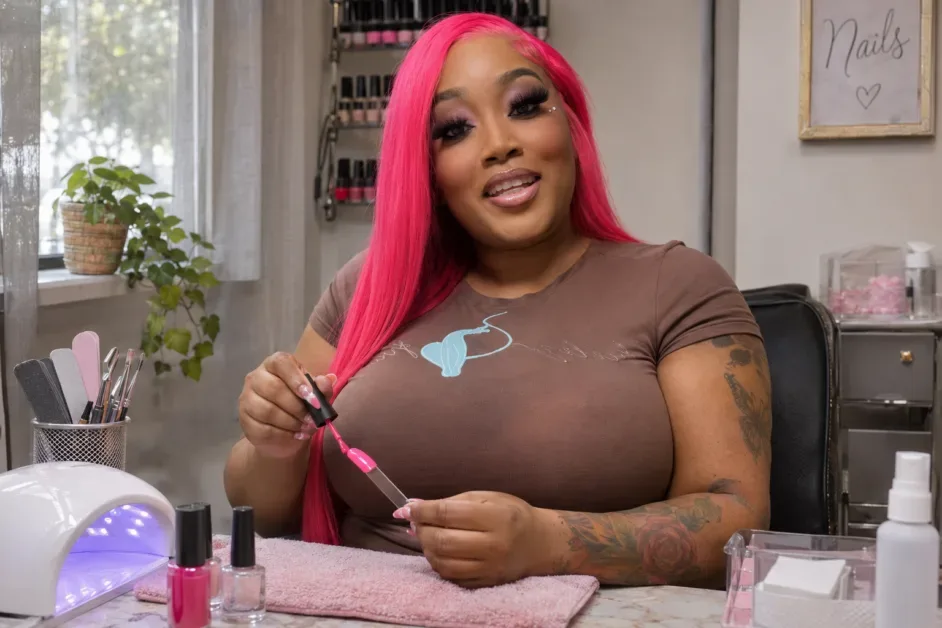
Dolly Babe was considering a practical detour away from music when a stripped-back recording changed the calculation. The Dallas rapper says she had looked into becoming a nail technician and considered a $700 course while trying to find a dependable way to make money outside rap. Then she recorded “Pink Blush” alone in her room on her phone.
The song was not the result of a carefully scheduled studio campaign. Dolly Babe said that, after years of studio sessions, she did not have the motivation to book another one. She put out the phone recording without mixing or mastering it, and it moved faster than anything she had released before.
That distinction matters because a viral moment and a lasting music career are not the same thing. Dolly Babe had experienced online traction before, but those earlier bursts had not endured. She was close to walking away from making music altogether when “Pink Blush” began to connect. Its subsequent performance shows a progression from an immediate online response into broader industry distribution: a remix with Megan Thee Stallion, a Billboard Hot 100 debut at No. 58, playlist placements, and radio support at Urban and Rhythmic formats.
From a bedroom recording to a wider campaign
Released June 30, “Pink Blush” became Dolly Babe’s summer breakout. A profile published November 9 placed the song’s Hot 100 entry at No. 58 and reported that she had reached 3.3 million monthly Spotify listeners. The same report counted more than 17 million video views and noted engagement around the track from Rihanna, Madonna and Janet Jackson.
Those markers each describe different parts of a modern music breakthrough. Monthly listeners are a rolling streaming-audience measure rather than a count of dedicated fans or sales. Video views can demonstrate visibility, but do not automatically show that listeners will return for future releases. A Hot 100 placement, meanwhile, signals that a song has crossed into a broader chart conversation. None of those figures alone tells the entire story; together, they indicate that “Pink Blush” found traction across more than one channel.
The remix featuring Megan Thee Stallion gave the record another major point of attention. Remixes can extend a single’s life by creating a new version for existing listeners while introducing the original artist to an established collaborator’s audience. In this case, it also placed Dolly Babe alongside a rapper who was previously on 300 Entertainment’s roster before Warner Music Group acquired 300 in December 2021.
Dolly Babe’s next single, “Hittin,” arrived October 27 through Princess Pink LLC under an exclusive license to 300 Entertainment. Its listed running time is two minutes. The release does not, by itself, establish a timetable or scope for a larger project, but it does show that “Pink Blush” was followed by another official release rather than left as an isolated moment.
Why the unpolished origin is notable
It would be easy to turn the story into a rule that artists should avoid studios or abandon finished production. The available details do not support that conclusion. Dolly Babe had spent years recording in studios, and “Pink Blush” was released in a moment when she felt unable to pursue another formal session. The relevant lesson is narrower: a recording’s emotional immediacy, timing and listener connection can matter as much as a conventional path to release.
Mixing is the stage in which separate recorded elements are balanced and shaped together, including choices involving levels, placement and effects. Mastering is a later preparation stage intended to make a final track ready for release across playback formats and platforms. Dolly Babe said “Pink Blush” was released without either process. That is an unusual detail in a release story, but it should not be mistaken for a claim that those processes are unnecessary. They remain distinct technical parts of how many commercial recordings are finished.
What the song’s trajectory does demonstrate is that audiences do not experience a track as a checklist of production steps. Listeners respond to the total record: its performance, phrasing, mood, shareability and the circumstances in which they encounter it. A phone recording can preserve a directness that resonates. That does not guarantee durability, and Dolly Babe’s own past viral experiences made her aware of that risk.
Her earlier moments of traction had faded, leaving her ready to quit. That history puts her caution in context. It also makes the speed of “Pink Blush” more significant than a simple surprise success: it arrived when she was weighing whether music was still a viable path at all.
Radio support points to a broader test
The response to “Pink Blush” did not remain solely on streaming and social platforms. The record impacted Urban radio on September 21. It was reported as the most-added song at both Urban and Rhythmic radio, with 42 Urban adds and 51 Rhythmic adds.
An add is a station’s decision to place a song into its programming rotation. It is not the same as a guaranteed hit, a sales figure, or a measure of how often every station will ultimately play the song. But a strong add count matters because radio programmers are making a separate decision from playlist editors and individual online listeners. It suggests that the record was being tested for repeat exposure in formats built around regular airplay.
Urban and Rhythmic are also not interchangeable labels. They refer to distinct radio programming lanes, even where their audiences and playlists may overlap. Receiving early backing in both gives a single more than one route to reach listeners who may not have found it through the initial online wave.
Spotify playlist exposure added another layer. Dolly Babe’s music appeared on New Music Friday, Feelin’ Myself, New Joints and Most Necessary. Playlist placement can make discovery easier by placing a new track within an established listening context, but it does not replace a sustained audience relationship. For an emerging artist, the practical challenge is turning that initial access into listeners who seek out the next release. “Hittin” is therefore a consequential follow-up, even though the available information does not establish how it has performed relative to “Pink Blush.”
Artists navigating that transition often face a tension between reacting quickly to a breakthrough and building at a sustainable pace. Dolly Babe appears to be taking the latter concern seriously. She said she is working on her first official project, while declining to promise an immediate release. Her stated aim is to make sure the finished collection meets her own standard before she delivers it to listeners.
A debut project is a different kind of promise
A breakout single can succeed on immediacy. A debut project asks for something broader: enough direction and consistency for listeners to understand what an artist wants to say beyond one record. That does not require every track to resemble “Pink Blush,” and there is no indication that Dolly Babe has defined a track list, release date or format. It does mean the next phase is likely to be measured less by one sudden spike and more by whether she can establish a body of work on her terms.
Her comments suggest she understands the difference. Rather than attaching an imminent deadline to the project, she framed it as a collection that must satisfy her standards. That restraint is notable after a rapid breakout, when outside expectations can pressure an artist to turn every surge of attention into an immediate album announcement.
The career pivot she nearly made also remains central to the story. Nail work was not presented as a stunt or punchline; it was a practical alternative she considered while looking for legitimate income. The contrast with what followed gives “Pink Blush” an especially clear before-and-after narrative, but it should not erase the uncertainty that came before it. Making the track on a phone did not make success automatic. It became meaningful because people kept responding after it was released.
Dolly Babe has also named Beyoncé as the collaborator she would most like to work with. For now, that is an aspiration rather than a confirmed plan. The confirmed next step is simpler: “Hittin” is out, a first official project is in progress, and Dolly Babe is choosing not to rush its completion.
For readers interested in the business choices that can sit behind an artist’s creative path, this look at how publishing can influence songwriting decisions offers related context. Dolly Babe’s current story is not about publishing, but it does underline the same larger reality: music careers are shaped by creative decisions and practical livelihood questions at the same time.