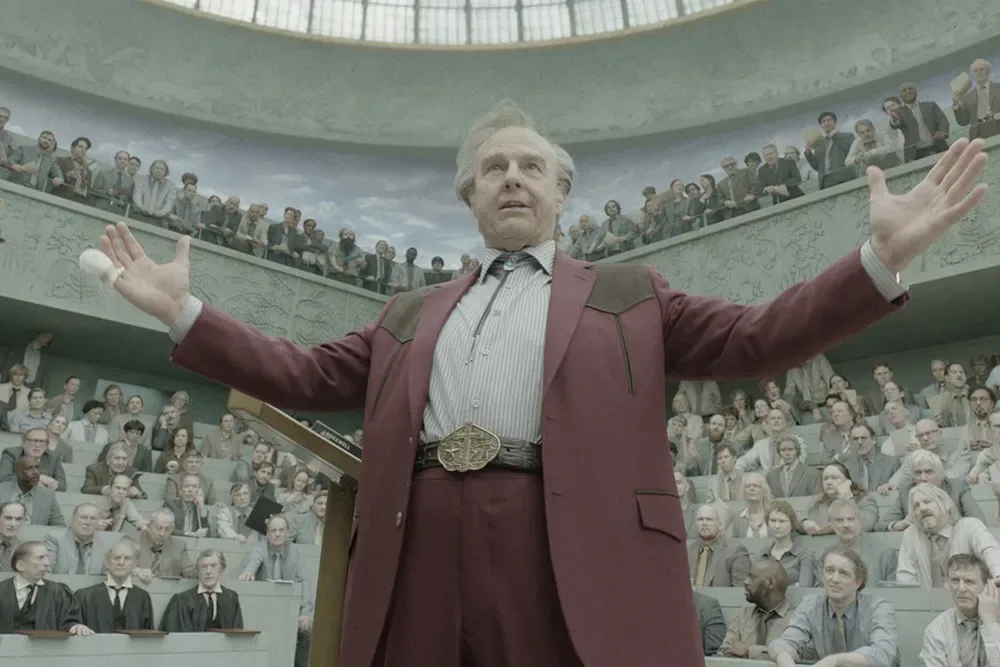
Digger is a 128-minute climate-change satire that arrives determined to be enormous. Alejandro G. Iñárritu’s film places Tom Cruise beneath heavy jowls, thinning white hair and an aggressively theatrical Southern drawl, then lets him play Digger Rockwell: a Texas oil magnate who appears to wield influence over his company, the United States and perhaps the world beyond it. He is not a man designed for subtle entrances, quiet responses or incremental self-awareness. He is a cartoon tyrant built at disaster-movie scale.
That premise contains a tantalizing contradiction. A performer known for exacting physical commitment is asked to embrace grotesque excess; a filmmaker associated here with an ornate, highly controlled visual approach takes on a subject that invites anger, dread and absurdity. The result is an ambitious climate fable set in a near future, one that pitches its central oil executive against a catastrophe too vast for even his wealth and denial to contain.
Its problem is not a shortage of nerve. Digger is strange, lavish and willfully outsized. Its problem is that its satire too frequently announces itself at maximum volume, mistaking scale for bite. A movie can be furious and funny, didactic and dramatically alive, but this one repeatedly lets its scolding overwhelm the wit that would make its critique land.
Tom Cruise plays a man made of bluster
Cruise’s Digger Rockwell is conceived as an exaggerated embodiment of American fossil-fuel power. His every line is pitched like a declaration. The performance uses bluster, menace and a gleeful bad-old-boy swagger to make the character feel less like a plausible executive than a towering cultural caricature.
There is an obvious connection to Cruise’s Les Grossman, the bombastic studio executive from Tropic Thunder. Both roles let him transform into a rude, inflated figure whose physical appearance and behavior serve the joke. Yet Digger carries a burden Les Grossman never had to bear. That earlier character existed as a compact show-business gag. Digger must embody corporate power, political influence, environmental destruction and an audience’s own uneasy participation in an oil-dependent world.
On a technical level, this is a performance driven by stylization: acting that deliberately heightens voice, gesture and behavior rather than attempting everyday realism. Cruise apparently commits to that mode fully. The work is carefully defined and energetic, and there is real pleasure in watching an actor of his control abandon restraint. But the character’s sheer breadth also establishes a central issue for the movie. If its villain begins as a giant joke, the film needs enough sharp comedy around him to prevent that joke from becoming exhausting.
It does not always find that balance. Digger is so insistently grotesque that the film’s anger can feel pre-decided. The audience is not invited to discover his emptiness or danger; it is handed a neon sign and told to look directly at it.
A climate disaster with a very large target
The story begins in a future that is close enough to the present to feel like a warning rather than distant science fiction. Digger awakens in a mansion described as part luxury estate and part fortified refuge. Beside him is a dying white cat, realized as a mechanical animal. It is an early signal of the film’s odd, artificial texture: even intimacy is filtered through spectacle and design.
News then arrives from Greenland. Oil exploration has encountered a growing crack in the ice. Digger responds with the denial that has served him for years, treating a visible warning as an inconvenience and continuing to champion drilling regardless of consequences.
The consequences, in the film’s heightened scenario, quickly become planet-sized. Reckless extraction and climate abuse unleash methane on a destructive scale. A 400-mile ice shelf breaks away, begins moving toward Europe and threatens a catastrophic collision, tsunami and mass death.
Methane is presented in the film as a dangerous climate force, part of the escalation that turns industrial arrogance into an imminent global emergency. The important dramatic function is clear even without treating the movie as a scientific briefing: Digger’s business model is no longer merely morally compromised or politically controversial. It has become physically impossible to ignore.
This is where Digger reaches for the tradition of apocalyptic political satire. Its structure evokes stories in which institutions continue performing confidence and routine while the catastrophe is already underway. It also seeks the media-rage and public-address intensity associated with films that turn a speech, a broadcaster or a political leader into a vehicle for social disgust.
Those are formidable ambitions, but they create a high standard. A disaster satire needs the contradictions of its characters and systems to generate laughter, not just alarm. Here, the apocalypse often works as a blunt instrument. The film’s escalating peril does not necessarily sharpen the comedy; it can turn the experience into a loud lecture in expensive clothing.
The most provocative idea points at the audience
The most potent section reportedly arrives when Digger addresses a global assembly as the crisis advances. Rather than simply blaming oil executives, he turns his attack outward. The world remains dependent on oil, he argues, because people want the lifestyle it enables: not just fuel for cars, but countless choices and comforts they are reluctant to surrender.
This is the film’s strongest complication of its own premise. It shifts from a familiar villain story toward a more difficult accusation about collective dependency. The implication is not that corporate power disappears as a problem, but that a system this entrenched has consumers, voters, institutions and habits intertwined with it. That is a more unsettling target than a single tyrant in a mansion.
Cruise’s performance seems particularly well suited to this sequence. Digger can make a moral accusation sound like a sermon, a threat and a self-serving defense all at once. For a brief stretch, the character’s monstrousness becomes useful: he articulates something the audience may resist hearing, and he does it with fire-and-brimstone relish.
Unfortunately, that thread does not appear to become the film’s governing argument. The narrative returns to accusatory disaster mechanics, reducing the force of the assembly speech. The loss is substantial. A satire that seriously examined shared dependence could have complicated its own villain and avoided the sensation that every answer was available before the film began.
Baroque craft, blunt impact
Iñárritu wrote the screenplay with Alexander Dinelaris, Nicolás Giacobone and Sabina Berman. The film’s aesthetic is described as baroque, with elaborately detailed environments and a largely monochromatic palette close to black-and-white. Emmanuel Lubezki is credited as cinematographer, with Conor O’Neill and Stephen Mirrone editing and Cosmo Sheldrake providing the music.
Baroque, in this context, means deliberately ornate and excessive rather than spare. It suggests a visual world packed with decoration, dramatic contrast and symbolic objects. That approach makes sense for Digger’s world. His power is inseparable from display; the mansion, bunker-like wealth and looming catastrophe all need to look like components of the same diseased system.
But immaculate design can also intensify the risk of self-importance. Digger is evidently fascinated by its own difference, presenting its unusual colors, elaborate sets and confrontational mood as proof that it is offering a major cinematic event. Craft is not the issue. The issue is whether the visual grandeur creates room for the satire to breathe. When every image insists on significance, smaller turns of humor, character or observation have little space to register.
The film also employs a fourth-wall maneuver, though its details are best left undisclosed. A fourth-wall break is a device in which a story acknowledges the audience or its own status as a constructed work. It can create complicity, deepen a joke or force viewers to rethink what they have been watching. In Digger, however, the choice reportedly produces a more distracting effect: it foregrounds the star and the construction of the film in a way that undercuts the climate argument. Instead of making the audience feel implicated, it risks making the project feel preoccupied with its own daring.
A supporting cast used as symbols
John Goodman plays the President of the United States, a part characterized by dour, one-note malice and an intentionally crude illness gag. Sandra Hüller plays Digger’s furious half-sister, who runs an environmental company. Riz Ahmed is Ganesh, Digger’s scientific adviser and a figure grounded more firmly in the unfolding reality than the people around him.
These roles reveal the movie’s larger weakness: too many supporting characters sound designed as functions of the thesis. The President represents ugly political power. Digger’s sister represents compromised or managed activism. Ganesh bears the impossible responsibility of delivering facts to a powerful person who does not want them, eventually becoming overwhelmed and drunk.
There is a viable satirical idea in each of those positions. Corporate environmentalism can become a decorative shield; expert warnings can be ignored until the experts themselves crack; politicians can turn public catastrophe into their own performance. Yet symbols have to retain enough personality to surprise us. When every figure already embodies a conclusion, the movie’s world becomes less an arena for conflict than a giant diagram.
That is why the film’s broader cast, which also includes Michael Stuhlbarg, Jesse Plemons, Robert John Burke, Emma D’Arcy, Burn Gorman and Sophie Wilde, faces such a demanding task. In a movie dominated by Cruise’s deliberate overstatement and Iñárritu’s visual architecture, the ensemble needs character-level specificity to counterbalance the scale.
Why the satire struggles to hit
The defining criticism of Digger is not that it lacks an argument. Its argument is often painfully clear. Fossil-fuel power has consequences. Denial is destructive. Political and corporate systems can turn catastrophe into spectacle. Personal comforts are entangled with the resource dependency people publicly condemn.
The question is whether the movie turns those ideas into a compelling comic experience. Satire works through friction: the gap between what people say and what they do, between confidence and incompetence, between official language and terrible reality. It does not require subtle subject matter, but it does require precision. A film can be outrageous without simply being overbearing.
Digger seems to confuse relentless escalation with escalating insight. Its huge budget, reportedly above $125 million, magnifies that concern. The money is visible in the scale of the disaster vision and the elaborate production values, but spectacle does not automatically earn urgency. If the movie feels like a monumental reprimand, the size of its construction can make the reprimand harder—not easier—to absorb.
There is still something admirable in the swing. Climate change is an enormously difficult subject for commercial filmmaking: it is systemic, global, gradual in some effects and horrifyingly immediate in others. A filmmaker trying to make it grotesque, funny and unforgettable is taking a legitimate risk. For readers interested in how the business around screens and theatrical culture keeps shifting, Joking Joystick has also examined the changing fight for the living room.
But audacity is only the opening move. Digger has a committed Cruise performance, a strange future-world premise and a genuinely bracing moment of self-implication. Those qualities suggest the outline of a great, caustic climate satire. The finished effect, however, is less like a scalpel than an alarm that never stops ringing.
Digger is rated R and runs 128 minutes.