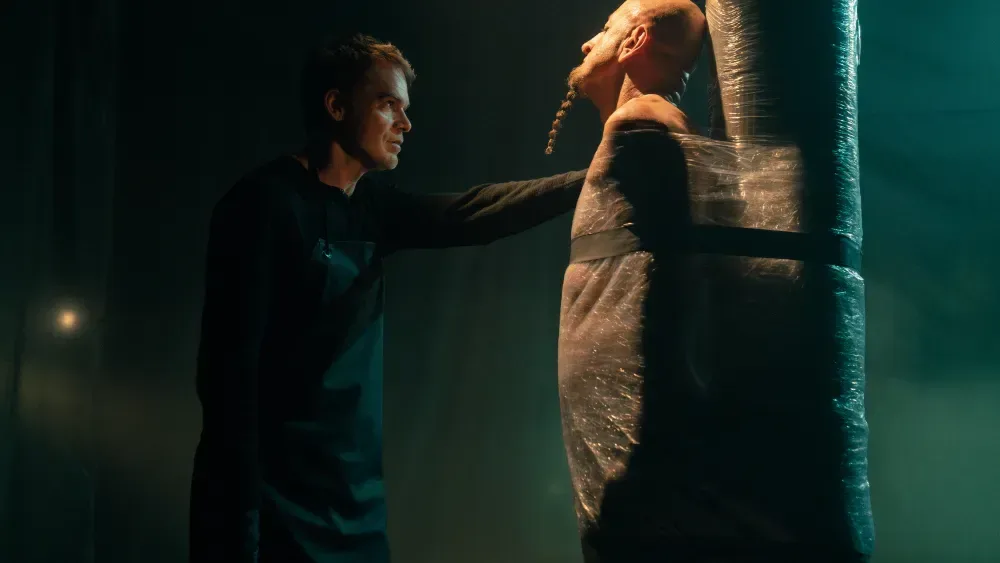
Dexter: Resurrection season 2 is positioning its central danger somewhere more intimate than a new killer or a fresh crime scene. Michael C. Hall has described Dexter Morgan as especially exposed around Charley, the hitwoman played by Uma Thurman, because she appears to offer something Dexter may not realize he wants: appreciation.
That is a telling vulnerability for a character whose identity has long been built around concealment, control and an ability to put emotional distance between himself and other people. The new season keeps Dexter in New York City, where he is trying to maintain an ordinary life as a rideshare driver and be present for his son Harrison. But the attempt at normality is not a clean break. Dexter returns to killing people he considers bad, and Charley’s return introduces an unresolved relationship whose stakes appear to be as psychological as they are deadly.
Why Charley is a particular risk to Dexter
Hall’s description of the pair’s connection identifies a subtle pressure point. Dexter is not merely threatened by an opponent who is physically capable, clever or connected to his past. He may be threatened by someone who recognizes his work and treats it with respect. Hall says Dexter has a need to be appreciated, even if he does not consciously acknowledge it, and that Charley seems to provide that validation.
In this context, vulnerability does not simply mean that Dexter could lose a fight. It means his judgment may be compromised. If he believes Charley understands him, values what he does or accepts a part of himself that he otherwise keeps hidden, he may miss the possibility that her attention serves a separate objective.
Hall frames that uncertainty as the source of the relationship’s danger: Dexter may not see Charley’s agenda. The season therefore has a built-in tension beyond the basic question of whether the two killers will cooperate or collide. The more Dexter reads Charley’s apparent regard as genuine connection, the less prepared he may be for what she wants from him.
That setup also makes Charley more than a returning associate orbiting Dexter’s latest problem. Her presence can test the limits of his self-knowledge. Dexter understands his rituals and his rationalizations well enough to maintain them, but Hall’s comments suggest that understanding does not extend to every emotional need underneath them.
Charley’s own confidence may be part of the mystery
Thurman describes Dexter and Charley as people who are both exceptionally smart, perhaps to their own detriment. Her view of Charley adds an important complication: Charley believes she understands what she does not understand. The character’s season-long path involves discovering that someone who is used to being right has not accounted for everything.
That distinction matters. Charley may have plans, training and confidence, but the show is not presenting her as infallible. Her apparent command of a situation could be incomplete, and the process of recognizing that gap is part of what interested Thurman in playing the character.
It creates a promising double-blind dynamic. Dexter may underestimate Charley’s hidden intentions because he is drawn to her approval. Charley, meanwhile, may overestimate her grasp of Dexter, her circumstances or the consequences of whatever she has set in motion. Neither person’s intelligence guarantees clarity. In a story about serial killers, that is a far more volatile arrangement than a straightforward alliance.
The unanswered question is why Charley remains involved now that Prater is dead. Previously, she had served as bodyguard to the billionaire. With that role no longer defining her position, the season leaves her motive intentionally unclear. Her return establishes that Dexter remains relevant to her, but it does not establish whether she is looking for partnership, leverage, revenge, information or something else entirely.
New York, a rideshare job and an unstable attempt at normal life
The second season continues Dexter’s time in New York City. On the surface, a rideshare-driver job places him inside an everyday routine: work, passengers and the city’s constant movement. It also fits the stated effort to be a more present father to Harrison. Yet the premise is deliberately uneasy because Dexter’s normal-life project exists alongside his decision to resume killing bad people.
The description of Dexter as going through something like a mid-life crisis clarifies the character’s direction. Rather than presenting his renewed violence as a purely external necessity, the season appears to connect it to a personal reckoning. He is trying to occupy the roles of worker and father while re-embracing the activity that has long defined him.
For viewers, that combination makes the word “attempt” do a great deal of work. Being present for Harrison is not the same as successfully becoming the dependable parent Dexter intends to be. Taking a conventional job is not the same as achieving a conventional life. And targeting people Dexter judges to be bad does not remove the fact that his return to killing creates risks for everyone around him.
Charley can intensify each of these conflicts. She is someone connected to the dangerous side of Dexter’s world at the exact moment he is trying, at least in part, to make room for domestic responsibility. If Hall is right that Dexter responds to the validation she offers, the threat is not only that she could expose or harm him. She could make the return to his old patterns feel affirmed.
Two more killers expand the pressure around Dexter
The season also adds Brian Cox as The New York Ripper and Dan Stevens as The Five Borough Killer. Those names signal that Dexter and Charley are not the only lethal figures shaping the New York setting. The supplied details do not reveal how either new character connects to Dexter, Harrison or Charley, so their roles remain open questions rather than clues to a confirmed plot.
Still, their arrival gives season 2 a larger field of danger. Dexter’s personal uncertainty with Charley unfolds amid a city story that includes multiple killers, each carrying a distinct title. The Ripper and Five Borough Killer names establish a heightened criminal landscape without explaining who is pursuing whom, who knows what, or where loyalties might fall.
The cast information also leaves Krysten Ritter’s involvement unresolved. It remains unknown whether she will return as Mia or appear as an entirely new character. That uncertainty should not be mistaken for confirmation of either outcome; it is simply another question the season has yet to answer publicly.
What the Hall and Thurman comments actually reveal
The comments provide more character insight than plot disclosure. They do not confirm Charley’s agenda, reveal the resolution of her connection with Dexter, or specify how the new killers fit into the main conflict. They do, however, establish the emotional logic that could make their scenes especially fraught.
- Dexter’s blind spot: He may be more affected by recognition than he realizes.
- Charley’s blind spot: She may assume she has correctly read a situation when important facts remain outside her view.
- The central risk: Mutual intelligence does not stop either character from misunderstanding the other.
- The wider complication: Dexter’s efforts to be a working father in New York continue while he returns to his own violent code.
That framework makes the relationship feel potentially dangerous without requiring a simple hero-versus-villain reading. Dexter is vulnerable because he wants something from Charley, perhaps without admitting it. Charley is vulnerable because certainty can become a liability when the person across from her is as hard to fully understand as Dexter. Their interaction may be rich precisely because both see pieces of the truth while missing other pieces.
For a different kind of pop-culture rumor story built around what is known, what is disputed and what remains unconfirmed, see this look at the conflicting accounts around Drake and 21 Savage.
When Dexter: Resurrection season 2 arrives
Dexter: Resurrection season 2 is set to arrive on Paramount Plus on October 30. With Dexter’s need for validation now identified as a possible weakness, Charley’s aims still obscured, and additional killers entering the picture, the season’s key suspense may lie in whether Dexter recognizes the trap before the person offering him understanding turns that understanding against him.