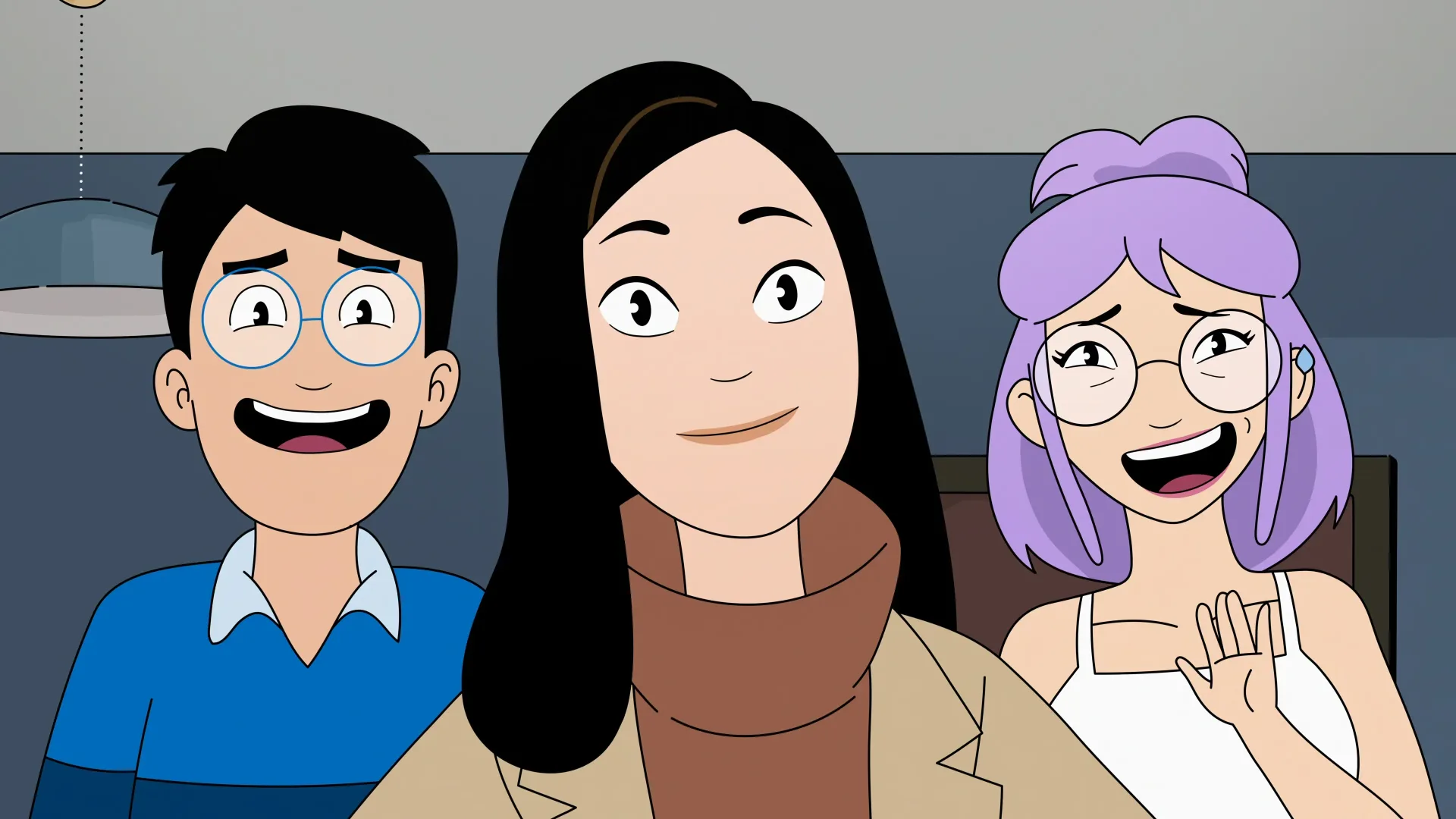
There is a particular kind of New York comedy built around people who are technically adults, legally responsible for their own choices and nevertheless catastrophically unequipped for ordinary life. “Dang!”, Netflix’s eight-episode animated comedy, knows that format well enough to skip the lengthy orientation. Its more distinctive move is to put the mess inside one family.
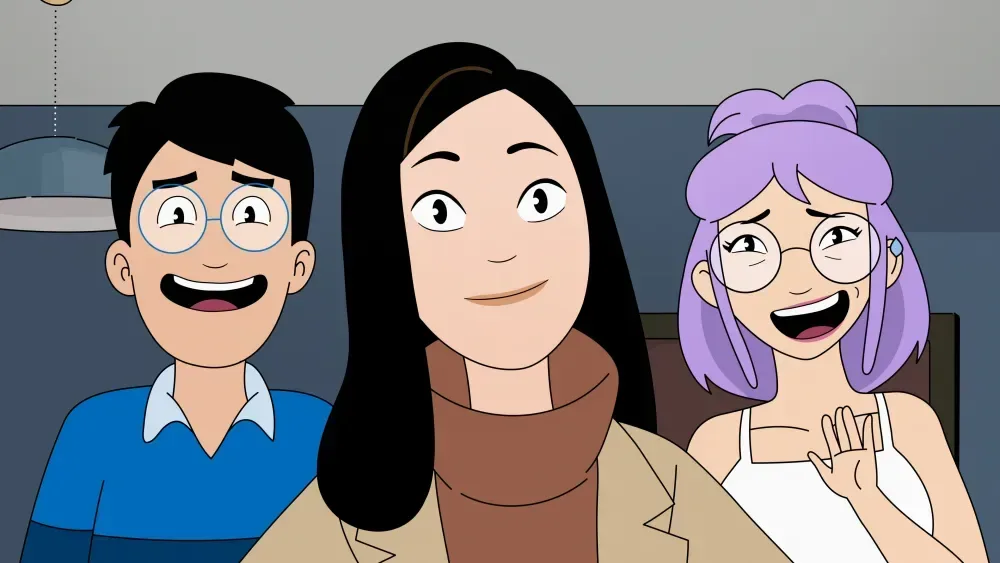
Created by and starring Andrew Law, “Dang!” follows Andrew Dang, his sister Eunice (Poppy Liu) and, eventually, their older sister Ruthie (Stephanie Hsu). Andrew and Eunice begin the series in a state of highly functional dysfunction: they are close, broke, unserious and remarkably accepting of lives that appear stalled from almost any outside perspective. Then Ruthie arrives, bringing a professional career, an air of judgment and a personal crisis large enough to disrupt the younger siblings’ precarious equilibrium.
That is an inviting setup for a comedy because the Dangs do not merely disagree about what to do next. They disagree about what counts as a problem in the first place. Andrew and Eunice have made a kind of peace with drifting. Ruthie has spent much of her life pursuing the approval of their immigrant parents and presenting herself as the responsible sibling. Yet her arrival makes clear that she is not simply above the chaos. She is drawn to the intimacy her brother and sister share, even as it frustrates her.
A sibling sitcom with a sharper kind of chaos
The show shares some surface DNA with contemporary comedies about flailing New Yorkers, especially stories where underemployment, questionable side hustles and overconfidence are treated as basic survival skills. But “Dang!” changes the voltage by making its central duo related. A roommate can leave. A friend can be ghosted. A sibling knows exactly which old wound to press, exactly which childhood rule was unevenly enforced and exactly how to make a family gathering feel like a courtroom cross-examination.
Andrew and Eunice’s bond is already established before Ruthie turns up. Eunice earns money through an OnlyFans foot-focused bread-crushing gig for paying customers. Andrew loses his place at a startup he helped found after operating an anonymous gossip account during bathroom breaks prompted by IBS. Rather than pursuing a stirring reinvention, he lands in a decorative merch-design position at the same company. The joke is not simply that their work lives are absurd. It is that neither younger Dang initially sees much reason to abandon an arrangement that lets them remain close and avoid too much self-scrutiny.
Ruthie’s predicament is more conventionally dramatic. She becomes pregnant through an extramarital affair and heads to New York to sort out what comes next, while keeping the pregnancy from her parents. Her secret could dominate the whole season, but the series does not relentlessly squeeze every episode through that one plot point. Instead, it lets the three siblings ricochet through smaller disasters, ugly truths and strange impulses. That choice gives the show room to establish their rhythms as a family rather than treating Ruthie only as a walking countdown clock.
The family tension also has specificity beyond the broad slacker-versus-achiever divide. Ruthie values the approval she receives from her parents, but feels excluded from the private language of Andrew and Eunice’s relationship. Eunice counters that Ruthie has her own special connection with their mother and father; Ruthie’s blunt reply is that she simply learned Mandarin in Chinese school. It is an efficient expression of what “Dang!” understands: family closeness is never evenly distributed, and every sibling has a different ledger of perceived injustices.
Three performances, three varieties of bad judgment
Law’s Andrew often functions as the not-quite-straight man amid louder displays of dysfunction. He is such an inveterate people-pleaser that even a bodega order can become a negotiation he is ill-equipped to win. His attempt to mentor a younger gay person from his church youth group gives the season one of its more bizarre threads, including a fake worship song called “Come Inside of Me.” The title alone explains why the show’s comedy is often happier to leap past good taste than to politely circle a punchline.
Related coverage includes ‘Dang!’ Turns Sibling Dysfunction Into Animated Chaos.
Liu gives Eunice a loose, seemingly permanently dazed delivery that makes her most outrageous observations sound almost accidental. She has an instinctive radar for the moment an uncensored clip of Lenny Kravitz tearing his pants resurfaces online. She also works an unpaid internship for a wellness brand with the sheen of a Goop-style operation, where an experimental diet drug becomes part of the orbit. Eunice can look unserious in any given scene, but the performance avoids reducing her to a one-note stoner caricature. Her blunt affection for the people around her is part of what holds the group together.
Hsu takes the opposite lane as Ruthie. Her voice work is sharp, controlled and forceful, well suited to a character who wants every room to operate by a set of standards that she herself is increasingly unable to meet. Ruthie’s preferred children’s book, “B Is for Border Security: How to Raise a Political Centrist,” is exactly the sort of pointed detail that defines her before she has to spell out her worldview. She is not merely uptight; she is someone who has made an identity out of being sensible, only to discover that sensibility has not protected her from impulsiveness or loneliness.
The result is a trio in which each person supplies a different comic pressure. Andrew tries to smooth conflict and worsens it through indecision. Eunice charges directly at the bizarre possibility nobody else wants to acknowledge. Ruthie attempts to impose order, often turning the smallest discomfort into an adversarial proceeding. It is a sturdy formula, and the animation allows their reactions to become bigger, stranger and more immediate than a grounded live-action scene might permit.
Animation makes ordinary crises weirdly elastic
“Dang!” uses animation not to build an elaborate fantasy world but to give everyday humiliation an elastic visual form. That matters most when the show turns a familiar social anxiety into something more excessive. When Eunice is trying to figure out whether a man she likes has an Asian fetish, the question does not stay confined to a standard brunch conversation. Instead, the series can elevate it into a celebrity-panel-style examination featuring appearances from Chloe Kim and Padma Lakshmi.
That approach fits the show’s overall sensibility. The Dangs’ problems are recognizably mundane—money, jobs, sex, parents, identity and the terror of deciding what adulthood should look like—but their internal logic is heightened. Animation lets a reaction become a spectacle and lets a passing reference become a full detour without requiring the series to make its characters live in an entirely surreal universe.
The New York setting is also doing quiet work. “Dang!” does not need to spend much time explaining why its characters have multiple hustles, cramped emotional boundaries and an endless supply of people to make a terrible decision with. The city is already an understood comic shorthand, just as it has been for earlier friend-group and twenty-something sitcoms. For another angle on how city life and cultural identity shape creative conversations, see KRS-One’s vision of “Little Hip-Hop” districts around the world.
A compact season that stays close to its best idea
Eight episodes is not a lot of real estate for a new comedy, particularly one that has three lead characters and a family secret waiting in the wings. “Dang!” benefits from resisting the temptation to endlessly enlarge itself. It remains centered on the nuclear unit: a brother, two sisters and the volatile mixture of love, resentment and mutual enabling they bring to every situation.
That compactness gives the show a useful sense of proportion. The pregnancy secret does not disappear, but it does not swallow the middle of the season. Andrew and Eunice are allowed their own detours, while Ruthie becomes more than the buttoned-up visitor whose job is to disapprove of them. By the finale, Ruthie is not yet visibly showing, an indication that the season is more interested in the immediate emotional rearrangement than in racing toward a single major-event payoff.
There are recognizable influences in the show’s creative lineage. Law and Liu previously worked on “Hacks,” while Michael Schur is an executive producer on “Dang!” as well. The series also belongs to a wider comic tradition of characters dealing with stalled mobility, unstable work and generational unease. But its strongest asset is less about its influences than its casting and concentration. The Dangs are specific enough that their arguments do not feel like generic millennial despair delivered through new names.
“Dang!” is now streaming on Netflix. Its premise may begin with two siblings who have learned to accept mediocrity, but the series finds its energy in what happens once that acceptance is challenged. Ruthie wants a better life, Andrew wants everyone to remain happy and Eunice wants to say the outrageous thing out loud. Those desires are incompatible—and for an animated sibling comedy, that is very good news.