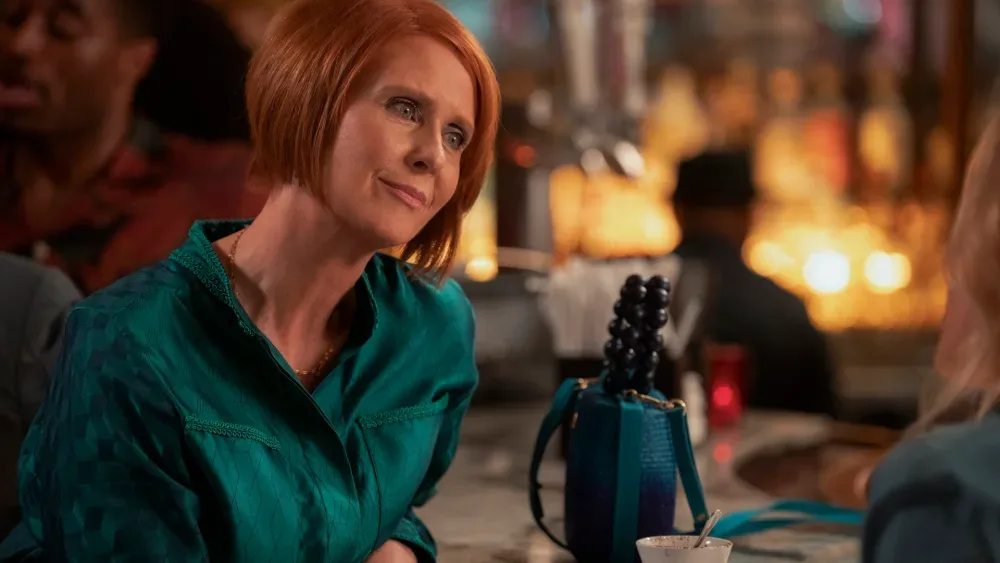
Cynthia Nixon is not retreating from the most controversial choices made for Miranda Hobbes in And Just Like That. The actor has defended the character’s troubled, awkward and frequently divisive revival-era trajectory, saying those very imperfections were what drew her to it.
Miranda’s shift from the assured lawyer many viewers remembered from Sex and the City became one of the defining flashpoints around the continuation series. Nixon acknowledged that audiences were unsettled by Miranda’s sadness, alcoholism and uncomfortable attempts to become more socially aware later in life. Her own response was emphatically different: “I loved that.”
That disagreement is central to why Miranda’s arc has endured as such a hotly debated piece of television. A returning character carries a built-in expectation: viewers do not only meet the person on screen, but also bring years of memory about who that person was. When a sequel or revival changes that person sharply, some audiences see a bracing depiction of upheaval while others see a break from the character they knew.
A revival built around disruption
And Just Like That revisited the world of the six-season HBO drama with its characters at substantially different points in their lives. Miranda’s story did not present personal reinvention as neat or glamorous. Instead, it placed her in situations marked by uncertainty, unhappiness and social clumsiness.
Nixon’s comments frame those elements as purposeful creative risks rather than accidents to be explained away. She said she agreed to return after becoming convinced the show could do “interesting, dangerous things.” In this context, “dangerous” does not mean physical danger; it means storytelling that risks a negative reaction by allowing a beloved character to behave in ways that may be uncomfortable, disappointing or difficult to recognize.
That approach helps explain why the response was so mixed. Viewers can reasonably disagree about whether a character’s choices feel convincing, but Nixon is making a separate case: that showing Miranda at her least composed had value. A character arc is the course of change a character experiences over a story. It does not inherently mean improvement. It can also mean regression, confusion, self-discovery or a period in which someone makes choices they later regret.
For Nixon, the appeal appears to have been that Miranda’s arc permitted all of those uncomfortable possibilities. Rather than treating middle age as a point when a person’s identity is permanently settled, the revival depicted a character still capable of major, destabilizing change.
The Che Diaz relationship became the pressure point
The most contentious development was Miranda’s relationship with comedian Che Diaz in the first season of And Just Like That. Miranda left her husband, Steve Brady, for Che, a choice that proved especially hard for many viewers to accept because Miranda and Steve’s history had been established over a long period.
Related coverage includes Cynthia Nixon Defends Miranda Hobbes’ Difficult ‘And Just Like That’ Journey.
In the original series, Miranda, a lawyer, met Steve, a bartender, in Season 2. They broke up, reconciled, married and had a child, Brady Hobbes, by the end of the original show’s run. That history matters because it turns Miranda’s later decision into more than a new romance. It reframes one of the original series’ enduring relationships.
For fans, continuity is often emotional as much as factual. Continuity means the connection between story details across episodes, seasons and related series. Here, the basic facts of Miranda and Steve’s past remain part of the story, but viewers may still feel that the emotional meaning of that past has been altered. That is often the source of a revival argument: not whether a new development literally happened on screen, but whether it honors what audiences understood the earlier story to mean.
Nixon’s defense does not ask audiences to pretend they were not upset. Instead, it suggests that upset was bound up with the project’s willingness to portray Miranda as unhappy and imperfect. The result is a useful distinction between a character being likable and a character being dramatically interesting. Television often asks viewers to stay with characters through bad judgment, awkward behavior and painful consequences. That can make for compelling drama, even when it does not make for easy approval.
Representation was part of Nixon’s reason for returning
Nixon also connected her decision to reprise Miranda to a desire to address a major limitation of the original show. She described its overwhelmingly white makeup as its chief past mistake and said the revival offered a chance to make amends while attempting stories that felt more ambitious.
This is an important part of the context around the revival’s changes. The series was not simply attempting to recreate the original formula. It was also trying to confront what Nixon identified as a shortcoming in that formula. Expanding the world and reconsidering its characters were linked ambitions, even if those choices were received unevenly.
Efforts to revisit older television through a contemporary lens can create a difficult balancing act. A production may try to preserve its established characters and tone while also acknowledging cultural blind spots that were embedded in the earlier version. Those goals can reinforce each other, but they can also produce friction when audiences feel a familiar world is changing too quickly or too visibly.
That friction does not settle the question of whether every storyline worked. It does clarify the creative intention Nixon has described. Her perspective is that the revival’s difficult turns—including Miranda’s uncertain efforts to become more aware—were part of making the series more willing to interrogate its own legacy.
Why Miranda still eclipses Nixon’s other work
Nixon said Miranda continues to overshadow the rest of her career in the public imagination, even 22 years after Sex and the City finished airing in 2004. That is a striking measure of the role’s cultural staying power, but it also explains why reactions to Miranda’s new direction were so intense.
When a role remains that closely associated with an actor, new work can be filtered through the audience’s relationship with the old character. Nixon is currently playing Ada Forte in HBO’s historical drama The Gilded Age, which debuted in January 2022 and has continued for three subsequent seasons. Its fourth season has premiered on HBO and HBO Max. Yet, in Nixon’s view, Miranda remains the role that most readily defines her for many people.
The contrast between Ada and Miranda also underlines the unusual challenge of returning to a character after a long gap. A new role begins without an audience-established baseline. A revival role arrives with years of attachment, interpretation and expectation already in place. Every major decision can become a referendum on whether the return was justified.
That phenomenon is not limited to television. As discussions of early reactions to films have shown, the gap between an initial critical or fan response and a work’s eventual audience relationship can be consequential. Early reactions can shape how people approach a project before they form their own view, particularly when it involves an established name or familiar property.
An ending Nixon did not expect
Nixon also said she was unprepared to learn that And Just Like That would not return for a fourth season. “I was not at all ready,” she said. “Not at all.” Her reaction gives the show’s debates an added sense of finality: whatever viewers make of Miranda’s path, the continuation will not have another season in which to further revise, extend or resolve it.
That does not make the response to the character any more uniform. Some will continue to see Miranda’s reinvention, her relationship with Che and the dissolution of her marriage to Steve as a deeply frustrating departure. Others may find value in a story that refused to protect a formerly controlled, successful character from instability and embarrassing missteps.
Nixon’s comments make her own position clear. She was attracted to the chance to play Miranda in discomfort rather than preserve her in amber. Whether that choice persuaded viewers is a separate question, and one the divided reaction to And Just Like That makes impossible to answer with a single verdict. But the controversy was not, from Nixon’s perspective, evidence that the story should have played it safer. It was tied to the risk she wanted the revival to take.