The Remarried Empress has arrived a little ahead of schedule. The Korean romance series released its first four episodes on Disney+ and Hulu one day before its planned November 4 premiere, bringing a high-profile adaptation of the Naver Webtoon to streaming after a campaign that had already built considerable attention.
The early release followed sold-out preview screenings at the Busan International Film Festival and a trailer that passed 13 million views across YouTube and social platforms in its first 48 hours. Those figures do not establish how the finished series will perform over time, but they do show why the release was treated as an opportunity rather than simply another date on a streaming calendar.
For Webtoon Entertainment, the launch also represents a particularly visible part of a broader screen-adaptation strategy. The company began as a digital comics and webnovel platform, and its ambitions now extend across Korean productions distributed internationally and English-language projects being developed with major U.S. partners. In practical terms, that makes The Remarried Empress more than a single fantasy-romance drama: it is an example of how a vertically read comic can become a streaming series, an anime project and potentially an entry point for new readers.
A royal marriage built for escalating stakes
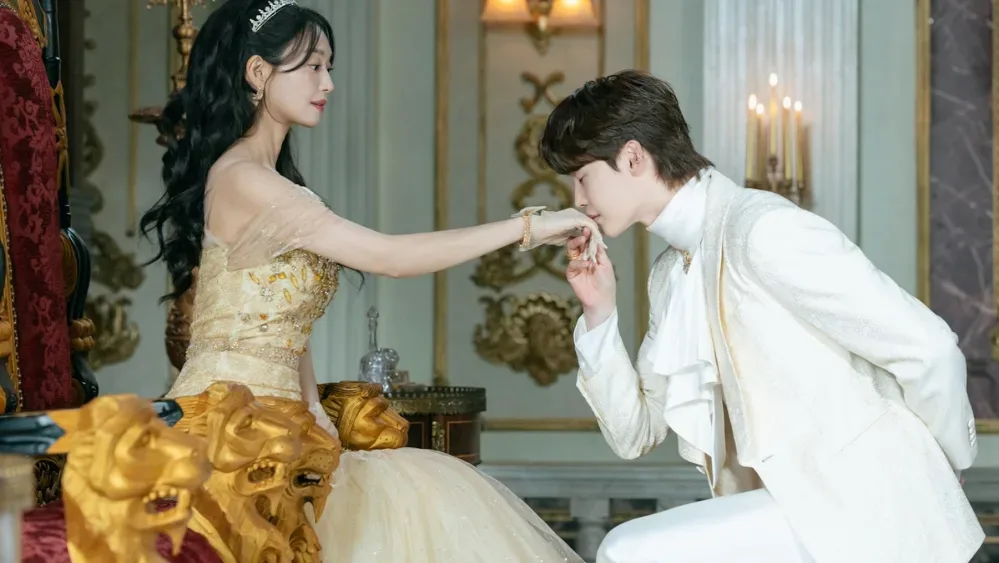
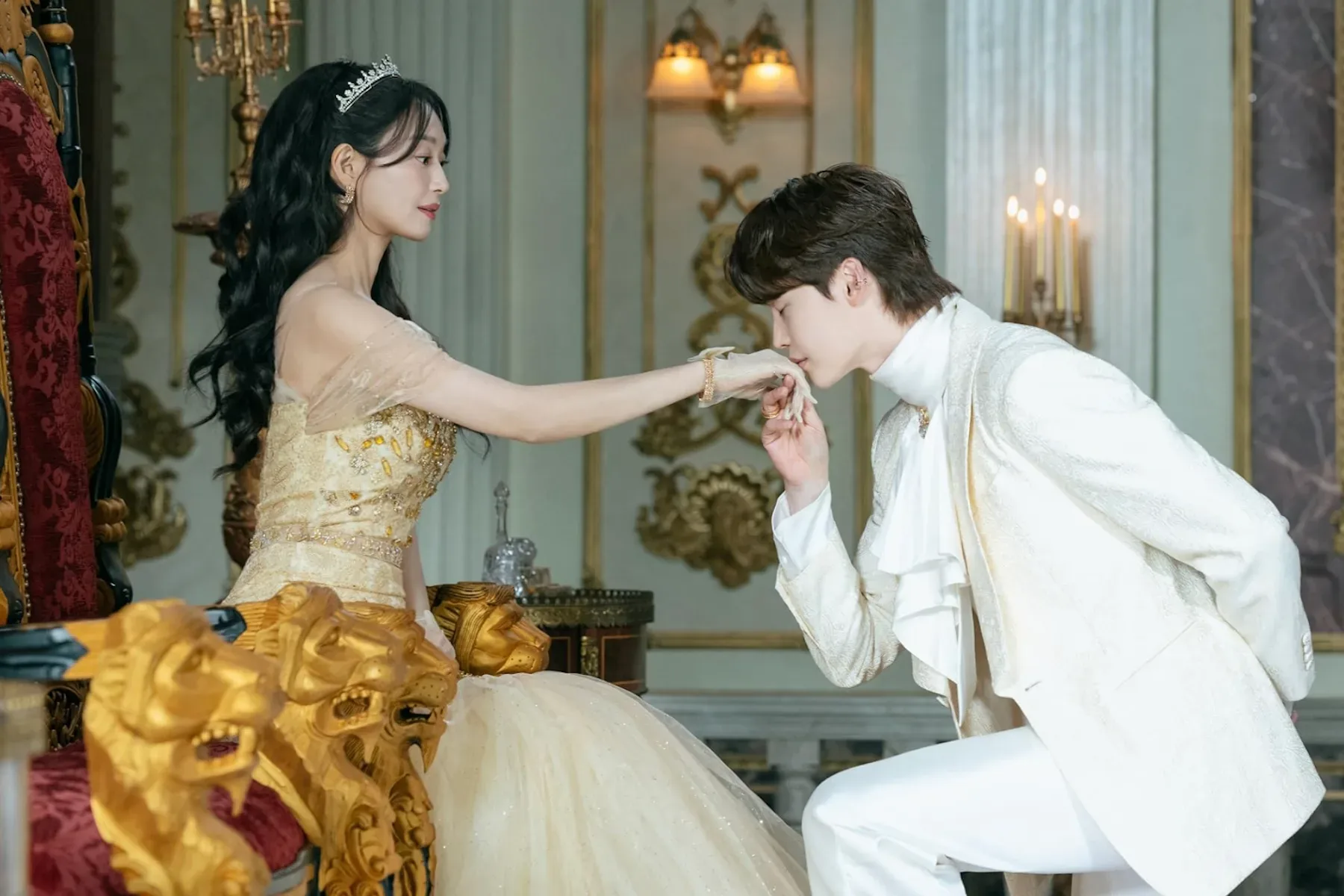
The Remarried Empress centers on Navier, played by Shin Mina, the respected empress of the Eastern Empire. Her marriage to Emperor Sovieshu, played by Ju Jihoon, comes under strain as anxiety grows across their land and Sovieshu falls for Rashta, a runaway slave played by Lee Seyoung.
The premise is defined by the collision of private betrayal and public power. Sovieshu attempts to win Rashta’s heart, while Navier refuses to surrender her dignity merely to preserve a broken marriage. She accepts the emperor’s desire to remarry only with a condition of her own: she must be allowed to remarry Crown Prince Heinrey of the rival Western Kingdom, played by Lee Jongsuk.
That setup gives the series several engines at once. It is a romance, but one structured around political consequence; it is palace drama, but with characters’ personal decisions carrying implications beyond the court. Navier’s condition is not framed as a quiet retreat from the conflict. It turns the emperor’s request into a diplomatic and dynastic problem involving the Western Kingdom.
For viewers coming to the property for the first time, the early four-episode drop provides an immediate block of story rather than a lone introduction. It also lets the adaptation establish the central relationships and the emotional terms of the conflict before audiences decide whether to continue.
What “Webtoon IP” means in this context
“IP” is short for intellectual property: a story world, characters and concepts that can be used across formats under the rights holder’s control. Here, the underlying property is a Naver Webtoon, and the screen version is an adaptation rather than a new story created independently for television.
Related coverage includes The Remarried Empress Arrives Early as Webtoon Expands Its Screen Ambitions.
Webtoons are digital comics commonly designed around vertical scrolling, a format associated with reading on phones. Screen adaptation asks for a different rhythm. A serialized comic can use an episode ending, a reveal or a visual pause to encourage the next scroll; television has to organize those same ideas across scenes, performances, sound, episode lengths and season-level pacing. The source material’s popularity can create awareness, but it does not eliminate the challenge of translating its structure to a new medium.
What it can provide is a proven audience connection. Webtoon Entertainment president Yongsoo Kim has said that The Remarried Empress has accumulated nearly 3 billion page views worldwide. Page views are not the same thing as individual readers, viewers or subscribers, so they should not be treated as a direct forecast for the television audience. Still, the number illustrates the unusual scale of familiarity behind this adaptation.
The move to Disney+ and Hulu is important for another reason: it gives fans in different markets a prominent streaming route to the show. Kim described global video adaptations as a way of reaching people who may not yet know the Webtoon brand. The intended loop is straightforward: a successful screen adaptation raises awareness of its original comic platform, while a substantial comic readership supplies attention for later screen projects.
One title, multiple adaptation paths
The live-action series is not the only planned version of The Remarried Empress. An anime adaptation is also set up with Crunchyroll. The coexistence of live action and anime is notable because it means the same underlying narrative is being prepared for audiences who may have very different expectations of performance, imagery and tone.
It is also a useful reminder that an adaptation is not a single, final conversion of a story from page to screen. A live-action drama must use actors, physical environments and television production choices to convey courtly tension. Anime can take a separate visual route while still working from the same foundational relationships and premise. Neither format is inherently a replacement for the other; they are distinct interpretations built around the same property.
That multi-format approach fits the larger slate Webtoon Entertainment is assembling. The company has projects involving Lore Olympus, The Mafia Nanny, Chasing Red, Stagtown and Death of a Pop Star. Their inclusion matters because the lineup is not limited to one genre, one production style or one market.
- Lore Olympus: An animated series is being made with Amazon MGM Studios for Prime.
- The Mafia Nanny: A live-action Hulu project is in development, with Charlize Theron attached as an executive producer.
- The Remarried Empress: A Korean live-action drama is now on Disney+ and Hulu, while an anime adaptation is set up with Crunchyroll.
This is a material distinction in Webtoon Entertainment’s strategy. Some of its most prominent screen successes have originated in Korea and been distributed globally, while projects such as Lore Olympus and The Mafia Nanny point toward English-language productions rooted in Webtoon properties. Kim has framed that expansion as a moment when U.S. audiences may encounter a large-scale animation or live-action project first, then discover that its source is a webtoon.
The existing screen track record
Webtoon adaptations already have recent examples of international traction. The second season of Netflix’s Bloodhounds appeared in the service’s top 10 non-English-language series for two weeks after debuting in April. Other Netflix projects cited among the company’s recent hits include Chicken Nugget and The Trauma Code: Heroes on Call.
On the film side, My Daughter Is a Zombie was the highest-grossing Korean film released in 2025 and the highest-grossing comedy in the country’s history. Those projects are not interchangeable with a palace romance such as The Remarried Empress, and their performance does not guarantee a similar result for it. They do, however, demonstrate that Webtoon-originated stories have already found routes into several genres and formats.
The distinction is worth keeping clear. A global streaming ranking, box-office result, trailer-view total and page-view count each measure different behavior. Rankings show relative performance in a particular service category and period. Box office measures ticket sales. Trailer views measure promotional reach and curiosity. Page views measure engagement with the original digital work. Together they describe momentum around a property or company, but they are not one universal score.
That nuance matters as Webtoon Entertainment makes a larger case for its catalog. The company has announced content deals over the past two years with Disney, Paramount, IDW Publishing, Dark Horse Comics, Dropout and others. Partnerships increase the number of possible pathways for stories, but development remains development until a project is completed and released. Of the titles discussed here, The Remarried Empress is the one viewers can now actually begin watching, while the other projects sit at different stated stages.
Why the early launch matters
Moving a premiere forward by a day may sound modest, but it is a confident promotional choice when attached to a property with an active built-in audience. It rewards viewers already waiting for the series and capitalizes on the energy generated by the Busan screenings and trailer campaign. Releasing four episodes at once further makes the premiere feel like an event, offering more than a brief sample of the adaptation’s approach.
It also places emphasis on the screen version’s ability to stand on its own. An enormous readership can attract curiosity, yet a television drama needs to work for people who have never read a vertical-scroll comic and may not recognize the underlying brand. The story’s most accessible hook is not industry language about IP pipelines. It is Navier’s predicament: a ruler confronted with humiliation, an emperor prepared to remake the terms of their marriage, and a rival crown prince waiting beyond the borders of an opposing kingdom.
For readers who know the comic, the adaptation offers a chance to see that conflict reframed through Shin Mina, Ju Jihoon, Lee Seyoung and Lee Jongsuk. For newcomers, it is a self-contained route into a story that has already generated extraordinary digital readership. And for Webtoon Entertainment, it is a high-visibility test of the broader proposition behind its Hollywood push: stories first built for digital comic readers can travel across languages, platforms and production styles without losing the appeal that made audiences seek them out in the first place.
That cross-media question is increasingly relevant well beyond webtoons. Entertainment companies across games, comics and film are all trying to determine how recognizable worlds can move between formats while keeping the trust of established fans. For another example of how established creative properties remain central to screen-industry conversations, see our coverage of the planned documentary about BioWare’s final years.
For now, The Remarried Empress gives audiences a concrete place to start: its opening four episodes are already available on Disney+ and Hulu, its anime counterpart is set up at Crunchyroll, and Webtoon Entertainment’s larger adaptation slate continues to take shape across live action and animation.