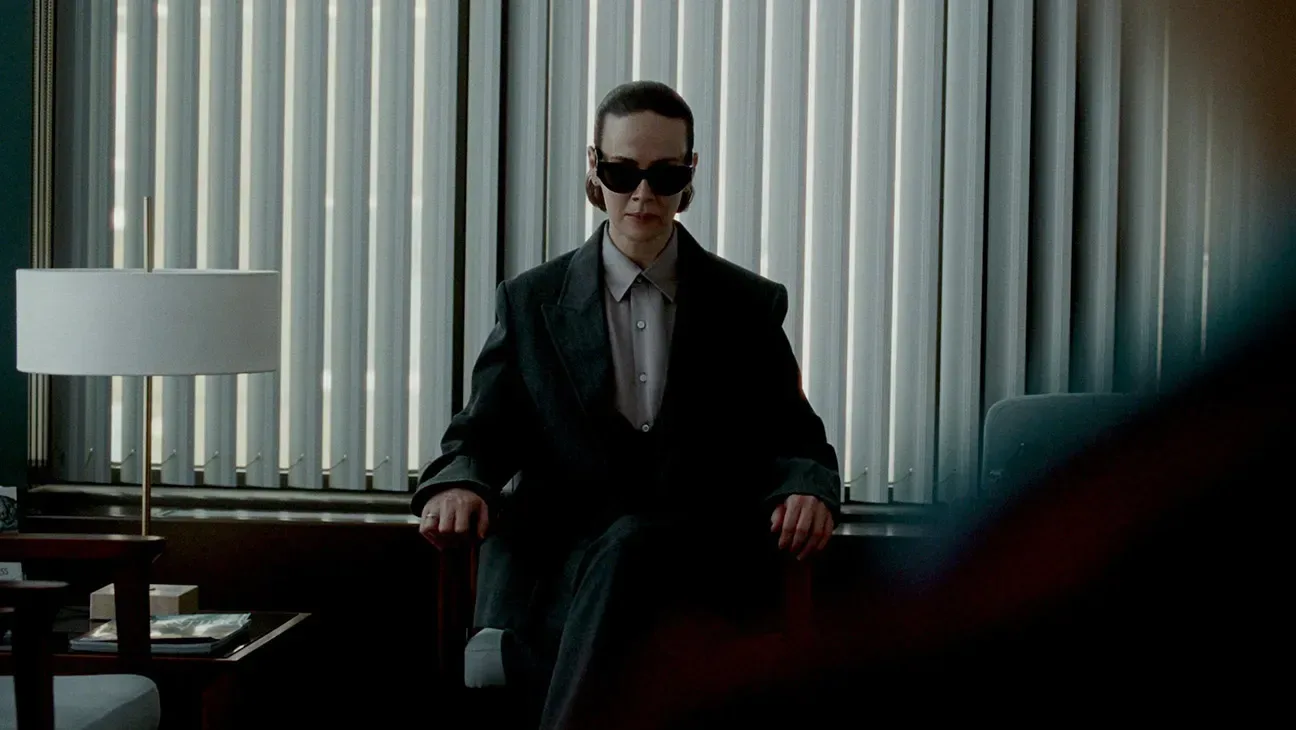
Closing Night begins with a family rupture and quickly makes clear that subtlety is not its preferred instrument. Cody Fern’s first feature, co-written with Devon Bostick, is a melodrama in the proud, high-volume sense: emotions are held too long, grievances have aged into identities, and every room feels ready to become a stage. Sarah Paulson, Naomi Watts and Dianne Wiest play women locked into a mother-daughter-sister triangle so volatile that a polite reunion is never remotely on the table.
The movie’s opening and middle sections reportedly find their sharpest rhythm in the collision of pain and pitch-black humor. That tonal mixture matters. Rather than using jokes to reduce the seriousness of estrangement, the comedy makes the family’s rawness more recognizable. A cruel aside, an ill-timed outburst or an act of outrageous self-dramatization can land with a laugh and still leave a bruise. That is a particularly useful mode for a story about relatives who have spent decades rehearsing their resentments.
At 115 minutes, Closing Night gives its actors room to make that warfare expansive. Fern’s approach may be heightened, but the central idea is clear: performance is not confined to Sandra’s profession. Everyone in this family knows how to make an entrance, control an audience and weaponize a pause.
A Broadway invitation opens an old wound
Paulson plays Sandra, a celebrated stage and screen actor who left Michigan for Hollywood at 15. Watts is April, Sandra’s sister, who stayed in Michigan, became a hairdresser and works in the salon run by their unpredictable mother Diane, played by Wiest. The siblings have been estranged since their teens, and the reason for that distance is initially held back as the film’s defining question.
Sandra attempts reconciliation by inviting April and Diane to New York for her Broadway performance. Diane declines. April goes, reluctantly, and discovers that Sandra has been meeting with April’s adult son Theo, played by Toby Wallace. Theo lives in New York with his girlfriend Lucy, played by Odessa A’zion, and has had little opportunity to know the aunt who has effectively been absent from his life.
That setup establishes a conflict with several valid pressures instead of a purely simple betrayal. April sees secret lunches as Sandra crossing a boundary around her son. Theo sees them as a chance to build a relationship with a family member he barely knows. Sandra’s gesture is both an overture and, inevitably, a provocation. The fact that all three readings can coexist gives the film a stronger foundation than a mere contest to identify a single villain.
The past is connected to Theo, but the movie’s broader concern is the way private histories are controlled. In a family estrangement, memory is never neutral. People remember different details, omit different details and tell the story in ways that protect the version of themselves they can live with. Closing Night turns that idea into plot when Sandra’s health abruptly deteriorates and a diagnosis affects her memory.
Melodrama as a deliberate style, not an accident
“Melodrama” is often used casually as a criticism, as though any elevated emotion were automatically artificial. In film terms, it can instead describe a mode that externalizes inner conflict: heightened performances, charged visual design, compressed circumstances and moral or emotional dilemmas pushed to their limits. Fern works openly in that register. The family’s arguments are not naturalistic murmurs. They are confrontations built for people who feel, consciously or not, as if a spotlight is always on them.
The film signals that idea early by setting Sandra’s actual stage work against an argument occurring in the audience between April and Theo. The crosscutting links the onstage text to the family drama unfolding just a few feet away. Sandra is a professional actor, but April and Diane have their own methods of performance: anxiety, judgment, grand injury and emotional interruption. The family does not merely have a problem with theatrics. The theatrics are how its members communicate.
That framework also explains why the performances are described as large by design. Wiest’s Diane arrives with leopard print, lipstick and a delivery that can slur or spit out a line. Watts makes April’s tension bodily, conveying a person who seems perpetually braced for the next insult. Paulson begins from Sandra’s superior, snide control before the character’s composure is stripped away. The roles ask their performers to make emotional excess precise rather than merely loud.
Theo and Lucy bring a comparatively grounded perspective, but they increasingly move aside as the three older women take command of the narrative. That decision concentrates the film’s energy. It is less interested in a sprawling ensemble study than in watching three members of one family force each other to confront what has been withheld, distorted or endured.
Memory turns reconciliation into a more difficult question
Sandra collapses during her Broadway performance, ending the show and putting her career in jeopardy. The health crisis arrives at the very moment April is in New York, a coincidence that operates on the movie’s deliberately elevated dramatic logic. Its consequence is more important than its convenience: Sandra’s illness threatens her memory, which radically changes what forgiveness could mean.
That is the film’s most intriguing thematic move. A reconciliation story usually assumes that characters must remember the past clearly enough to account for it, apologize for it or forgive it. Closing Night complicates the equation. If memory falters, is a wound repaired because it has been understood, or merely because one of the people carrying it can no longer access it in the same way? Does forgetting offer mercy, evasion or something painfully unresolved?
The question should give Paulson and Watts especially potent material. Sandra’s control has long depended on the distance she built between herself and her Michigan family. April’s identity, meanwhile, seems bound to the harm she believes has been done to her. When a shared past becomes unstable, neither woman can rely on the story she has practiced for years. The emotional stakes are not just whether they reconcile, but whether either is able to surrender the protective narrative that has organized her life.
Dark interiors and a late opening toward light
Fern’s mood-building appears to be one of the film’s most consistent strengths. Cinematographer Yves Bélanger photographs spaces in deep, saturated shades including oxblood, emerald and indigo. Sandra’s Manhattan home is kept so dark, with its curtains generally closed, that it seems insulated from the city around it. The imagery makes her physical environment an extension of the character: elegant, guarded and separated from exposure.
That visual strategy is simple but expressive. Closed curtains can indicate privacy, but within this story they also suggest isolation and a desire to keep the outside world—along with its demands—from entering. A later scene placing Sandra and April beside a bright window therefore has more force because the film has withheld that openness for so long. Light is not simply decorative; it marks a shift in emotional possibility.
Production design, costume and performance are all apparently pulling in the same direction. The color-saturated gloom, Diane’s flamboyant presentation and Sandra’s theatrical vocation make the movie feel intentionally composed rather than accidentally overwrought. Editor Dany Cooper and composer Mathieu David Gagnon are credited alongside Bélanger in shaping a film whose atmosphere is central to its effect.
Where the final act changes the temperature
The primary reservation is a tonal one. The film reportedly begins as a turbulent, darkly funny confrontation piece, then slows into a much more mournful and conventional tearjerker in its closing movement. The ending’s depth of despair can feel labored after the bracing volatility that precedes it.
That does not erase the logic of Fern’s choice. A story built around memory loss, a career-ending diagnosis and decades of family pain has reason to move toward grief. But the most distinctive version of Closing Night seems to be the one that lets hysteria and humor share the frame—the version that understands a joke at a dreadful moment can sharpen sorrow rather than contradict it. When the humor recedes, the film risks exchanging its particular bite for a more familiar form of catharsis.
Even so, the central trio appears to make the journey worthwhile. Paulson, Watts and Wiest are not asked to sand down their characters into easy sympathy. Instead, the film gives each woman room to be cruel, scared, needy, absurd and wounded. That balance is vital in family melodrama. If everyone were only monstrous, the conflicts would become tiresome; if everyone were only tragic, the movie would lose its comic electricity. Closing Night aims for the uncomfortable overlap.
The film premiered in the Special Presentations program at the Toronto Film Festival on September 12, 2026. For readers following other recent cinema with a sharply defined emotional and comic register, this look at Guria offers another perspective on how humor can coexist with serious human stakes.
Bottom line: Closing Night is a consciously theatrical chamber drama powered by three actors willing to go all the way to the emotional rafters. Its final stretch may press too insistently toward desolation, but its volatile mix of comedy, grievance, memory and maternal conflict gives Fern’s debut a vivid identity.