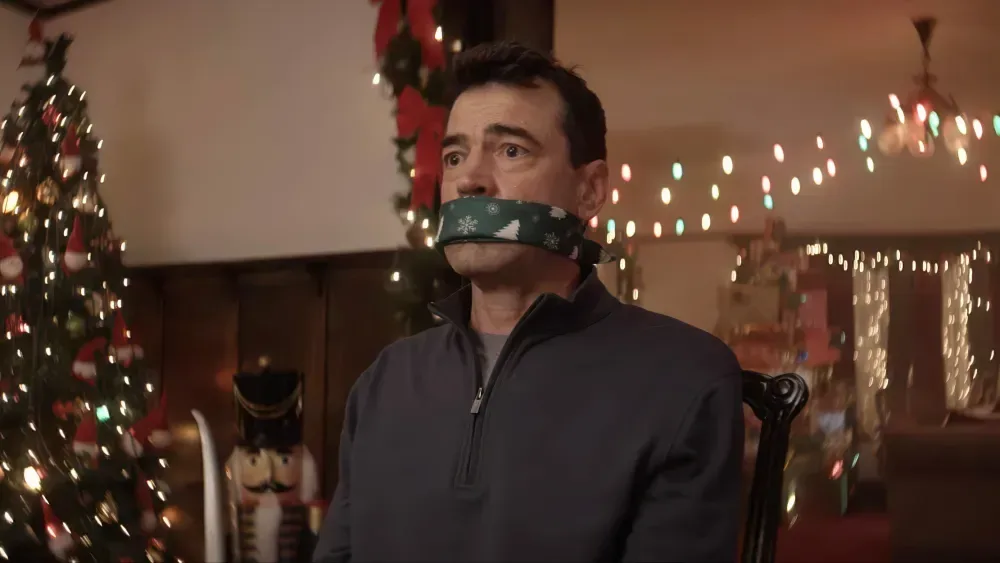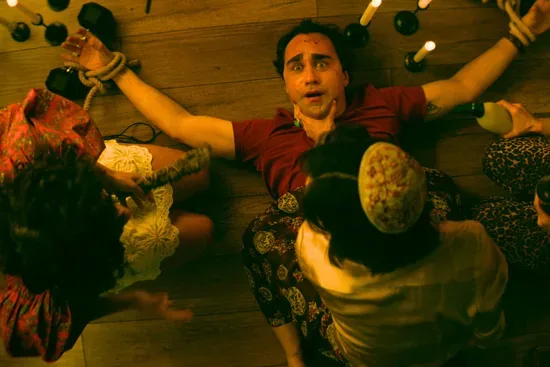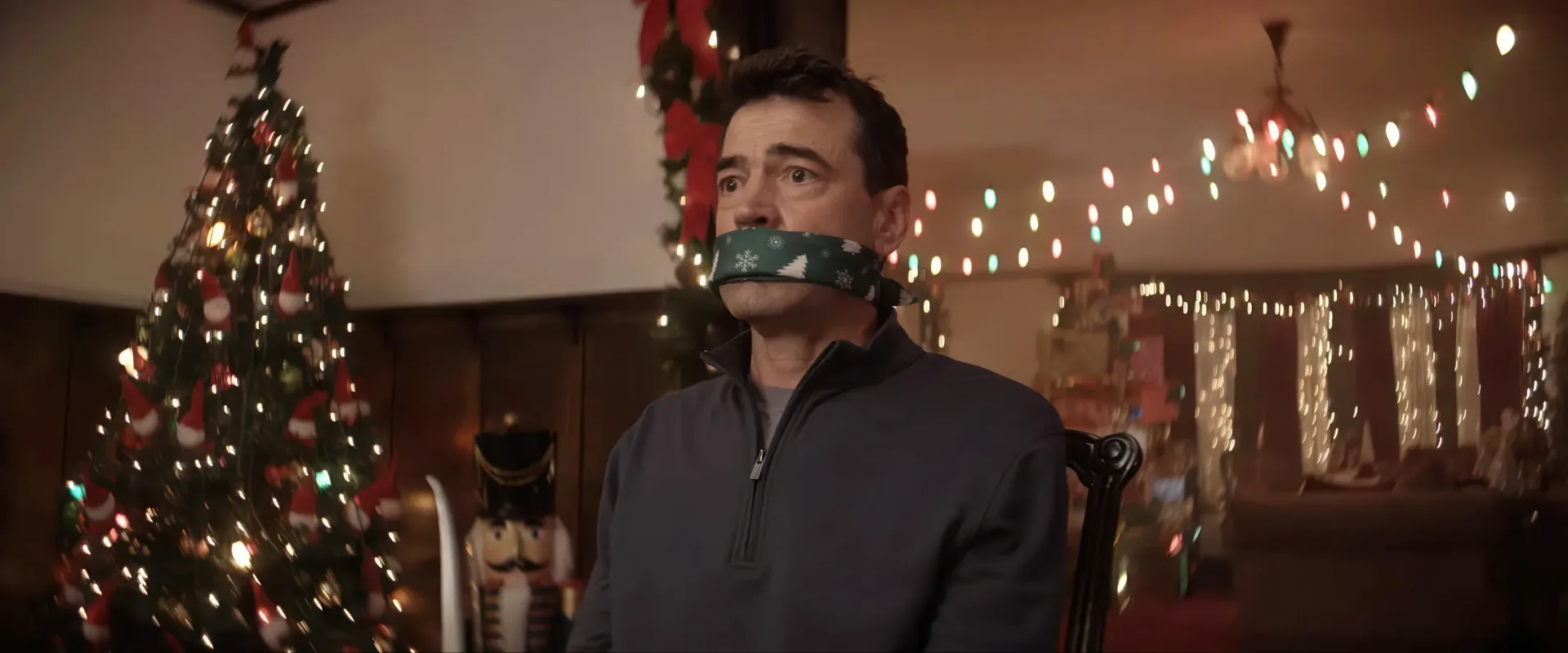
Christmas at the Kringles has an immediately workable horror-comedy premise: a strained family moves to a small town and discovers that its aggressively festive neighbors may be much more dangerous than they seem. The movie has a capable comic ensemble, a year-round Christmas household, an R rating and a 98-minute running time—ingredients that could support a lean, gleefully strange seasonal scarefest.
But Kevin Lewis’ film, written by Zack Imbrogno, reportedly struggles to turn those ingredients into either a satisfying comedy or an effective horror picture. Its biggest issue is not merely that the tone is dark or that its characters make frustrating choices. Horror-comedy needs the frightening and funny material to reinforce each other. Here, the holiday imagery, rapid editing and strange behavior appear to generate noise rather than tension, while the jokes seldom build into a comic payoff.
The result is a seasonal thriller that has the wrapping paper but not the present inside: conspicuously decorated, broadly performed and apparently packed with genre signals, yet unable to give viewers a strong reason to care about the people facing the danger.
A family move sets up the Kringles’ holiday nightmare
Ron Livingston plays Mark Severson, a stock trader whose fixation on work has put his marriage under strain. He relocates with his wife Julie, played by Rachel Bilson, and their son Bobby, played by Jack Jewkes, to a small town in an attempt to stop the family from breaking apart.
The Seversons arrive shortly before Christmas and meet the Kringles, neighbors who celebrate the holiday every day of the year. Nick Kringle, played by Thomas Lennon, invites the family to Christmas Eve dinner. Mark initially brings a city-dweller’s skepticism to the encounter, but agrees at Julie’s urging—and the evening goes better than he expects.
The premise advances two months later, when Mark is once again absorbed by work. Julie had hoped for a Valentine’s Day celebration, while Carol Kringle, played by Arden Myrin, invites Julie and Bobby back to the Kringles’ home. Mark is initially pleased that his family has neighbors to spend time with. The mood changes when Daryl, a neighbor played by Donald Faison, warns him that the Kringles are not what they appear to be.
Mark heads to the house, finds himself locked out, and joins Daryl in seeking help from a mall Santa played by Rob Riggle. That Santa belongs to a network of fellow holiday entertainers who have identified the Kringles as dangerous. When the promised backup does not arrive, Mark and Daryl must enter the home themselves to try to save Julie and Bobby.
It is a useful setup because it puts a familiar holiday ideal—community, cheer and neighborly hospitality—under suspicion. The Kringles’ total devotion to Christmas could have been played as genuinely inviting at first, then steadily warped into something sinister. Meanwhile, the Seversons’ marriage offers a human stake beyond simply escaping a threatening house.
The central tonal problem: horror and comedy do not meet
Horror-comedy is a balancing act, not a simple alternation between a scare and a punchline. A joke can release fear at the right moment, sharpen a character’s response to absurd danger, or make the danger more unsettling by showing how casually someone embraces it. Likewise, horror can give comedy consequence: the audience laughs because the characters’ predicament is recognizably desperate, not because the movie has stopped to perform a disconnected gag.
Christmas at the Kringles seems to miss that balance. The film’s comedy is described as largely unfunny, while the threat fails to develop a forceful sense of menace. That leaves the story in an especially difficult position. If a horror-comedy is not amusing, it needs escalating suspense or strong character investment to carry viewers through its darker passages. If it is not scary, it needs wit, imaginative absurdity or an emotional hook. This film reportedly finds neither side reliably.
The Kringles themselves embody that shortfall. Lennon and Myrin reportedly commit to their characters’ extreme holiday enthusiasm, treating their lifestyle with zealotry and a smug, performative confidence. That is a promising comic foundation. But commitment alone is not menace. Nick’s unhinged wholesomeness does not reportedly gain enough real danger once the story’s stakes rise, meaning the film cannot fully convert its strange neighbors from an odd joke into memorable antagonists.
Carol’s invitation and the family’s constant holiday presentation should be fertile ground for an escalating social nightmare: politeness becomes pressure, hospitality becomes control, and cheerful rituals become traps. Instead, the film’s broader explanation for the Kringles’ conduct is said to raise basic questions without rewarding the audience’s curiosity. Details involving children in the home, possible disappearances and an especially bizarre resident do not cohere into a satisfying mythology or even a sufficiently outrageous comic detour.
Characters are given stakes, but not enough dimension
Mark is the film’s principal point of view, and that creates another obstacle. His workaholism is meant to establish a man who has lost sight of his family, but he is portrayed as so broadly jaded and unpleasant that it becomes hard to understand Julie’s continued investment in their relationship. The story gives him an eventual reason to fight for his wife and son, yet his development reportedly does not make him especially capable or engaging in the process.
This matters because the movie asks the audience to follow Mark from marital strain to suburban suspicion to a rescue attempt. A flawed lead can work exceptionally well in horror: someone selfish, cynical or dismissive may have to confront a threat nobody else believes. But the flaw needs to become part of the drama. Mark’s skepticism should either make the Kringles harder to detect, provide comic friction with the more trusting Julie, or sharpen the stakes of his late realization. Without enough texture, his unpleasantness becomes less a trait to overcome than an impediment to audience sympathy.
Julie has a clear desire for small-town connection and for the couple to recover some lost closeness, but the character is given limited shading. Bilson’s work nonetheless provides more nuance than the writing appears to offer Mark. Bobby largely functions as part of the family unit at risk, rather than as a deeply developed third perspective on the move or the Kringles.
Faison, however, brings valuable energy to the final stretch. Daryl’s incredulity offers a more effective comic response to the situation, particularly once he and Mark are forced to take action at the Kringles’ home. In a movie premised on outlandish holiday horror, incredulity can be an asset: it grounds the nonsense, gives an audience permission to see the absurdity and can create a useful contrast with villains who treat their bizarre world as perfectly normal.
Riggle’s mall Santa has a role suited to his established comic persona, delivering dependable humor even if it does not feel particularly new. The cast also includes David Wain and Beverly D’Angelo. On paper, the number of performers with strong comedy credentials makes the film’s muted comic impact more disappointing, not less.
Fast cutting cannot substitute for escalation
The movie begins with a chase involving a woman and a killer in a Santa suit, but the sequence is said to lack clear spatial geography and visual continuity. Spatial geography is the viewer’s understanding of where characters are in relation to each other and to the setting: who is close to an exit, where the threat is coming from, and what route might offer escape. In chase and siege scenes, that clarity is crucial. Without it, frantic cutting may convey movement, but not suspense.
The same disjointed feeling reportedly continues through the film. Expository scenes move quickly, with little time to establish the central family before ominous events intrude. A brisk pace can be a major advantage for a 98-minute genre movie, but speed works only when scenes supply new information, deepen relationships or increase the danger. Rapid movement through underdeveloped material can instead make a story feel thinner.
Lewis uses quick-cut montages that recall a recognizable high-energy filmmaking style, yet the technique reportedly does not add meaning or entertainment. A montage is a compressed sequence of shots designed to communicate information, a change in time, an emotional shift or a comic escalation. It is not inherently exciting because it is quick. It needs a precise function within the scene. When visual flourishes do not clarify character or action, they can make the experience feel more scattered.
For audiences looking for a more promising recent horror-game angle, Joking Joystick has also covered AGNI: Village of Calamity’s folklore-driven horror focus. The contrast is useful only in the broadest sense: horror needs an identifiable source of dread and a firm command of its atmosphere, whether it is working in film or games.
What holiday-horror fans should expect
There is no shortage of raw material in Christmas at the Kringles. A dysfunctional family, a too-friendly neighborhood, a mall Santa connected to an unusual network and villains who maintain Christmas décor all year are enough to build a darkly playful genre movie. The film also arrives with a roster of actors capable of selling heightened material.
Yet the available evidence points to a misfire whose underlying concepts remain more appealing than their execution. The movie reportedly cannot make its lead’s personal problems compelling enough, its villains threatening enough, its visual style coherent enough or its comic moments funny enough. The unanswered questions around the Kringles do not function as tantalizing mysteries; they instead read as signs that the script has not connected its own ideas.
Christmas at the Kringles is rated R and runs 98 minutes. It was directed by Kevin Lewis, with cinematography by Brandon Cox, editing by Ryan Liebert and music by Émoi. For viewers specifically seeking a holiday horror-comedy, the premise and cast may still be the draw. But anyone expecting a successful meeting point between seasonal cheer, satire and slasher-style menace should temper expectations.