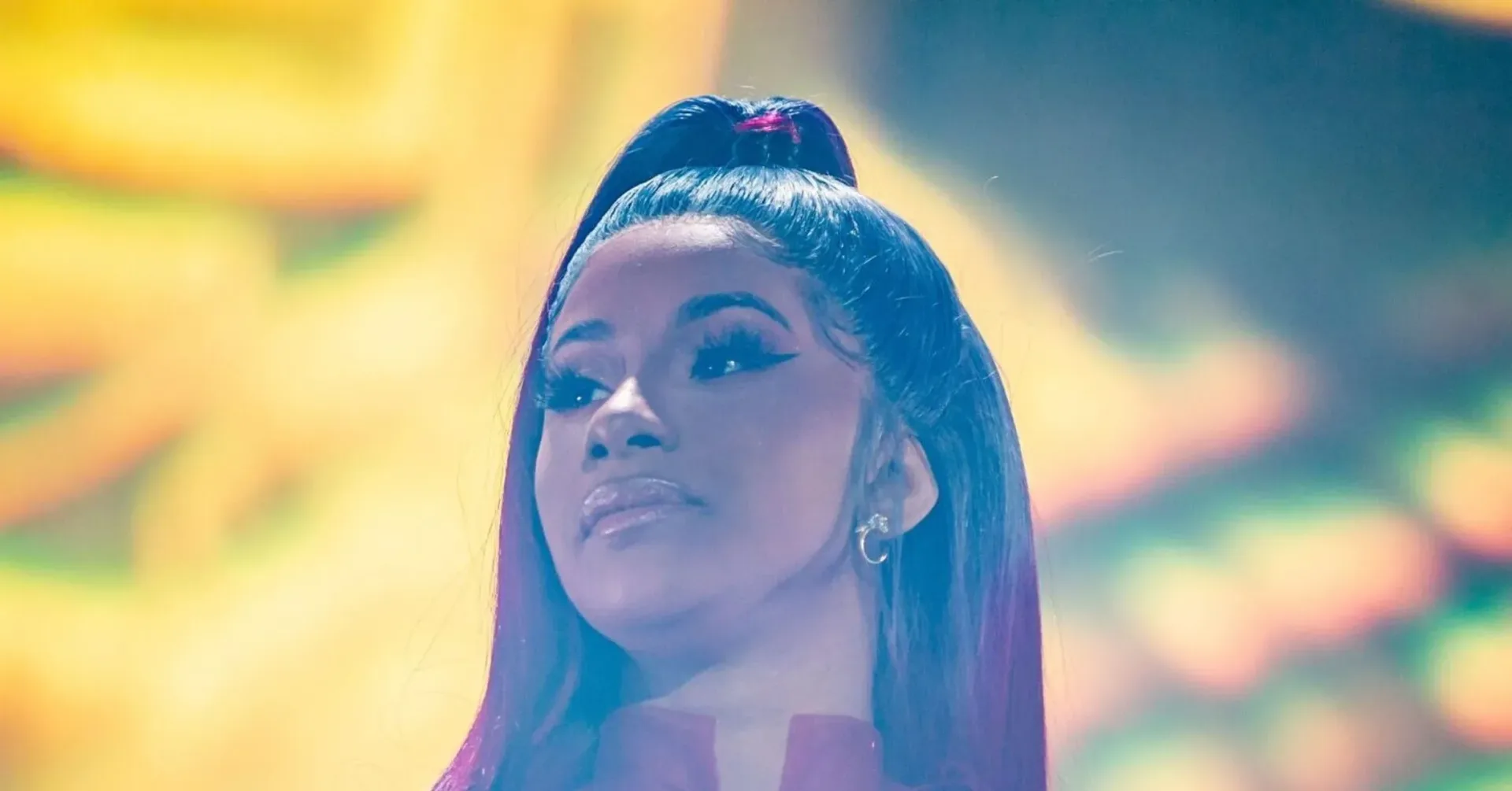
Cardi B has responded to renewed criticism over the artists she named as childhood influences, rejecting the idea that she should alter her own musical history to satisfy fans debating Nicki Minaj’s place in it.
During an X Spaces conversation on October 21, Cardi addressed reactions to a recent magazine profile that cited Madonna, Lil’ Kim, Foxy Brown and Trina among the performers who shaped her when she was younger. The conversation became contentious because Nicki Minaj was not included, prompting some of Minaj’s supporters to read the omission as a deliberate slight.
Cardi’s answer was less about denying another rapper’s importance and more about defining what she meant by influence. She said the women she identified were already part of her musical world before Minaj became prominent. Cardi also noted that she listened to another female rapper at around age 17, but drew a line between discovering somebody as a teenager and the music that formed her tastes throughout childhood.
That may sound like a narrow distinction, but it is central to the argument. Public conversations about an artist’s influences often turn a personal memory into a ranking system: if a major name is absent, observers may assume that name has been dismissed. Cardi’s comments suggest a different framework. A list of early influences is not necessarily a catalogue of every artist someone respects, has heard, or believes mattered to rap as a whole. It can simply be a record of what was playing during a particular stage of life.
Childhood influence is not the same as a complete rap lineage
The reaction illustrates how quickly “who inspired you?” can become a loaded question in a fan-driven online environment. It can be interpreted as a verdict on artistic importance, allegiance, rivalry and legacy all at once. But those are separate questions.
Influence, in this context, means an artist’s impact on another performer’s developing tastes, style or ambitions. It does not automatically mean imitation, personal friendship, professional endorsement or a claim that one artist is more significant than everyone left off a list. Cardi’s argument hinges on chronology: the performers she named were, in her telling, the voices she encountered while growing up. A later discovery belongs to a different chapter, even if that artist’s career and cultural footprint are substantial.
Cardi questioned why listeners were so upset by a list she has repeatedly offered in interviews. Her position was that she should not have to revise formative memories in response to outside expectations. The point is especially relevant when celebrity discourse treats every omission as coded messaging. Sometimes an omission may be intentional; Cardi’s explanation is that timing, rather than a refusal to recognize anybody’s accomplishments, guided this particular list.
She did not name Nicki Minaj while explaining that distinction. The broader dispute nevertheless arrived in the shadow of their long-running conflict, which has included public insults and social-media clashes since 2017. That history means even routine remarks about female rap can be absorbed into the established rivalry, whether or not the speaker frames them that way.
Cardi says personal conflict does not erase musical impact
One of Cardi’s clearest examples involved Foxy Brown. Cardi said Brown “never fucking liked me,” but maintained that this would not change the fact that she grew up listening to her music. The remark reinforces the separation Cardi was trying to make: an artist can be a formative presence even where there is no warm personal relationship.
That distinction matters because influence debates are frequently treated as loyalty tests. They need not be. A performer can acknowledge inspiration from somebody with whom they have tension; they can also refrain from placing a peer on a childhood list without declaring that peer unimportant. Cardi’s Foxy Brown example presents her standard as relatively straightforward: personal feelings and early listening history are different categories.
It also undercuts a simplistic reading of her comments as an attempt to use influence credits as a weapon. If Cardi is willing to identify Brown as a childhood influence while describing a difficult relationship, then the criterion she is presenting is exposure to the music, not whether the artist is currently an ally.
That is not likely to end arguments around Cardi and Minaj. Their history makes neutral readings difficult for audiences already invested in either side. Still, the actual claim Cardi made is narrower than the online debate around it: she does not want others to retrofit her childhood based on what they think her answer ought to be.
Her larger point: recognition is not replication
The X Spaces discussion moved beyond the dispute over names. Cardi also spoke about what helps female rappers build sustainable careers, praising Megan Thee Stallion, GloRilla and the City Girls for developing recognizable identities instead of trying to reproduce somebody else’s formula.
By identity, Cardi appeared to mean the combination of personality, regional character and individual approach that makes an artist immediately distinct. Her examples were tied to different regional influences and different personas, rather than a single approved model for women in rap. That is a meaningful part of her argument: a successful artist can openly honor predecessors without borrowing their mannerisms wholesale.
“There’s nobody I ever wanna be. I became famous being Cardi B,” she said.
That statement is both a career principle and a response to a common form of fandom debate. Online comparisons can imply that a newer performer must prove legitimacy by aligning themselves with one established figure. Cardi’s view is that copying a predecessor’s presentation does not guarantee the same outcome. What worked for one rapper was shaped by that rapper’s own voice, personality and moment; repeating the surface elements is not the same as building an enduring identity.
It is possible to appreciate this argument without turning it into a dismissal of artistic influence. In fact, Cardi’s comments make a more nuanced case. Musical growth often includes both inheritance and separation. Artists absorb sounds, personas and ambitions from people who came before them, then turn those inputs into something that is recognizably their own. The tension between those two processes—acknowledging the past while refusing to be reduced to it—is at the heart of what Cardi described.
That conversation about individuality also has relevance beyond the immediate dispute. Rap audiences often use comparisons as shorthand, especially when discussing women artists working in a closely watched field. Comparisons can provide context, but they can also flatten artists into a perceived successor role. Cardi’s warning is that an artist’s path cannot simply be replicated by adopting someone else’s style, gestures or public image.
There is a useful contrast in the music discussion elsewhere on the site: Pusha T’s comments on how Clipse changed over time likewise center on the idea that artists are not fixed copies of an earlier version of themselves. Cardi’s point is focused on individual identity, but both discussions emphasize evolution rather than a demand for perfect repetition.
Why this keeps returning to the Cardi B–Nicki Minaj feud
In a vacuum, a performer identifying Madonna, Lil’ Kim, Foxy Brown and Trina as childhood influences would be a normal autobiographical detail. Within the context of Cardi and Minaj’s public history, however, that detail is likely to be read as a new move in an old fight.
The debate shows how fandom can transform a descriptive statement into a competitive one. “These were the artists I listened to while growing up” becomes “these are the only artists who matter,” then becomes “this is an insult to someone else.” Cardi’s remarks push back on that chain of assumptions. She argued for the right to talk about her own musical upbringing without adjusting it to fit a rivalry-centered interpretation.
Her remarks also arrived alongside her stated fatigue with feuding among female rappers. During the same conversation, Cardi said she was becoming bored with exchanging insults and less interested in replying to perceived disses. That does not erase the existing history or prevent future disagreements, but it establishes the posture she is claiming now: less appetite for escalation, and more attention to her own perspective and work.
Whether the wider conversation follows that lead is another matter. The subject of Minaj’s influence, Cardi’s list and their years of conflict gives social-media audiences plenty to argue over. But Cardi’s stated position is relatively direct. She can recognize the artists who shaped her childhood, acknowledge that another rapper entered her listening later, and insist that neither personal friction nor fandom pressure should dictate the story she tells about her own development.