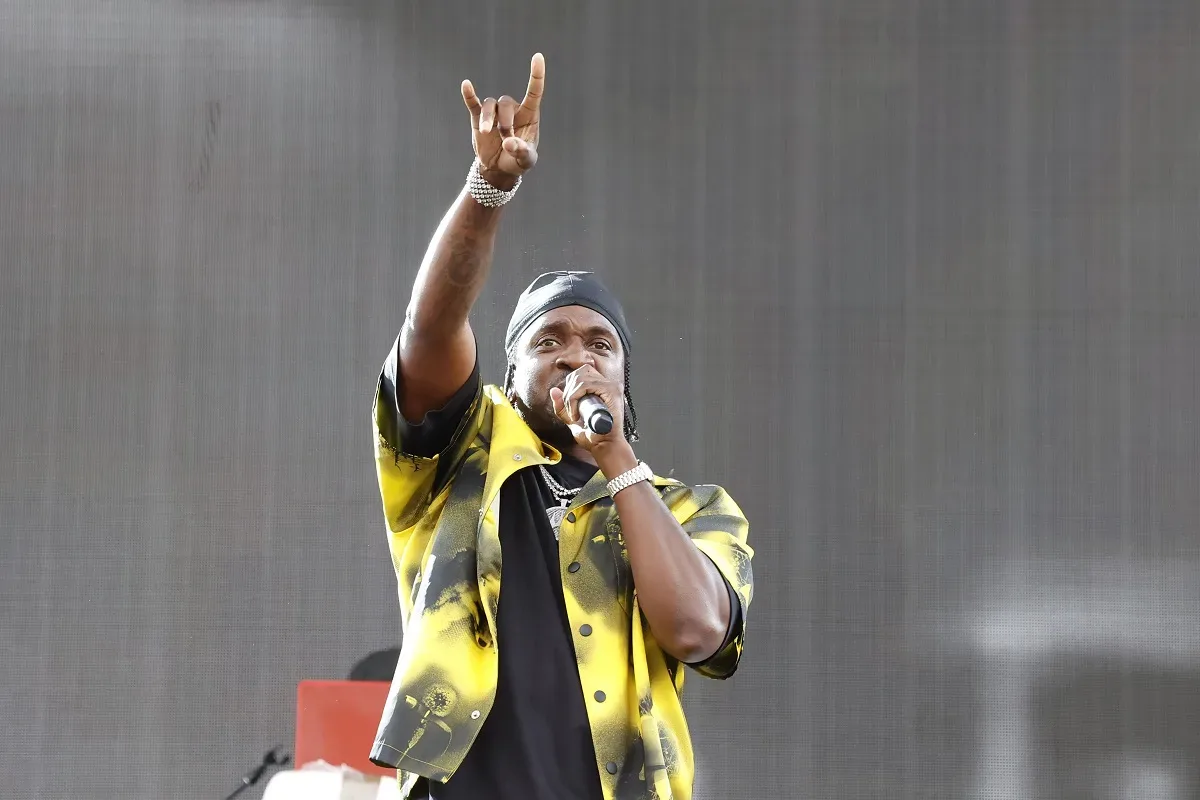
Pusha T has put Clipse’s 2025 reunion album, Let God Sort Em Out, ahead of the duo’s revered 2006 record Hell Hath No Fury—but not because he is dismissing the older album’s reputation. His comparison is rooted in the distance between the people who made each project.
Speaking with longtime Clipse collaborator Pharrell Williams, Pusha T called Let God Sort Em Out “a tutorial on the maturation of a Rap group.” The phrase gets at a question that follows nearly every long-delayed reunion: can an act return with the force that made it important without pretending the intervening years did not happen?
For Pusha and his brother Malice, the answer appears to be yes. Let God Sort Em Out reunited the Thornton brothers for their first Clipse album in nearly 16 years when it arrived in July 2025. It retains the sharp, urgent character associated with the group’s street narratives, while making space for subjects that carry the weight of changed lives: faith, family and loss.
The key distinction is not that Clipse have traded intensity for reflection. Pusha and Pharrell instead characterized the group’s work as “fight or flight music,” preserving urgency as a central ingredient of the sound. What has changed is the source of that urgency. Pusha has said he could never make Hell Hath No Fury again, because that record came from bitterness and a powerful need to prove himself—conditions he does not want to revisit merely to recreate an old artistic high point.
Why Pusha T’s comparison is about growth, not a scorecard
Calling a new album better than a celebrated classic can sound like a simple ranking exercise. Pusha’s explanation is more personal than that. He is not reducing the two records to a contest over beats, verses or influence. He is describing what it means for a group to make music that is honest to its present rather than trapped in its past.
Hell Hath No Fury belongs to a period Pusha now associates with resentment and self-assertion. Those emotions helped create music that remains highly regarded, but he has been direct that he does not wish to be returned to the circumstances behind it. That is an important qualification: an artist can respect the work produced by a difficult period without romanticizing the pain, pressure or outlook that fed it.
Pharrell’s joking reference to Pusha’s activities during the earlier era prompted an equally candid acknowledgment from the rapper that he was in a very different place at the time. The exchange underscores why a literal recreation would not be the point. Repeating a subject or an aesthetic is not necessarily the same as repeating a record’s emotional truth. Pusha’s view is that the newer album’s value lies in meeting Clipse’s established standards from a transformed vantage point.
That makes “maturation” more than a polite way of saying the music is older. In this context, it means the duo can still deploy the qualities listeners associate with Clipse—vivid narrative detail, pressure and edge—while acknowledging experiences that had not been central to their earlier work. Maturity does not erase the old identity; it changes what that identity is capable of containing.
Related coverage includes Pusha T Says Clipse’s 2025 Return Surpasses Hell Hath No Fury.
What Let God Sort Em Out adds to the Clipse story
The album’s title itself carries a different kind of emotional and spiritual frame, and its material reportedly brings personal reflection beside the brothers’ familiar street-focused storytelling. “The Birds Don’t Sing” is the clearest example cited: the song addresses the deaths of their parents.
Loss, family and faith do not automatically make a rap album more mature, nor do they make its harder-edged material less meaningful. The notable point is that these are experiences the reunion record is willing to foreground. Clipse have long been associated with vivid storytelling; the newer work broadens the range of stories the duo brings into that style.
That breadth matters because reunion projects can be caught between two unhelpful expectations. One is nostalgia: make exactly the thing people remember, preferably unchanged. The other is reinvention for its own sake: abandon the defining features that established the group in the first place. Pusha’s remarks suggest Clipse are pursuing a narrower, harder balance. The music must still feel like Clipse, but it also has to sound like two brothers who have lived nearly two decades beyond their prior album.
Pharrell’s role is a meaningful part of that continuity. He is a longtime collaborator and produced Let God Sort Em Out, linking the reunion to a creative relationship embedded in the group’s history. But continuity here should not be mistaken for stasis. The same collaborators can arrive at a different work when their lives and concerns have changed.
“Fight or flight” as an artistic principle
The phrase Pusha and Pharrell used for Clipse’s music conveys immediacy: music designed to feel pressured, alert and in motion. In ordinary terms, fight-or-flight describes the body’s response to perceived threat. Applied to music, it is a metaphor for tension and survival-minded focus rather than a technical genre label.
That distinction helps explain why Pusha does not frame the 2025 album as a calmer or softened version of the group. The urgency remains. What he rejects is the idea that urgency has to come from the same bitterness that shaped an earlier chapter. A mature record can retain stakes without manufacturing a crisis. It can be direct without being frozen in an old grievance.
For listeners, that offers a more useful way to approach Let God Sort Em Out than treating it as an attempt to beat a classic under identical rules. The record is a continuation of Clipse’s voice, but it is also documentation of what Pusha sees as growth. Its personal material is not an interruption to the group’s core identity; it is part of the evidence that the identity has endured long enough to evolve.
Malice’s return changes the equation
The reunion is also about the particular value of making music with a brother. Malice has previously connected his spiritual growth and his time away from the group to the reunion. Pusha, meanwhile, has contrasted working with Malice against the competitive surroundings of his solo career.
That does not establish that collaboration is free of competition or tension. It does clarify that Clipse represents a different creative environment for Pusha: one shaped by shared history rather than the individual positioning of a solo run. The brothers’ relationship gives the project a perspective that cannot simply be reproduced by assembling an album around the name recognition of an older catalog.
It also makes the personal themes on Let God Sort Em Out especially consequential. A song about their parents’ deaths is not merely another narrative subject. Within a record from two brothers returning to a shared group, it represents a family experience entering a musical partnership already defined by family.
That context gives Pusha’s preference more specificity. He is not necessarily claiming that the 2006 album’s artistic force has diminished. Rather, he favors the newer record because it carries a version of Clipse that could only exist after everything between the releases: time away, Malice’s spiritual development, Pusha’s solo-career context and the brothers’ shared losses.
A reunion that refuses to romanticize its origin story
There is a tendency to discuss foundational albums as if the difficult circumstances around them were inseparable from their greatness. Pusha’s comments push against that idea. Hell Hath No Fury may remain a defining Clipse album, while the mindset that produced it remains a place he does not want to inhabit again.
That is not revisionism. It is a distinction between celebrating art and wanting to relive the conditions of its creation. By choosing Let God Sort Em Out, Pusha values a project that can preserve Clipse’s intensity while reflecting a life he would rather be living now.
In practical terms, his view sets a demanding standard for legacy acts. A comeback cannot rely only on familiar collaborators, references to former glories or the repetition of a proven mood. It needs to answer what the act has to say now. For Clipse, that answer includes the same urgency listeners expect, but also the faith, grief and family history that distinguish the 2025 record from its predecessor.
The broader entertainment calendar continues to create room for artists to reconnect with defining collaborations, as seen when Doja Cat and Rico Nasty revisited “Tia Tamera”. Clipse’s case is more substantial than a one-song reunion, though: it is an album-length argument that a return is strongest when it does not confuse familiarity with repetition.
Pusha T’s preference, then, is a statement of perspective. Hell Hath No Fury captures a time of raw competitiveness and bitterness that helped make the music powerful. Let God Sort Em Out keeps the pressure intact while refusing to perform that past as though nothing changed. For Pusha, that ability to sound unmistakably like Clipse while speaking from a different life is precisely why the comeback stands higher.